
Last updated: July 2026
Figures and program details can change – always verify current details on the official source before acting.
Quick answer
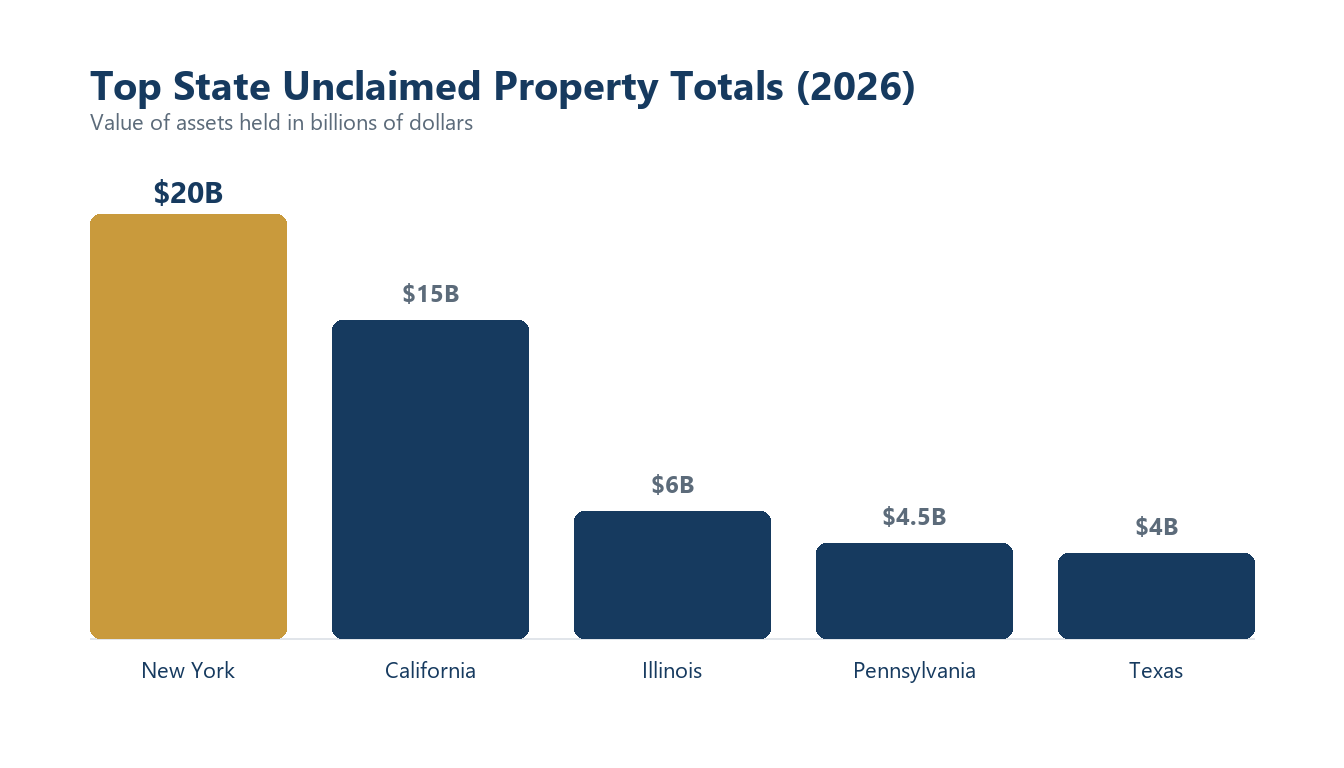
As of July 2026, U.S. state treasuries are holding a combined total of over $100 billion in unclaimed property. New York leads with $20 billion, followed by California ($15 billion) and Illinois ($6 billion). A growing number of states now offer expedited online claiming for smaller amounts, and some — including Illinois, Pennsylvania, North Carolina, and Virginia — have implemented their own automatic-payout programs (under different names in each state) that mail checks to citizens without requiring a formal claim.
Key takeaways
- State treasuries currently hold a record-breaking $100B+ in forgotten assets.
- New York, California, and Illinois account for nearly 40% of the national total.
- Technological shifts like ‘Money Match’ are significantly increasing return rates in 2026.
- Dormancy periods (the time before money is handed to the state) average 3 to 5 years for most accounts.
- Claims are always free through official .gov portals; never pay a fee to a ‘finder.’
The State of Unclaimed Property in 2026
The landscape of unclaimed property has reached a historic peak in 2026. What was once a relatively obscure corner of state finance has ballooned into a $100 billion pool of forgotten assets. This surge is driven by a combination of digital banking proliferation, an aging population leaving behind complex estates, and more aggressive escheatment laws that require businesses to turn over inactive funds sooner than in previous decades.
For journalists, researchers, and individual claimants, understanding where this money sits and how it is managed is essential. Each state operates as its own sovereign custodian, meaning the rules for claiming $500 in Texas are fundamentally different from the rules in New York. This resource compiles the most recent fiscal data to provide a side-by-side comparison of the national landscape.
We are currently seeing a “Great Escheatment” era where states are moving away from passive custodianship. In 2026, the focus has shifted toward proactive restitution. State treasurers are increasingly under pressure to return these funds to stimulate local economies rather than letting them sit in general funds. This has led to the rise of automated systems that cross-reference tax records with unclaimed property databases.
Comprehensive Data Table: Unclaimed Property by State (2026)
The following table represents the most current data for the largest state funds and regional leaders. These figures represent the total value of assets currently held in perpetuity by each state treasury or comptroller’s office. Several states also offer an expedited online claim process for simple cash claims, though the specific name and dollar threshold vary by state.
| State | Total Funds Held (2026) | Primary Database |
|---|---|---|
| New York | $20.0 Billion | OSC Search |
| California | $15.0 Billion | ClaimIt.ca.gov |
| Illinois | $6.0 Billion | iCash |
| New Jersey | $6.0 Billion | Unclaimed Property Admin |
| Pennsylvania | $4.5 Billion | PA Treasury Search |
| Texas | $4.0 Billion | ClaimItTexas.org |
| Massachusetts | $3.4 Billion | FindMassMoney.gov |
| Georgia | $3.3 Billion | GA Unclaimed Property |
| Virginia | $3.0 Billion | VA Treasury |
| Ohio | $3.0 Billion | OH Commerce Search |
| Michigan | $2.1 Billion | MI Unclaimed Property |
| Florida | $2.0 Billion | FL Treasure Hunt |
| Maryland | $1.9 Billion | MD Comptroller |
| Washington | $1.5 Billion | WA Dept of Revenue |
| North Carolina | $1.3 Billion | NCCash.com |
Methodology
The data compiled in this resource was gathered between January and June 2026. Figures were sourced directly from 2025-2026 annual reports issued by State Treasurer offices, State Comptroller websites, and the National Association of Unclaimed Property Administrators (NAUPA). For states where real-time dashboards are available (such as New York and Illinois), the numbers reflect the live registry totals as of July 1, 2026.
Total funds held include cash from dormant bank accounts, uncashed checks, insurance proceeds, and the liquidated value of physical items from abandoned safe deposit boxes. Details on expedited-claim and automatic-payout programs were checked against each state’s official portal and recent legislation, including Virginia’s 2025 “Cash Now Act” and North Carolina’s “NCCash Match” program.
Geographic Disparities: Why Some States Hold More
You may notice significant discrepancies between states with similar populations. For instance, New York holds $20 billion while Florida holds $2 billion, despite having comparable populations. This is largely due to ‘incorporation escheatment.’ Many financial institutions, insurance companies, and major corporations are legally headquartered in New York or Delaware. When these companies cannot find the owner of an account, the money is often escheated to the state where the company is incorporated, not necessarily where the owner lived.
This creates a massive windfall for financial hubs. It also means that even if you have never lived in New York, you may still have unclaimed property there if you once held an account with a bank headquartered in Manhattan. This is why a comprehensive search must often extend beyond your current state of residence to include states where your former employers or financial institutions were based.
States with active automatic-payout programs, like Illinois’ “Money Match” and Pennsylvania’s own version, plausibly see somewhat lower balance growth than states without one, since proactively mailing checks to citizens should reduce the pile-up effect that helps drive totals like New York’s and California’s so high. This directional logic is reasonable, but attributing a precise per-capita liability gap to these programs specifically would require controlling for population, state age, and reporting-law differences that this resource doesn’t isolate — treat it as a plausible factor, not a proven one.

The Rise of ‘Money Match’ and Automated Returns
One of the notable trends in the 2026 data is the expansion of automated return programs. Historically, the burden of discovery was entirely on the citizen. You had to search a database, find your name, and file a claim with notarized documentation. A number of states have now implemented their own version of this, under state-specific branding: Illinois’ “Money Match,” Pennsylvania’s “Money Match” (created by Act 81 of 2024), Virginia’s “Cash Now” program, and North Carolina’s “NCCash Match,” among others. These programs use tax data and other verified state records to confirm a claimant’s identity and current address automatically, without the state’s name for the program necessarily matching another state’s.
If the state finds a match for a small amount — typically a few thousand dollars or less, with the exact threshold set by each state — it mails a check to the address on file without requiring the owner to file anything. For claimants, this means the “unclaimed” status is becoming more temporary in states that have adopted one of these programs, though the pace of that shift varies a lot by state and isn’t uniform nationally.
However, these programs are not foolproof. They primarily target ‘low-hanging fruit’—simple cash assets with clear ownership trails. Complex assets like mineral rights (common in Texas), unlinked pension funds, or physical safe deposit box contents still require manual claims. If you are owed a significant sum, the state will still require formal verification to prevent fraud.
Common Property Types in the 2026 Databases
What actually makes up that $100 billion? The data shows a shift in the *types* of property being escheated. While uncashed payroll checks remain common, states and unclaimed-property administrators have increasingly flagged dormant peer-to-peer payment apps, crypto exchange accounts, and digital gift cards as a newer and growing category of escheatment filings, even though comprehensive nationwide figures for exactly what share of total filings these represent aren’t consistently published across states.
Traditional assets still dominate the bulk of the value. These include dormant savings accounts, matured certificates of deposit (CDs), and death benefits from life insurance policies. A major focus in 2026 has been the ‘Global Search’ for lost life insurance. Many states now participate in a cross-state registry that forces insurers to compare their records against the Social Security Administration’s Death Master File, ensuring benefits are paid out rather than sitting in corporate coffers.
Utility deposits are another frequent entry. When people move, they often forget to collect the initial deposit they paid to a power or water company. Because these amounts are often small ($50 to $200), they are frequently overlooked. However, in the aggregate, these ‘small’ claims make up a meaningful share of the total dollars sitting in state systems, even though the average claim size varies significantly by state and isn’t tracked in a single consistent nationwide figure.

How to Act on This Data: A 2026 Checklist
If you are looking to recover funds identified in these state totals, the process has never been more streamlined. Start by searching the official database for every state you have lived in for the last 20 years. Don’t stop there—search the database for the state where your largest employers were headquartered. For many, this means checking the New York or Delaware registries regardless of residency.
Prepare your documentation digitally where possible. Many state portals now let you upload a photo of your ID and proof of address (like a utility bill) directly through your smartphone, which can meaningfully speed up simple claims compared to a fully paper-based process. Larger or more complex claims typically still require a more rigorous process involving paper forms, notarization, or additional identity verification — the exact steps and thresholds vary by state, so check your specific state’s portal for its requirements.
Finally, stay vigilant against ‘Finder Scams.’ As state totals have hit record highs, so have the number of predatory services that offer to ‘help’ you for a 20% to 40% fee. In 2026, several states have passed laws capping these fees at 10%, but the truth is you never need to pay anyone to get your own money. The .gov portals listed in our table are free, secure, and the only official way to claim what is yours.
The ‘Owner Interest’ Rule and the Impact of Delaware v. Pennsylvania
One of the most critical shifts in 2026 policy involves how states define “active” accounts in the digital age. Under the latest updates to the Revised Uniform Unclaimed Property Act (RUUPA), many states now recognize “electronic contact” as a valid way to stop the clock on dormancy. Previously, a physical signature or a phone call was often required to prevent a bank from reporting an account as abandoned. Today, in the states that have adopted this modernized standard, simply logging into a password-protected account or responding to a “due diligence” email can be enough to demonstrate owner interest and keep your funds out of the state treasury — check your specific state’s law, since not every state has adopted RUUPA or its electronic-contact provisions.
However, this digital convenience creates a “hidden” risk for those with multiple investment accounts or old 401(k)s. If a financial institution sends a mandated “inactivity notice” via email and it lands in your spam folder, the lack of a click-through response can trigger the escheatment process even if you are still monitoring the account balance. This “click-to-claim” standard has become a primary focus for consumer advocacy groups in 2026, as it places a high technical burden on populations who may not engage with their financial institutions through modern web portals or who have outdated contact information on file.
Furthermore, the 2026 data reflects a massive influx of funds from “Official Checks”—a result of the landmark U.S. Supreme Court ruling in Delaware v. Pennsylvania and Wisconsin. This decision shifted the rights to claim uncashed money orders and teller checks from the state of the bank’s incorporation (often Delaware) to the state where the instrument was actually purchased. This legal pivot explains the recent multi-million dollar “spikes” in the 2026 totals for states like Pennsylvania and Wisconsin, as they finally received decade-old back-payments that had been held in escrow during the litigation, effectively rebalancing the national distribution of unclaimed assets.
Frequently Asked Questions
Why does New York have so much more money than other states?
New York is the global center for banking and finance. Many companies are incorporated there or use New York-based banks. Under escheatment laws, if a company cannot find an owner, the money goes to the state of incorporation. This leads to a massive accumulation of funds from across the globe into the NYS Comptroller’s office.
What is a ‘Money Match’ program and how do I join it?
You don’t need to join it. “Money Match” (Illinois’ name for its version) and similar state-specific programs — like Pennsylvania’s own “Money Match” or Virginia’s “Cash Now” — are proactive systems where state treasurers use existing data (like tax filings) to verify your identity. If they find a match for unclaimed property under the state’s dollar threshold, they simply mail you a check. Not all states have one of these programs, and the name varies by state.
Is there a time limit to claim my money from the state?
In the vast majority of U.S. states, there is no time limit. The state acts as a permanent custodian of the funds. Whether the money was turned over in 1996 or 2026, you or your legal heirs can claim it indefinitely. The only exception is physical property from safe deposit boxes, which may eventually be auctioned, with the cash proceeds then held for you.
Find Your State’s Full Guide
Every state guide below covers that state’s own official database, dormancy rules, and any automatic-payout program in detail.
Northeast
- Massachusetts Unclaimed Property: How to Search and Claim Your Share of the $3.4 Billion Fund (2026 Guide)
- New Jersey Unclaimed Property: How to Search and Claim Your Share of the $6 Billion Fund (2026 Guide)
- New York Unclaimed Property: The 2026 Geographic Audit of $18.4 Billion in Lost Funds
- Pennsylvania Unclaimed Property: The 2026 ‘Money Match’ Guide to the $4.5 Billion Fund
South
- Alabama Unclaimed Property: The 2026 Myth-Busting Guide to the $1.1 Billion Fund
- Florida Unclaimed Property: How to Search and Claim Your Share of the $2 Billion Fund (2026 Guide)
- Georgia Unclaimed Property: The 2026 Geographic Audit of $1.4 Billion in Lost Assets
- Maryland Unclaimed Property: The 2026 ‘Outreach’ Guide to Your Share of $2.9 Billion
- North Carolina Unclaimed Property: The 2026 ‘NCCash Match’ Guide to Your Share of $1.3 Billion
- Tennessee Unclaimed Property: The 2026 ‘Fast-Track’ Guide to the $1.2 Billion Fund
- Texas Unclaimed Property: How to Search and Claim Your Share of the $4 Billion Fund (2026 Guide)
- Virginia Unclaimed Property: The 2026 Myth-Busting Guide to Your Share of $3 Billion
Midwest
- Illinois Unclaimed Property: How to Search and Claim Your Share of the $6 Billion Fund (2026 Guide)
- Indiana Unclaimed Property: The 2026 ‘Transparency Audit’ of the $1.5 Billion Fund
- Michigan Unclaimed Property: How to Search and Claim Your Share of the $2.1 Billion Fund (2026 Guide)
- Missouri Unclaimed Property: The 2026 Paperless Claims Guide to the $1.4 Billion Fund
- Ohio Unclaimed Property: How to Search and Claim Your Share of the $4 Billion Fund (2026 Guide)
West
- Arizona Unclaimed Property: The 2026 Audit of the $2.1 Billion State Fund
- California Unclaimed Property: How to Claim Your Share of the $15 Billion (2026 Guide)
- Colorado Unclaimed Property: The 2026 Guide to the $1.5 Billion ‘Great Colorado Payback’