
Last updated: August 2026
Figures and program details can change – always verify current details on the official source before acting.
Quick answer
As of August 2026, the Alabama State Treasury is holding over $1.1 billion in unclaimed property. You can search for your share for free at the official unclaimed.alabama.gov portal. Most claims are now processed using Knowledge-Based Authentication (KBA), which can result in a payout via check or direct deposit in as little as 7 to 10 business days.
Key takeaways
- Alabama holds $1.1 billion in forgotten assets, ranging from uncashed utility deposits to insurance payouts.
- The state never takes ownership of these funds; they are held in a custodial trust indefinitely until claimed.
- New 2026 identity verification tools allow for ‘paperless’ claims for many residents.
- Searches are always free through official government channels, and you should never pay a fee to access your own money.
Myth #1: The State Government Eventually Keeps Your Unclaimed Money
One of the most persistent rumors in the Yellowhammer State is that if you don’t claim your forgotten utility deposit or old paycheck within a few years, the government ‘absorbs’ it into the general budget. In reality, Alabama law (specifically the Uniform Unclaimed Property Act) dictates that the State Treasurer acts only as a custodian.
This means the state holds the money in a specialized trust fund, waiting for the rightful owner or their heirs to come forward. There is no ‘statute of limitations’ on your right to claim these funds. Whether the money was turned over to the state in 1996 or 2026, it remains yours legally.
While the state may earn interest on the aggregate pool of funds to help offset the costs of the program, the principal amount is always reserved for you. As noted by the Alabama State Treasury, their primary mission is “reuniting owners with their unclaimed property,” not growing the state’s coffers at the expense of residents. In fact, Alabama’s laws are among the most consumer-friendly in the nation regarding property retention; unlike some states that may eventually move funds into a general fund after decades of silence, Alabama maintains the ledger indefinitely, ensuring that even a great-grandchild can eventually claim a long-lost ancestor’s assets.

Myth #2: You Have to Pay a Fee to Search or Claim Your Cash
If you receive a letter or an email offering to help you recover ‘lost millions’ for a 15% or 20% ‘finder’s fee,’ be extremely cautious. While Alabama law does allow for licensed ‘property finders’ to operate, their services are entirely optional and, in most cases, completely unnecessary.
The official Alabama Unclaimed Property portal is 100% free to use. You do not need a lawyer, a consultant, or a middleman to file a claim. In fact, Alabama law restricts finders from even contacting you until the property has been held by the state for a specific period of time (typically 24 months). Furthermore, state regulations generally cap the fees these finders can charge—usually at 10%—making any solicitation asking for a high percentage a major red flag.
Most residents find that the DIY process is so streamlined in 2026 that paying a third party is an unnecessary drain on their recovery. For a small $50 utility refund, a finder’s fee might seem negligible, but on a $5,000 forgotten life insurance benefit, that fee represents a significant loss of your personal wealth. The Treasury’s own staff is available via phone to walk you through complex claims at no cost, effectively rendering ‘professional’ finders obsolete for the average citizen.
Myth #3: The Alabama Claim Process Is Burdened by Slow Paperwork
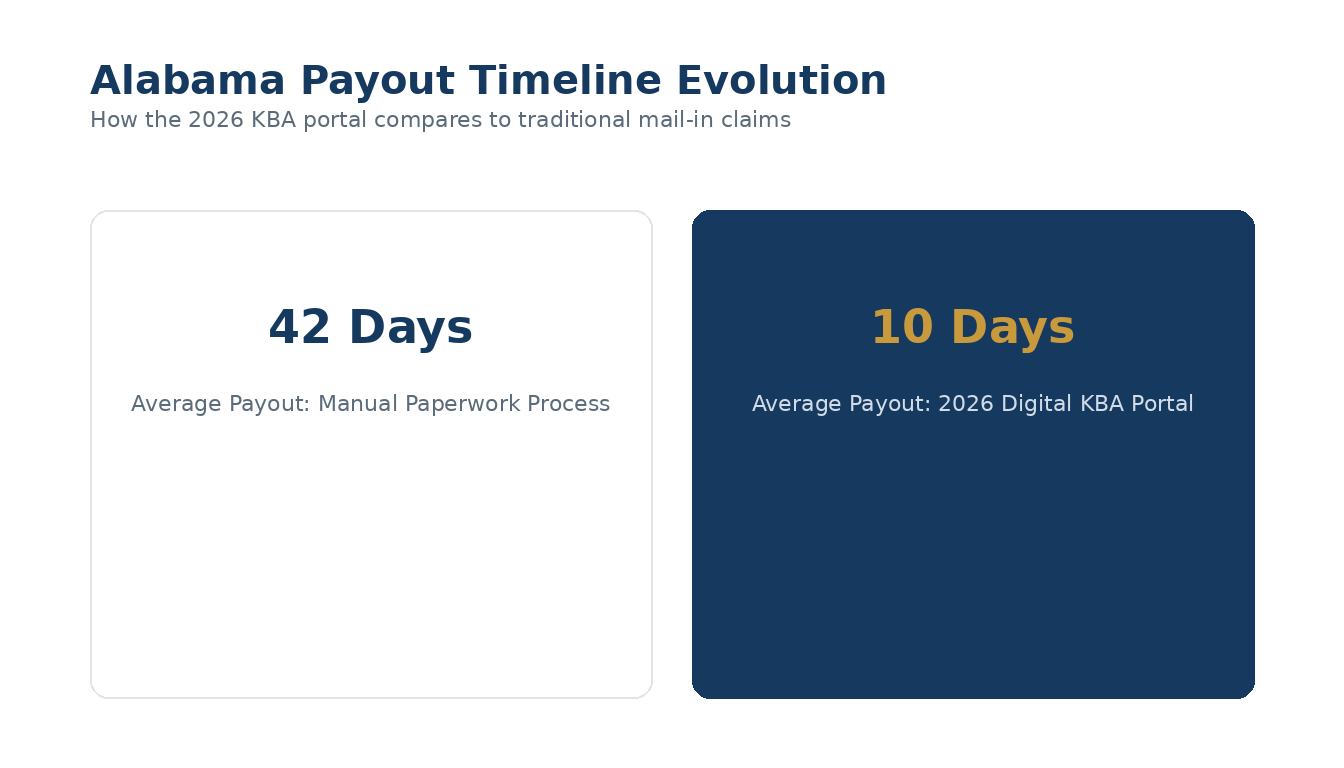
In years past, claiming money from the state meant printing out forms, finding a notary public, and mailing a packet of sensitive documents to Montgomery. In August 2026, the process has been radically modernized. Most claims are now handled through a system called Knowledge-Based Authentication (KBA).
When you find property in your name, the system will ask you a series of specific questions based on your public records—such as previous addresses or past vehicle registrations—to verify your identity instantly. If you pass this ‘E-Verify’ step, your claim is flagged for immediate approval without the need for physical paperwork. This system is secured with bank-level encryption, ensuring that your responses to these “out-of-wallet” questions remain private.
For those who cannot use KBA—perhaps because they have a thin credit history or have recently moved from overseas—the digital upload tool allows you to take a photo of your ID and Social Security card with your smartphone and submit them directly through the secure portal. This shift has reduced the average payout timeline from months to less than two weeks. In many cases, if you select the direct deposit option, the funds can hit your account before the Treasury’s automated confirmation letter even arrives in your physical mailbox.
| Property Type | Alabama Dormancy Period | Common Sources |
|---|---|---|
| Uncashed Wages | 1 Year | Final paychecks, commissions |
| Utility Deposits | 1 Year | Electric, water, or gas refunds |
| Bank Accounts | 3 Years | Checking, savings, or CDs |
| Insurance Benefits | 3 Years | Life insurance, premium refunds |
| Safe Deposit Boxes | 5 Years | Jewelry, coins, or documents |
Myth #4: If It’s Not on MissingMoney.com, It Doesn’t Exist
Many people believe that checking a national aggregator like MissingMoney.com is the beginning and end of their search. While Alabama is a participating member of that national database, relying solely on third-party aggregators can sometimes lead to ‘search lag’ where the most recent uploads to the Alabama Treasury haven’t synced yet.
To be absolutely thorough, you should always conduct a direct search on the official state site: unclaimed.alabama.gov. This ensures you are seeing the ‘live’ database, including assets that may have been reported in the most recent filing cycle. Some high-value assets or those undergoing specific audits may also be temporarily visible only on the state-run site.
Furthermore, the state portal often provides more granular details about the ‘property type’ and the ‘reporting entity’ (the company that sent the money to the state), which can help you verify if the money is actually yours or belongs to someone with a similar name. This is particularly important for those with common last names who might see hundreds of results. The state portal allows for advanced filtering by middle initials and specific historical zip codes that national aggregators often strip away for simplicity.

Myth #5: Unclaimed Property Is Only for Wealthy Individuals
There is a misconception that unclaimed funds only consist of large stock portfolios or forgotten estates. In reality, the $1.1 billion fund is comprised of millions of small accounts. The average claim in Alabama is approximately $500, but the state holds plenty of ‘micro-assets’ like $15 overpayments to a cell phone provider.
These small amounts add up. In Alabama, companies are required to report even small credit balances. If you have moved several times within the state, you likely have a ‘moving day gap’ where a final utility bill resulted in a credit that never reached your new address. Common examples include $25 refunds from cable providers like Spectrum or Brightspeed, or even small escrow overages from a mortgage refinancing that took place years ago.
As we’ve seen in our guide to unclaimed utility deposits, these are the most common types of forgotten funds. Even if you don’t think you’re ‘owed’ anything, a five-minute search is a high-ROI activity that frequently turns up ‘found money’ for everyday residents. It is not uncommon for a single person to find three or four separate small properties that, when combined, equal a significant grocery trip or utility payment.
Insider Tip: The “Under $50” Visibility Rule
In many states, very small amounts aren’t always visible in public search results for privacy reasons, but Alabama’s portal is designed to show most accounts. However, if you are searching for a deceased relative, some older records may only appear if you use the ‘Exact Match’ search setting or contact the Treasury’s Unclaimed Property Division directly at (334) 242-9614. They can often perform a “behind-the-scenes” search for records that may have fallen off the public-facing index due to age or system migrations.
The Heir’s Reality: Claiming Money for Deceased Relatives
A significant portion of Alabama’s $1.1 billion belongs to individuals who have passed away. If you are the legal heir or the executor of an estate, you can claim this money on behalf of the deceased. This is a common part of our guide for heirs and beneficiaries.
To successfuly claim ‘Legacy Cash’ in Alabama, you will typically need:
- A copy of the death certificate.
- Proof of the deceased’s Social Security number.
- Proof of your identity (Driver’s license).
- Letters of Administration or a Small Estate Affidavit (if the estate was not probated).
Alabama’s ‘Small Estate’ rules can often simplify this process. As of 2026, if the total value of the assets is below the state’s inflation-adjusted threshold (typically around $36,000 to $40,000 depending on the specific year’s adjustment), you can often bypass the lengthy and expensive probate court process. The Treasury provides a specific “Affidavit for Collection of Personal Property” that allows heirs to claim these funds without hiring a lawyer, provided they are the rightful next-of-kin under Alabama intestacy laws.
Reclaiming Assets as a Small Business Owner
It isn’t just individuals who lose track of money; Alabama businesses are frequently listed in the database as well. If you owned an LLC or a corporation that has since been dissolved, you may still be entitled to funds held in the company name. This often happens when a vendor sends a refund check to a closed storefront, or when a business overpays its workers’ compensation premiums.
To claim money for a closed business, you will need to provide the Alabama Secretary of State’s dissolution papers and proof that you were an authorized officer (such as a President or Member) at the time of closing. This is a frequently overlooked source of capital for former entrepreneurs who may have moved on to new ventures but left thousands of dollars behind in the names of their former entities.
Special Case: Mineral Rights and Royalties
Given Alabama’s rich history in mining and natural gas, specifically in the Black Warrior Basin and the coastal regions, a unique category of unclaimed property involves mineral royalty payments. When energy companies cannot locate the heirs of a deceased mineral right holder, those royalties are deposited with the State Treasury. Because these rights are often passed down through multiple generations without formal deed updates, these accounts can grow significantly over decades. If your family has historical ties to land in counties like Tuscaloosa, Walker, or Mobile, a search of the database for elder relatives’ names is highly recommended.
Peer Comparison: Alabama vs. Neighbors
When compared to its neighbors, Alabama’s program is highly rated for its transparency. For example, while Georgia holds roughly $1.4 billion, their dormancy periods for certain assets are longer than Alabama’s. In Alabama, most bank accounts and insurance policies are turned over after just 3 years of inactivity, whereas some states wait 5 years.
This faster ‘turnover rate’ means your money reaches the safety of the state vault sooner in Alabama, protecting it from being eroded by ‘dormancy fees’ that some private banks charge on inactive accounts. Once the money is with the Alabama Treasury, those fees stop immediately. Furthermore, Alabama’s 2026 KBA implementation puts it ahead of Mississippi and Florida in terms of average processing speed for simple cash claims.

Avoiding Alabama-Specific Unclaimed Property Scams
As the fund grows, so does the creativity of scammers. In 2026, we are seeing a rise in ‘Spoofing’ scams where callers pretend to be from the “Alabama Treasury Department” demanding your Social Security number to ‘release’ a check. They may even use software to make the caller ID appear as a (334) Montgomery area code.
The Golden Rule: The Alabama State Treasurer will never call you out of the blue to ask for your Social Security number or a payment. If you didn’t initiate the claim on the official .gov website, any contact regarding unclaimed money should be treated with extreme skepticism. Always navigate directly to the official URL rather than clicking links in texts or emails. If you receive a suspicious letter, you can verify its authenticity by calling the Treasury directly at their published official number before providing any data.
Looking for another state? See our full state-by-state unclaimed money directory to find your state’s official search portal.
Frequently Asked Questions
How long does it take to get a check from Alabama Unclaimed Property?
If you use the online KBA verification system, most claims are approved and paid within 7 to 10 business days. For those who opt for direct deposit during the final step of the online claim, the turnaround can be even faster. Claims that require manual review—such as those involving safe deposit box contents, mineral rights, or physical documentation for an estate—can take between 4 to 8 weeks depending on the complexity of the asset and the volume of claims being processed by the Montgomery office.
Is there a fee to claim my money in Alabama?
No. Searching and claiming your property through the official state portal (unclaimed.alabama.gov) is a free service provided by the Alabama State Treasury. You should never pay anyone a fee to access these records or file a claim. While private “finders” may offer to assist you for a percentage of the total (capped by state law), these services are strictly optional and the Treasury does not endorse or require them for any claim type.
What happens to the items in unclaimed safe deposit boxes?
After a period of five years of inactivity, the contents of a safe deposit box are turned over to the State Treasurer. The state holds the physical items for a period of time, but they eventually conduct public auctions to make room in their high-security vaults. These auctions often include rare coins, jewelry, and historical collectibles. Crucially, the cash proceeds from those auctions are held indefinitely in the owner’s name. If your grandfather’s gold watch was auctioned, you can no longer get the watch back, but you can claim the full dollar amount it fetched at auction.
How do I know if the money is actually mine if I have a common name?
The Alabama portal allows you to filter results by city and zip code, which is the first step in narrowing down the list. When you start the claim process, the Treasury will ask for proof that you lived at the address associated with the property. This proof can include an old utility bill, a tax return, or even a piece of junk mail from that era. For high-value claims, they may also verify your Social Security number against the records provided by the reporting company (like a bank or insurance firm) to ensure the money goes to the correct person.
Official Sources for Alabama Residents:
- Alabama State Treasury Unclaimed Property Portal: https://unclaimed.alabama.gov/
- Alabama State Treasurer Office: https://treasury.alabama.gov/unclaimed-property/