

Last updated: July 2026
Figures and program details can change – always verify current details on the official source before acting.
Quick answer
Ohio is currently holding approximately $4 billion in unclaimed funds. You can search for your name for free at the Ohio Department of Commerce’s official portal, unclaimedfunds.ohio.gov. If you find a match, you can file a claim online or by mail with proof of identity, typically receiving your payment within 30 to 90 days depending on the complexity of the asset.
Key takeaways
- Ohio currently holds over $4 billion in forgotten assets, ranging from old utility deposits to uncashed paychecks.
- The official search and claim process is 100% free through the Ohio Department of Commerce; avoid any service charging a percentage fee.
- Claims under $1,000 often qualify for expedited processing if all required identification is uploaded digitally.
- Searching for deceased relatives is a common way for Ohioans to discover significant inherited funds.
Safety First: Spotting Ohio Unclaimed Property Scams & Finders
Before diving into Ohio’s massive pool of forgotten capital, it is critical to arm yourself against the predators targeting hopeful claimants. Because of the scale of the state’s registry, many residents receive letters or phone calls from “professional finders” or “asset locators.” These individuals scour state databases to find large sums of money and then track down the owners. In exchange for telling you where the money is, they usually charge a percentage of the total claim—sometimes as high as 10% to 20%.
In Ohio, finders are legally regulated and cannot charge a fee for property that has been held by the state for less than 24 months. While their services are legal, they are almost never necessary. Any information a finder has is available to you for free on the official Department of Commerce website. Using a finder is essentially paying someone for a secret that is publicly available.
If you do choose to use a finder, ensure they are registered with the state and that the contract you sign clearly states the fee percentage. However, we always recommend the DIY approach first. The official portal is designed to be user-friendly, and state employees are available to help you navigate the process without taking a cut of your inheritance.
Red Flags of an Unclaimed Money Scam
- Upfront Payment: The state of Ohio never requires a “processing fee” or “tax” to be paid before they release your funds.
- Social Media DMs: No official government agency will ever contact you via Facebook or Instagram to tell you about unclaimed money.
- Pressure Tactics: Scammers often claim you must act within 24 hours or the money will be “forfeited to the government.” In reality, Ohio holds funds forever.
- Request for Gift Cards: Any request to pay a fee via gift card, wire transfer, or cryptocurrency is a 100% guarantee of a scam.
For more tips on staying safe, you can read our guide on how to spot the grant scams that often target people looking for free money. Understanding these differences is the best way to protect your personal information.
The $4 Billion State Surplus: Ohio’s 2026 Unclaimed Property Reality
Once you know how to protect yourself, you can explore the sheer scale of the funds held by the state. As of mid-2026, the Ohio Department of Commerce, Division of Unclaimed Funds, is managing a staggering $4 billion in assets that belong to current and former residents. This fund grows every year as banks, insurance companies, and utilities turn over accounts that have been dormant for several years.
Under the Ohio Revised Code Chapter 169, these companies are legally required to hand over these funds to the state for safekeeping until the rightful owner is found. This means the money doesn’t belong to the state; they are merely the custodians of your cash. Whether you lived in Cleveland, Columbus, or a small town in the Appalachian foothills, there is a statistically high chance that you or someone you know has a forgotten account waiting to be reclaimed.
While some states have smaller pools of capital, Ohio’s fund is one of the largest in the Midwest. Much of this is due to the state’s deep industrial history and the sheer number of corporations headquartered in the region. These companies often hold onto uncashed dividends or forgotten vendor payments that eventually make their way into the state’s vault.
Identifying Your Assets: What Counts as Unclaimed Property?
Many people assume unclaimed property is just a few dollars from a forgotten savings account, but the reality is much broader. In Ohio, the most common types of property reported include uncashed payroll checks, forgotten utility deposits, and inactive checking accounts. However, more complex assets like mineral royalty payments and stock certificates are also frequently turned over.
Utility deposits are a frequent source of “found money” for those who move frequently. When you close an account with an electric or gas company, any remaining credit or deposit is supposed to be mailed to your new address. If that mail is returned as undeliverable, the utility company must eventually send that money to the state.
Safe deposit boxes also fall under this category. If a box is left unpaid and the owner cannot be reached for several years, the bank will drill the box and send the contents to the Division of Unclaimed Funds. While the state eventually auctions off physical items like jewelry or coins, the cash value of those sales is held in perpetuity for the owner.
| State | Total Fund Size (Approx.) | Search Portal Name |
|---|---|---|
| Ohio | $4.0 Billion | Ohio Unclaimed Funds |
| Pennsylvania | $4.5 Billion | PA Unclaimed Property |
| Michigan | $2.1 Billion | MI Unclaimed Property |
| Indiana | $1.2 Billion | Indiana Unclaimed |
| Kentucky | $0.8 Billion | KY Unclaimed Property |
As you can see, Ohio’s fund is significantly larger than many of its neighbors, trailing only Pennsylvania in total value. If you have ever lived in one of these bordering states, it is worth checking their databases as well, as covered in our Pennsylvania unclaimed property guide.
Search Strategy: Navigating the Official Ohio Database
The first step in retrieving your money is using the official Ohio Unclaimed Funds search tool. While many third-party sites offer to help you find money, you should always start at the source to avoid unnecessary fees or data privacy risks. The Ohio portal allows you to search by your last name and first name, or by a business name if you have ever owned a small company.
When searching, it is vital to check every variation of your name. If you have a common last name like Smith or Jones, include your middle initial to narrow the results. If you have moved recently, or even twenty years ago, searching by your previous city can help filter out people with identical names who never lived in your area.
Don’t stop at your own name. Many Ohioans find significant sums by searching for deceased parents or grandparents. In these cases, the funds can be claimed by the rightful heir or the executor of the estate. Because Ohio keeps records indefinitely, you might find a forgotten life insurance policy from a relative who passed away decades ago.

The Verification Process: Why Most Claims Get Delayed
Once you find a match in the database, the process of filing a claim begins. For many small claims, the state offers an online filing option that is relatively fast. However, the most common reason for a claim being denied or delayed is a lack of documentation. The state must be 100% certain they are sending the money to the right person to prevent fraud.
You will typically need to provide a copy of your driver’s license or state ID, along with something that links you to the address listed in the search result. This could be an old utility bill, a tax return, or even a piece of mail from that time period. If you cannot prove you lived at that specific address, the state may ask for additional verification of your Social Security number.
For larger claims or those involving a deceased relative, the requirements are more stringent. You may need to provide a death certificate, probate court documents, or an affidavit of heirship. Taking the time to gather these documents before you start the online process can save weeks of back-and-forth correspondence with state auditors.
Claim Documentation Checklist
To make the process as smooth as possible, gather these items before you begin your search. Having them ready in a digital format (PDF or high-quality photo) will allow you to complete the process in one sitting.
- Proof of Identity: A clear photo of your current Driver’s License, State ID, or Passport.
- Proof of Social Security: Usually a copy of your Social Security card or a tax document (like a W-2 or 1099) showing the full number.
- Proof of Address: An old bill, bank statement, or even a high school transcript that shows you lived at the address associated with the funds.
- Probate Documents: If claiming for a deceased relative, you will need the court-issued letters of authority naming you the executor.
- Business Authorization: If claiming for a business, you’ll need proof that you are an officer of the company authorized to sign for it.

The Final Countdown: Payout Timelines and Expectations
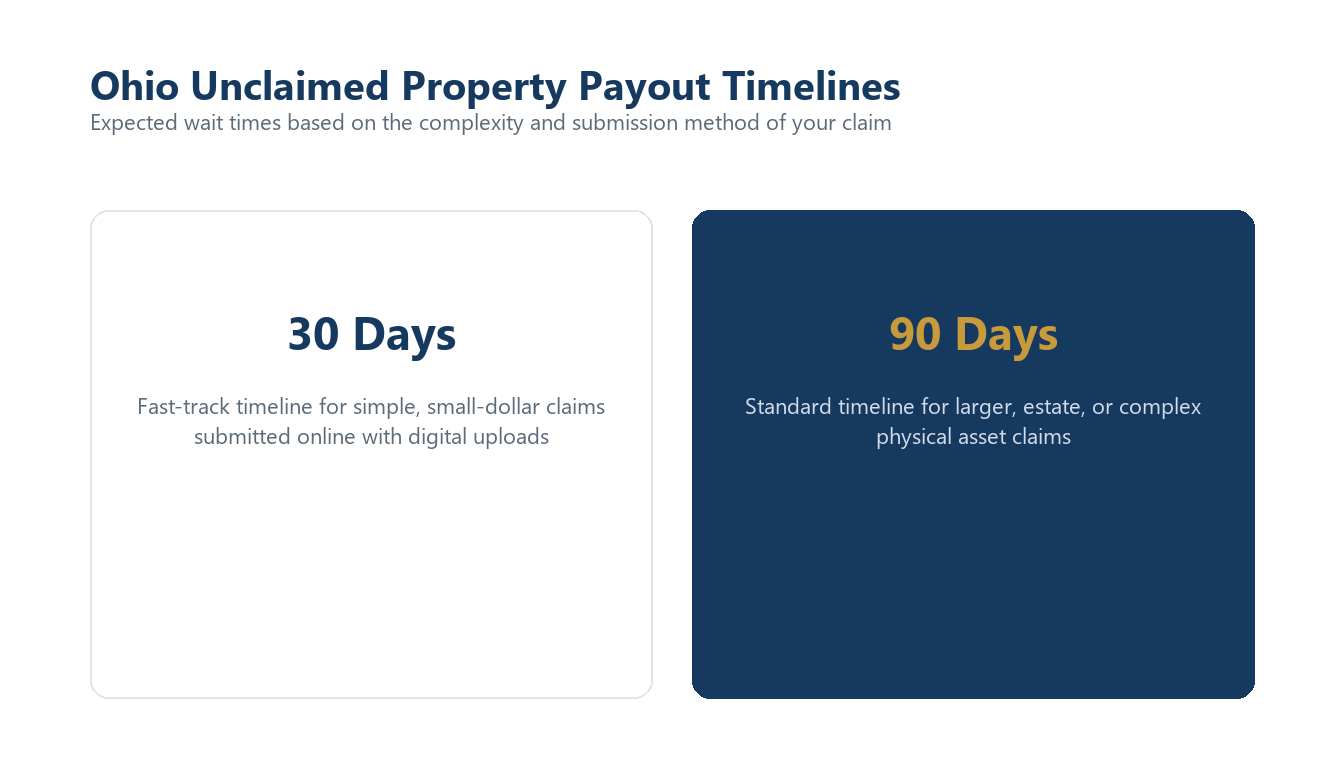
Once your claim is submitted and all documents are verified, the waiting game begins. For simple, small-dollar claims submitted through the online portal with digital uploads, you might see a check in your mailbox in as little as 30 days. These “fast track” claims are the priority for state workers because they require less manual auditing.
Larger claims, or those involving complex assets like stocks or safe deposit box contents, can take much longer. It is not uncommon for these to take 90 days or even six months to process. This is because the state may need to coordinate with the original reporting company or wait for an external audit of the asset’s current market value.
You can check the status of your claim online using the claim ID provided when you first submitted your request. If the status says “Pending Documentation,” it means the state sent you a letter or email asking for more proof—be sure to respond quickly, as claims that sit idle for too long may be closed, requiring you to start the entire process over again.

Proactive Payments: Does Ohio Have an Automatic “Money Match”?
In recent years, several states have implemented “Money Match” programs that automatically send checks to residents when a data match is found between the unclaimed funds list and current tax records. Ohio has experimented with similar outreach programs, particularly during the Ohio State Fair, where the Division of Unclaimed Funds runs a booth to help thousands of people search on the spot.
However, as of 2026, the majority of Ohio claims still require the owner to initiate the process. The state does send out occasional postcards to residents at their last known address, but these often go to old homes or are discarded as junk mail. You should not wait for the state to find you; a proactive search once a year is the best way to ensure you aren’t leaving money on the table.
The state also works with local newspapers to publish lists of names with unclaimed property. While these lists are helpful, they are often incomplete due to space constraints. The online database remains the most comprehensive and up-to-date resource available to the public.
How long can Ohio hold my money before it becomes state property?
In Ohio, unclaimed property never becomes the property of the state. The Division of Unclaimed Funds holds the money in perpetuity until the rightful owner or their heirs claim it. There is no deadline to file a claim, though it is always better to do so sooner to avoid the complexities of proving ownership for very old accounts.
Is there a fee to search the Ohio unclaimed funds database?
No, there is never a fee to search the official database or to file a claim through the Ohio Department of Commerce. Any website asking for a credit card number or a payment to “search” is a scam. The only legitimate costs involved might be small fees you pay to a third party for things like notary services or obtaining a certified death certificate if your claim requires them.
Can I claim money for a business that is now closed?
Yes, you can claim funds for a dissolved or closed business if you were a legal officer of that company (such as the President or CEO) or if you are the legal successor to the business’s assets. You will likely be required to provide corporate resolution documents or articles of dissolution to prove your authority to act on behalf of the former business entity.
What happens to the physical items found in safe deposit boxes?
Physical items like jewelry, collectible coins, or stamps are eventually sold by the state at a public auction. However, the state does not keep the proceeds. The money generated from the sale is credited to the owner’s account and held just like cash property. If you find a listing for a safe deposit box, you will be claiming the cash value of the items that were inside.
Sources:
Ohio Department of Commerce: Division of Unclaimed Funds
National Association of Unclaimed Property Administrators (NAUPA)
Ohio Revised Code Chapter 169: Unclaimed Funds