
Last updated: July 2026
Figures and program details can change – always verify current details on the official source before acting.
Quick answer
The USDA Section 504 Home Repair program provides grants up to $10,000 to homeowners aged 62 or older to remove health and safety hazards from their homes. Low-interest 1% loans up to $40,000 are also available to very-low-income homeowners of any age. Applications must be submitted through your local USDA Rural Development office.
Key takeaways
- Grants are strictly reserved for seniors (62+) who cannot afford a loan repayment.
- Homes must be located in eligible rural areas (typically populations under 35,000).
- The funds must be used for specific repairs like roofing, heating, or ADA accessibility.
- Real federal grants never require an upfront “processing fee” or “activation tax.”
The Reality of Federal Home Repair Grants in 2026
Every day, thousands of Americans search for “free government grants” to fix their homes. While the internet is flooded with scams promising easy money, there is one genuine, long-standing federal program that actually delivers: the USDA Section 504 Home Repair program.
In 2026, as housing costs remain high, this program has become a vital lifeline for rural homeowners who face expensive repairs they simply cannot afford on a fixed income.
However, qualifying for these funds is not automatic. You must meet strict income, age, and geographic requirements. This guide will walk you through the 2026 criteria, the application process, and how to tell the difference between this real government assistance and the common scams circulating on social media.
Myth 1: USDA Section 504 Grants Are Available to Anyone, Anywhere
Reality: The Single Family Housing Repair Loans & Grants program, managed by the U.S. Department of Agriculture (USDA) under Section 504, has incredibly strict eligibility rules. Its primary mission is to help very-low-income homeowners repair, improve, or modernize their homes, but you must meet specific age, income, and geographic criteria.
To access these funds, you must meet four primary criteria. First, you must be the homeowner and occupy the house as your primary residence. Second, you must be unable to obtain affordable credit elsewhere, meaning you don’t have the savings or a high enough income to get a standard bank loan.
Third, your family income must be below the “Very Low” limit for your specific county. This is generally defined as 50% of the area’s median income (AMI). Because these limits vary wildly between a rural county in Georgia and one in Pennsylvania, you must check the current USDA income limit map for 2026.
Finally, the home must be located in an eligible rural area. Many people are surprised to find that “rural” doesn’t just mean a remote farm; many small towns and suburbs with populations up to 35,000 are still designated as eligible for USDA assistance.
Because populations change, the USDA updates its “Eligible Area” maps periodically. A town that qualified in 2020 might be disqualified in 2026 if its population has surged. Conversely, new areas are sometimes added during economic shifts.
Before you fill out a single form, use the official USDA Eligibility Map tool. You simply type in your home address, and the system will give you a definitive “Yes” or “No” on whether the location qualifies. This one step can save you weeks of wasted effort.
If your address is ineligible, don’t give up. Check with your county’s Housing Authority or the local office of Habitat for Humanity. Many counties receive federal funds (CDBG) specifically to run local home repair programs for seniors that have different geographic boundaries than the USDA.
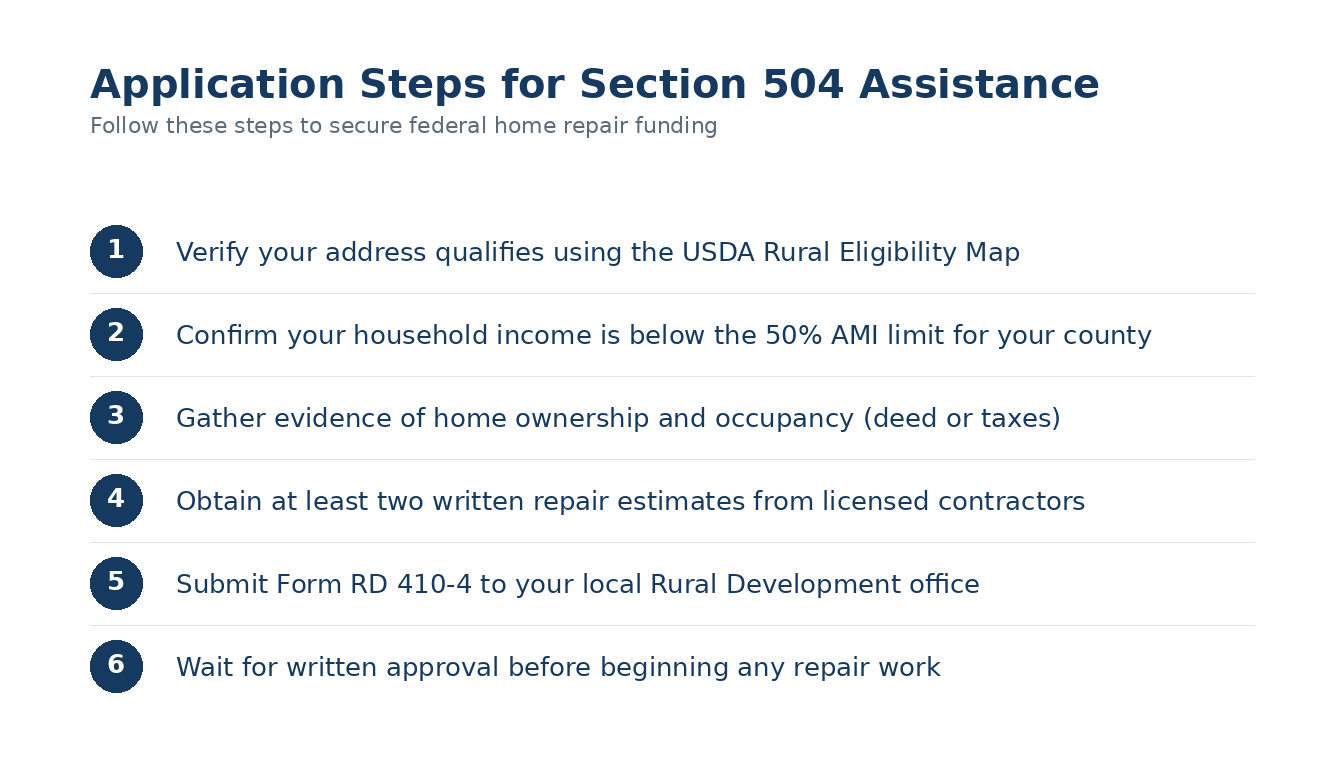
As shown in the checklist above, the process starts with verifying your geography. If your home is in a major metropolitan center like Atlanta or Chicago, you will not qualify for Section 504, though you may find similar local programs through HUD’s CDBG program.
Myth 2: You Must Hold a Traditional Property Deed to Qualify for Assistance
Reality: One of the most common barriers for rural homeowners is a “tangled title” or heirs’ property—where a home has been passed down through generations without a formal deed transfer or probate. In many cases, seniors find themselves living in a home their grandparents built, but because the legal paperwork was never updated, they lack the clear deed usually required for bank financing. The USDA Section 504 program addresses this through a specific “alternative ownership” provision. This rule allows very-low-income applicants to qualify for the $10,000 grant even if they cannot produce a traditional deed, provided they can prove they are the de facto owners of the property.
To utilize this exception, you must demonstrate what the USDA calls “possessory interest” through a history of residency and responsibility. Generally, this requires evidence that you have occupied the home as your primary residence for at least the last 10 years and have a consistent track record of paying the property taxes. If you don’t have a deed, the USDA may accept a combination of records such as long-term utility bills, “affidavits of heirship” from disinterested community members, or evidence that you have personally funded major maintenance over the previous decade. Because this process involves more nuance than a standard application, you should explicitly mention your “heirs’ property” status when first contacting your USDA Rural Development state office to ensure you receive the specific supplemental forms for alternative evidence of ownership.
It is important to understand that while this exception allows you to access federal repair funds, it does not legally “clear” your title for a future sale or a mortgage. The program’s goal here is strictly the physical stabilization of the home to keep it habitable for the resident. However, by securing these funds to fix critical health and safety hazards like a failing septic system or a collapsing roof, you prevent the home from being condemned. This can buy your family the necessary time to work with a local legal aid clinic to resolve the underlying title issues. For those living on ancestral land, this alternative documentation rule is often the only mechanism available to preserve the home’s integrity for the next generation.
Myth 3: You Can Use Section 504 Funds for Any Home Upgrades Without Any Repayment Rules
Reality: The USDA is very specific about how these funds can be used, and there is a major distinction between the grant and the loan. Many applicants are disappointed to learn they only qualify for the loan, but even the loan is a significant financial benefit due to its near-zero interest rate.
The program is split into two categories: loans and grants. The loans are incredibly affordable, featuring a fixed 1% interest rate with a 20-year repayment term. The grants, which do not have to be repaid unless the property is sold within three years, are specifically designated for elderly homeowners.
In 2026, the maximum grant amount stands at $10,000, while the maximum loan amount is $40,000. It is possible to combine both for a total of $50,000 in assistance if you meet the specific requirements for both categories.
| Feature | Section 504 Grant | Section 504 Loan |
|---|---|---|
| Max Amount | $10,000 | $40,000 |
| Age Requirement | 62 years or older | 18 years or older |
| Interest Rate | N/A (No repayment) | 1% Fixed |
| Repayment Term | None* | Up to 20 Years |
| Purpose | Safety/Health hazards only | Repair, improve, or modernize |
*Note: If you receive a grant and sell the home within three years, the federal government requires you to repay the grant in full from the sale proceeds. This prevents people from using the grant to “flip” a house for a quick profit.
You cannot use these funds for cosmetic upgrades like new kitchen cabinets, landscaping, or painting. Every dollar must be tied to the structural integrity or the immediate safety of the occupants living in the home.
For the grant portion ($10,000), the focus is strictly on health and safety. This includes repairing a leaking roof, replacing a failing furnace, fixing hazardous electrical wiring, or installing a wheelchair ramp and widening doorways for ADA accessibility.
The loan portion ($40,000) is slightly more flexible. While it must still be used to improve the home’s habitability, it can cover modernization efforts that also improve energy efficiency, such as new windows or insulation, which can lower your long-term utility bills.
Myth 4: You Must Pay an Upfront Fee or Hire a Specialist to Secure Your Funds
Reality: Real federal grants never require an upfront “processing fee” or “activation tax.” All the information and application forms for the Section 504 program are free and available directly through the official USDA website. Private companies that charge $50 to $500 to “find” grants for you are almost always scams.
If you receive a message on Facebook or an unsolicited phone call saying you’ve been selected for a “Home Improvement Grant” from the government, be extremely cautious. Real government agencies do not reach out to individuals through social media to offer money. As we’ve noted in our previous scam prevention guide, legitimate grants are something you must apply for, not something that finds you.
Unlike searching for lost funds through a state database, as covered in our guide on finding unclaimed money, applying for a USDA grant involves a significant amount of paperwork. You will need to prove your income, your home ownership, and the cost of the repairs.
You begin by contacting your local USDA Rural Development office. They will provide you with Form RD 410-4 (Uniform Residential Loan Application). You will also need to gather “evidence of ownership,” which is usually your property deed, and recent tax returns or Social Security benefit statements.
A crucial part of the application is the repair estimate. You must obtain written bids from licensed contractors detailing exactly what work needs to be done and how much it will cost. The USDA will often send an inspector to verify that the proposed repairs meet the program’s safety definitions.
The biggest mistake homeowners make is starting the repair work before their application is approved. The USDA will not reimburse you for work already completed. You must wait for the “Notice of Approval” before any hammers hit any nails.

Frequently Asked Questions
Can I get a grant if I am under 62?
No, the grant portion of the Section 504 program is strictly limited to those aged 62 and older. Homeowners under 62 may still apply for the 1% interest rate loan, which is much more affordable than any private bank loan currently available in 2026.
Do I have to pay the grant back?
Generally, no. The grant only requires repayment if you sell the property within three years of receiving the funds. If you remain in the home for more than three years, the grant is completely forgiven and becomes yours to keep.
What is the maximum income to qualify?
The limit is 50% of the Area Median Income (AMI). For example, if the median income in your rural county is $60,000, your household income must be below $30,000 to qualify as “very low income.” These numbers are updated annually by the USDA.
How long does the approval process take?
The timeline varies by state and current funding levels, but typically it takes 30 to 90 days from the time you submit a complete application to receive a decision. Applications with immediate safety hazards (like a collapsing roof) are sometimes expedited.
Sources:
USDA Rural Development – Section 504 Official Page
Grants.gov – Federal Grant Search
U.S. Dept. of Housing and Urban Development (HUD)