

Last updated: August 2026
Figures and program details can change – always verify current details on the official source before acting.
Quick answer
Colorado is currently holding over $1.5 billion in unclaimed property through its official program, “The Great Colorado Payback.” Residents can search for free at colorado.findyourunclaimedproperty.com. Notably, Colorado’s “Proactive Check Campaign” initiative proactively sends checks to residents for smaller amounts without requiring a claim form, though larger amounts and complex assets like mineral royalties still require a manual search and verification process.
Key takeaways
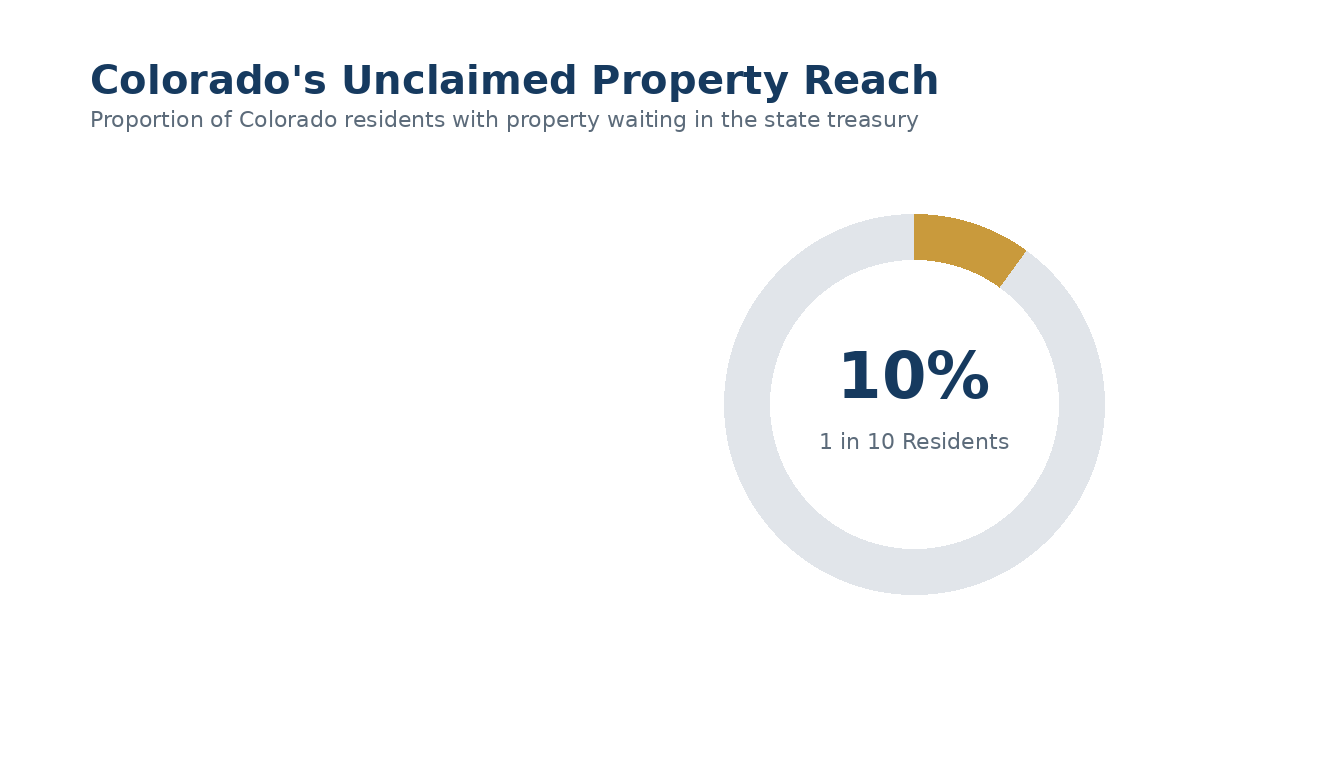
- Colorado holds roughly $1.5 billion in lost assets, with 1 in 10 residents owed money.
- The “Proactive Check Campaign” program automatically mails checks for many smaller claims.
- Unique assets like mineral royalties and rural utility deposits are common in Colorado.
- State law requires no fees for searching or claiming; all official tools are free.
As of August 2026, the Colorado Department of the Treasury is managing a record-breaking pool of forgotten assets. With over $1.5 billion waiting to be reunited with its rightful owners, the state has moved beyond a passive “search-and-wait” model. The current administration has pivoted toward aggressive “proactive payouts,” leveraging state tax data to cut through the red tape that usually traps unclaimed funds in government vaults.
Whether you are a lifelong resident of the Front Range or briefly lived in the state for a ski season years ago, there is a statistical 10% chance that Colorado is holding money in your name. From forgotten security deposits at Colorado Springs utility companies to uncashed dividends from Denver-based startups, these funds are legally yours—and in 2026, getting them back is easier than ever.
To understand the scale of what is available, one must look at the diverse categories of property the state protects. Unlike many other states that primarily hold bank accounts, Colorado’s database is uniquely heavy with mineral royalties and energy-sector wages, reflecting the state’s industrial history. The following table compares the most common types of property currently held by the “Great Colorado Payback” program.
| Property Type | Typical Source | Dormancy Period (CO) | Common Claim Complexity |
|---|---|---|---|
| Unclaimed Wages | Former Employers | 1 Year | Low – Usually requires ID |
| Utility Deposits | Xcel Energy, Rural Co-ops | 1 Year | Low – Often part of the Proactive Check Campaign |
| Mineral Royalties | Oil & Gas Leases | 3 Years | High – Requires deed/title |
| Bank Accounts | Savings/Checking/CDs | 3 Years | Medium – Requires account proof |
| Insurance Payouts | Life Insurance/Refunds | 3 Years | Medium – Beneficiary proof needed |
The 2026 Proactive Check Campaign Advantage
The most significant development for Coloradans in 2026 is the expansion of the Proactive Check Campaign. Traditionally, unclaimed property required the owner to initiate a search, fill out a claim form, and provide notarized documentation. The Proactive Check Campaign flips this script by using secure data-sharing between the Department of Revenue and the Treasury to verify your identity and current address automatically.
This automated system works by cross-referencing the Social Security numbers or Taxpayer Identification Numbers (TIN) associated with unclaimed funds against active state tax filings and DMV records. If a perfect match is found for a property valued under $500, the Treasury can bypass the formal claim paperwork entirely. In 2026, this technology has been upgraded to include “Address Linkage Logic,” which can even identify owners who have moved multiple times within the state by tracking the progression of their residential history through utility records.
If the state holds property in your name—typically for amounts under $500 with a clear name and address match—they may simply mail you a check. In the first half of 2026 alone, thousands of these proactive checks were issued. However, if you have moved frequently or if the assets are high-value, you still need to use the official search portal to trigger the payout process.

It is important to note that the Proactive Check Campaign does not cover every asset. Complex holdings, such as the contents of safe deposit boxes or fractional mineral interests, always require a manual claim. If you haven’t received an unexpected check in the mail, you should not assume the state isn’t holding money for you. A manual search remains the only way to audit the full $1.5 billion database.
How to Search the ‘Great Colorado Payback’ Database
Searching for your share of the $1.5 billion is a straightforward process that takes less than two minutes. The Colorado Treasury maintains a dedicated portal specifically for this purpose, which is separate from the general state government site. Follow these steps to ensure a comprehensive search of the 2026 records:
- Navigate to the official portal at colorado.findyourunclaimedproperty.com.
- Enter your last name (or business name) and first name. For better results, search only by last name if yours is unique, as this catches middle-initial variations.
- Review the results for matching addresses. Colorado’s database includes records dating back decades, so look for old apartment addresses or former workplaces.
- If you find a match, click “Claim” to add the item to your secure cart. You can claim multiple properties at once.
- Follow the prompts to provide your current contact information and Social Security number for identity verification.
Pro Tips for a Successful Search
To maximize your chances of finding hidden funds, consider these advanced search techniques used by professional researchers in 2026:
- Search Maiden Names: Many people forget that utility deposits or old bank accounts may still be listed under a previous surname.
- Common Misspellings: If you have a name that is frequently misspelled (e.g., “Smyth” vs. “Smith” or “Jon” vs. “John”), try searching for common variations. The database relies on how the reporting business entered the data.
- Business Variations: If you owned a small business, search for the business name both with and without “LLC” or “Inc.” suffixes.
- Family Members: Colorado allows you to search for relatives. While you can’t claim their money directly while they are living, you can alert them to the existence of the funds.
Once submitted, the system will categorize your claim. Many 2026 claims are processed quickly, and if the data matches perfectly, you may receive your funds via direct deposit or check within a few weeks. More complex claims involving deceased relatives or mineral rights may take several months to process as a state technician must manually review the legal chain of ownership.

Why Colorado Money Often Goes Missing
Understanding why this money exists can help you identify where else to look. In Colorado, “unclaimed property” is not a tax refund or a grant; it is private property that a business lost contact with. Under the Revised Uniform Unclaimed Property Act, businesses are required to turn these funds over to the State Treasurer if they cannot find the owner after a “dormancy period”—usually one to three years.
Common scenarios in the Rocky Mountain region include unreturned mountain-resort security deposits, forgotten credits from local credit unions, and uncashed checks from the healthcare industry. As we discussed in our guide on dormancy periods by state, Colorado’s timelines are relatively short, meaning money moves from businesses to the state treasury faster than in many other jurisdictions.
This is particularly true for utility deposits. With Colorado’s high rate of residential turnover—especially in college towns like Boulder and Fort Collins—thousands of final utility credits go unmailed because the resident didn’t leave a forwarding address. These funds represent a massive chunk of the current $1.5 billion total. Furthermore, 2026 has seen a surge in unclaimed funds from the telecommunications sector as residents switch between 5G providers and fiber-optic startups, often leaving small credit balances behind.
Beyond Cash: Safe Deposit Boxes and Tangible Assets
While the majority of the $1.5 billion is in the form of liquid cash, the Colorado State Treasury also safeguards tangible property. When a safe deposit box at a bank remains unpaid or inactive for several years, the bank is legally required to drill the box and send the contents to the state.
These items often include:
- Rare Coins and Currency: Historical gold coins and silver certificates.
- Jewelry and Heirlooms: Engagement rings, watches, and family medals.
- Military Decorations: Colorado has a specific program dedicated to reuniting veterans or their families with lost Purple Hearts, Bronze Stars, and other service medals found in safe deposit boxes.
- Stock Certificates: Physical paper certificates for companies that may have since merged or gone public.
If the state cannot identify the owner of physical items after a certain period, they may be sold at a public auction. However, the proceeds from those sales are held in perpetuity for the owner. This means even if your grandfather’s watch was sold a decade ago, you can still claim the cash value of that sale today.
The Complexity of Mineral Rights and Royalties
Colorado is one of the few states where unclaimed mineral royalties represent a significant percentage of the total fund. If a family member owned land in Weld, Garfield, or La Plata counties decades ago, they may have retained mineral rights that are now generating royalties from active oil or gas wells. If the energy company cannot find the heirs, those royalties are escheated to the state.
Claiming these assets is more difficult than claiming an old paycheck. You will often need to provide a clear “paper trail” of the family tree, including birth and death certificates and, in some cases, a copy of a probated will or a recorded deed. These claims involve the “Chain of Title,” where a state investigator must verify that the claimant is the legal successor to the original mineral interest owner. In 2026, the Treasury has added specialized landmen to their staff to help expedite these complex oil and gas royalty claims.
While the process is longer, these accounts are often the most valuable, sometimes reaching five or six figures in accumulated back-payments. Because mineral rights are often severed from surface rights, many Coloradans are completely unaware they even own these interests until they perform a search on the Great Colorado Payback website.

Business-to-Business (B2B) Unclaimed Property
One of the most overlooked sectors of the $1.5 billion pool is money owed to Colorado businesses. Small business owners often focus on their customers but forget to track their own overpayments to vendors. Common B2B unclaimed property includes:
- Vendor Overpayments: Paying a supply invoice twice.
- Credit Memos: A credit issued by a wholesaler that was never applied to a future purchase.
- Insurance Premium Refunds: Refunds from worker’s compensation or general liability policies that were mailed to an old office address.
If you have ever operated a business in Colorado, it is vital to search under the business name. Unlike individual claims, business claims may require a Federal Employer Identification Number (FEIN) and proof that you are an authorized officer of the company (such as an Operating Agreement or Articles of Incorporation) to initiate the payout.
Red Flags: Avoiding Colorado Unclaimed Property Scams
The visibility of the “Great Colorado Payback” program in 2026 has unfortunately attracted scammers. These individuals, often called “private finders” or “asset locators,” may contact you via text, email, or social media claiming they have found a large sum of money for you. While some finders are legal, they often charge a fee of up to 20% or 30% of your total claim.
In Colorado, there is absolutely no reason to pay a fee. Every tool provided by the Colorado State Treasury is 100% free. If someone asks for your credit card number or an upfront payment to “release” your funds, it is a scam. The state will never ask for payment to process a claim; they deduct nothing from your payout.
Always verify that you are on a “.gov” or official state-contracted site like unclaimed.org (the National Association of Unclaimed Property Administrators). If you receive a suspicious communication, you can contact the Colorado Treasury directly to verify if a legitimate claim exists in your name before providing any sensitive information. Be especially wary of callers who claim they are from the “Department of Unclaimed Funds”—this is not a real department name in Colorado.
Looking for another state? See our full state-by-state unclaimed money directory to find your state’s official search portal.
Frequently Asked Questions
How long does it take to get my money from the Colorado Treasury?
For simple claims with electronic verification, payouts often occur within 2 to 4 weeks. This is because the system can verify your identity against existing state records in real-time. However, complex claims involving estates, trusts, or mineral rights can take 90 days or longer due to the manual legal review required. If the Treasury requires additional documentation, such as a certified copy of a death certificate or a court-ordered Letter of Administration, the clock usually restarts once they receive those physical documents.
Is there a deadline to claim my property in Colorado?
No. Colorado acts as a perpetual custodian of the funds. Even if the money has been held for 30 years, it remains available for the rightful owner or their legal heirs to claim. The state never takes permanent ownership of unclaimed private property; instead, the funds are held in the state’s General Fund where the interest earned helps fund public projects, but the principal amount is always ready to be paid out to the owner upon verification.
Can I claim money for a deceased relative?
Yes. You will need to provide proof of the person’s death (usually a death certificate) and legal documentation showing you are the authorized representative of the estate or the rightful heir. The portal provides a specific workflow for these “Heir Claims.” Depending on the value of the property, you may be able to use a “Small Estate Affidavit” if the total value of the deceased person’s Colorado assets is below a certain threshold. For larger amounts, you may need to provide probate documents from the county court where the relative resided.
What is the ‘Proactive Check Campaign’ check I received?
If you received a check from the Colorado State Treasury without filing a claim, it is likely part of the Proactive Check Campaign. The state matched your name and address with current tax records to verify your identity and proactively returned your funds. This is a legitimate state check designed to reduce the backlog of small-dollar claims. You should deposit it immediately as these checks have an expiration date (typically six months). If you lose the check or it expires, you will need to contact the Treasury to have it reissued, which may then require a manual claim form.