

Last updated: August 2026
Figures and program details can change – always verify current details on the official source before acting.
Quick answer
Pennsylvania currently holds over $4.5 billion in unclaimed property. While most residents must search the official Patriot database at the PA Treasury website, the state’s expanded 2026 “Money Match” program now automatically mails checks to verified residents for claims under $10,000 without requiring a formal application.
Key takeaways
- The Pennsylvania Treasury is holding a record-breaking $4.5 billion in forgotten assets.
- The “Money Match” program automatically returns funds to many residents without a claim form.
- Manual searches are conducted via the official “Patriot” portal at patreasury.gov.
- One in ten Pennsylvanians has money waiting, with the average claim valued at $1,600.
The 2026 Shift: How Pennsylvania is Forcing Money Back to You
For decades, the burden of finding unclaimed money in Pennsylvania rested entirely on the citizen. You had to remember an old utility deposit from a move to Pittsburgh or a forgotten savings account in Allentown, then navigate a complex paper trail to prove it was yours. In August 2026, that dynamic has fundamentally shifted thanks to the full-scale expansion of the Pennsylvania “Money Match” initiative.
This program allows the PA Treasury to cross-reference unclaimed property data with current tax records. If the names and addresses match with 100% certainty, the Treasury simply cuts a check and mails it to you. This proactive approach has already returned tens of millions of dollars this year alone, targeting small-to-medium balances that often go ignored by busy families. However, automation isn’t perfect, and billions still sit in the state’s vault waiting for a manual claim.
Breaking Down the $4.5 Billion Pennsylvania Treasure Trove
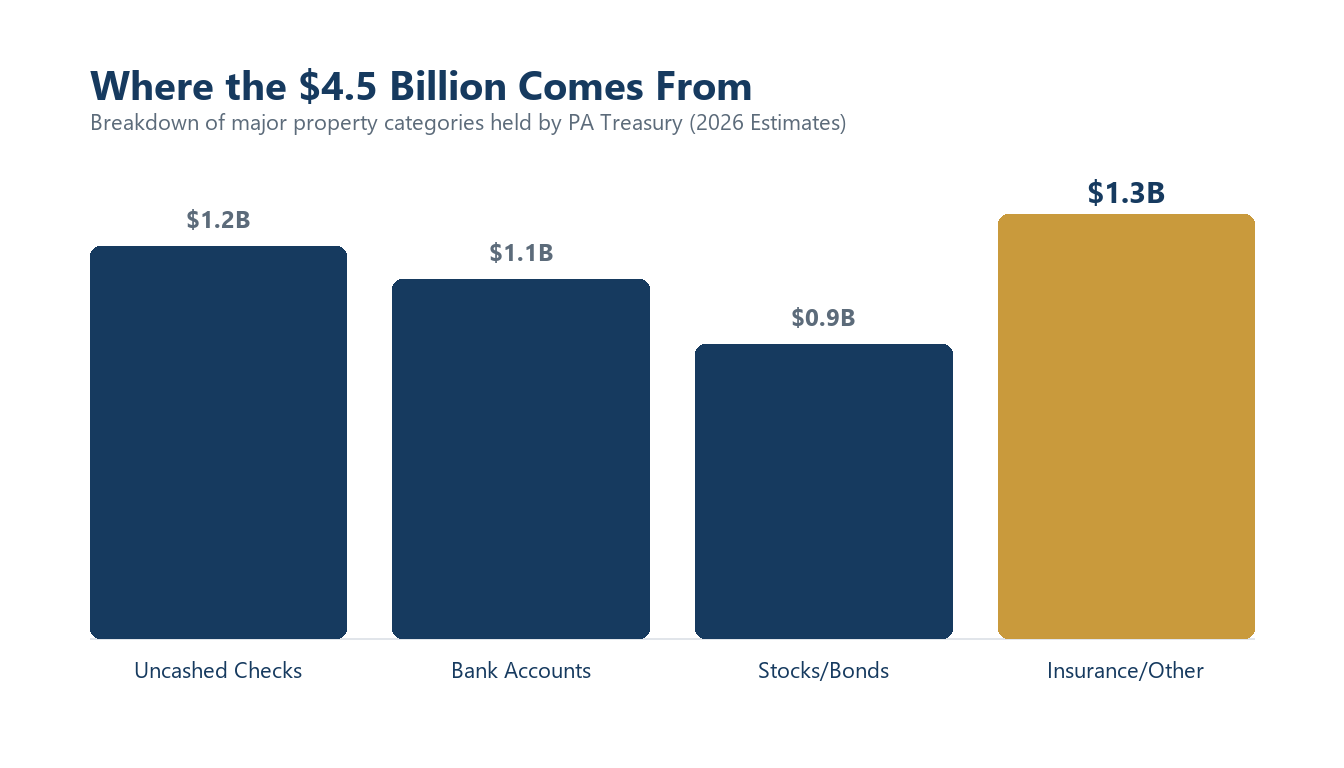
To understand why you likely have money waiting, you have to look at the sheer scale of what the Treasury is holding. This isn’t just loose change from a piggy bank; it represents the financial debris of millions of lives lived in the Keystone State. From uncashed payroll checks in the Lehigh Valley to forgotten stock dividends in Philadelphia, the variety is staggering.
Pennsylvania law requires businesses to turn over property to the state after a “dormancy period,” which is usually three years for most items. If a bank or insurance company loses contact with you, they cannot keep that money. By law, they must hand it to the State Treasurer, who acts as a perpetual custodian until the rightful owner—or their heir—comes forward.
Does the PA Treasury Already Have Your Current Address?
The success of the “Money Match” system depends entirely on data accuracy. If you have moved recently or have a common name, the automated system may bypass you to avoid sending a check to the wrong person. This is why the Treasury still encourages every resident to perform a manual check at least once a year, even if they haven’t received a surprise check in the mail.
Current 2026 data suggests that roughly 1 in 10 Pennsylvanians is owed money. This includes not just individuals, but also small businesses, non-profits, and local governments. Because Pennsylvania has a long industrial history, many claims involve older assets like physical contents of safe deposit boxes or forgotten demutualization shares from life insurance companies.

A Manual Search Strategy for the “Patriot” Portal
If you haven’t received an automatic payout, your next step is the official Pennsylvania Treasury search tool, known internally as the “Patriot” system. Unlike third-party aggregate sites, this is the only site where your search and claim are entirely free. To start a search, you only need a last name, but adding a city or zip code can help narrow down results in a state as populous as Pennsylvania.
When searching, do not just look for your current name. Search for your maiden name, the names of deceased parents or grandparents, and any business names you have operated. You should also search for any address where you have lived for more than six months. Often, a utility refund or a final paycheck is sent to an old apartment long after you have moved away.
The Step-by-Step Guide to Filing a Pennsylvania Claim
If you find a match in the database, the process of getting that money into your bank account follows a specific set of requirements. Here is how the 2026 claim process typically unfolds for most residents:
- Initiate the Claim: Click the “Claim” button next to the property in the Patriot search results. This will generate a unique Claim ID number.
- Verify Identity: You will be asked to provide your Social Security Number. For many simple claims, the system can verify your identity instantly through an electronic interface with credit reporting agencies.
- Submit Documentation: If the claim is larger or involves a deceased relative, you may need to upload a scan of your driver’s license, a utility bill showing the old address, or probate documents.
- Review and Approval: A Treasury examiner will review the files. For standard cash claims, the 2026 average processing time is approximately 30 to 60 days.
If you are looking for more information on how Pennsylvania’s holding periods compare to other states, you can view our guide on Unclaimed Property Dormancy Periods by State.
Common Property Types and Their Waiting Periods
Not all property is turned over to the state at the same time. The “dormancy period” is the amount of time an asset must sit untouched before the holder is legally required to send it to Harrisburg. Understanding these timelines can help you predict when a missing refund might actually appear in the state’s database.
| Property Type | Dormancy Period (PA) | Common Origin |
|---|---|---|
| Bank Accounts | 3 Years | Savings, checking, and CDs |
| Uncashed Checks | 3 Years | Payroll, dividends, and refunds |
| Insurance Proceeds | 3 Years | Death benefits and premium refunds |
| Utility Deposits | 3 Years | Electric, water, and gas deposits |
| Safe Deposit Boxes | 3 Years | Jewelry, coins, and documents |
The “Military Medal” Mission: A Unique Pennsylvania Feature
One of the most distinct aspects of the Pennsylvania Treasury’s work is its commitment to returning military medals. When safe deposit boxes are abandoned and eventually drilled open, the contents are sent to the Treasury. While most items are eventually auctioned to fund the program, Pennsylvania law strictly prohibits the auctioning of military decorations.
The Treasury currently holds hundreds of medals, including Purple Hearts and Bronze Stars, dating back to the Civil War. They have a dedicated team that works with veterans’ organizations to track down the original recipients or their descendants. If you had a relative who served and may have had a safe deposit box in a Pennsylvania bank, searching the unclaimed property database could lead to the recovery of a priceless family heirloom.

Claims for the Deceased: Recovering a Family Legacy
A significant portion of the $4.5 billion belongs to Pennsylvanians who have passed away. These funds do not vanish; they become part of the decedent’s estate. If you are the executor or a legal heir, you have the right to claim these funds, regardless of how much time has passed. Pennsylvania does not have a statute of limitations on claiming unclaimed property.
To claim money for a deceased relative, you will generally need to provide a death certificate and proof that you are the rightful recipient (such as a will or letters of administration). This is a common way for families to discover “hidden” assets during the probate process. If you are also checking for federal assets, be sure to consult our guide on Unclaimed Veteran Benefits.
Mistakes to Avoid When Searching and Claiming
While the process is designed to be user-friendly, many Pennsylvanians make simple errors that delay their payments or lead them into the arms of scammers. By far the most common mistake is paying a fee for a service you can get for free. Here is how to stay on the right track:
- Never Pay Upfront: Official state searches are always free. If a site asks for a credit card to “search the records,” leave immediately.
- Check Your Junk Mail: In the era of “Money Match,” the Treasury may send you an official letter asking for one final piece of verification. Don’t throw away mail from the “Pennsylvania Treasury Department.”
- Use Full Legal Names: If your name is Jonathan, don’t just search for “Jon.” The database matches legal records provided by banks.
- Verify the URL: Ensure the site ends in .gov. Scammers often create “look-alike” sites with .org or .com addresses that mimic the official state colors.
Security Protocols: Spotting Pennsylvania-Specific Scams
With the news of record-breaking returns and the “Money Match” program, scammers have stepped up their efforts to target Pennsylvanians. A common tactic in 2026 involves a text message or social media DM claiming you have a “pending payout” and providing a link to a fake portal. The PA Treasury will never contact you via text message or social media to initiate a claim.
Another red flag is any “finder” who demands a percentage larger than the legal limit. While Pennsylvania does allow licensed “finders” to help people locate property, they are strictly regulated. By law, a finder cannot charge more than 10% of the value of the property, and they cannot contact you until the property has been held by the Treasury for at least 24 months. In almost every case, you can do the work yourself in five minutes for free.

Official Resources for Pennsylvania Residents
Always use official channels to manage your financial assets. The following sources are the only verified ways to interact with the Pennsylvania unclaimed property system:
- Official Search Portal: Pennsylvania Treasury Unclaimed Property (Patriot)
- Contact Number: 1-800-222-2046 (PA Treasury Unclaimed Property Bureau)
- Reporting Authority: NAUPA (National Association of Unclaimed Property Administrators)
If you live near the border or have lived in neighboring states, you should also check their databases. For example, if you formerly lived in the Empire State, our New York Unclaimed Property Guide can help you navigate their $20 billion fund.
Pennsylvania Unclaimed Property FAQ
How long does it take to get my money from the PA Treasury?
For most claims filed electronically in 2026, the turnaround time is 30 to 60 days. If the claim is complex—such as those involving safe deposit box contents, stocks, or deceased estates—it may take 90 days or longer to verify all documentation and liquidate physical assets.
What is the Pennsylvania Money Match program?
Money Match is a proactive initiative where the Treasury uses tax data to verify your identity and current address. If a match is found for property under a certain threshold (currently $10,000 for many claims), the state will mail you a check automatically without requiring you to file a claim form.
Does Pennsylvania auction off unclaimed property?
Yes, the Treasury periodically holds auctions for the contents of abandoned safe deposit boxes (such as jewelry and collectibles) after they have been held for several years. However, the proceeds from these sales are held in perpetuity for the original owner, and military medals are never auctioned.
Is there a deadline to claim my money in Pennsylvania?
No. Pennsylvania acts as a permanent custodian for unclaimed property. Whether the money was turned over three years ago or thirty years ago, you or your legal heirs can claim it at any time. The money never rolls into the state’s general fund for permanent use.