

Last updated: August 2026
Figures and program details can change – always verify current details on the official source before acting.
Quick answer
Virginia is currently holding over $3.3 billion in unclaimed property, and approximately 1 in 4 residents is owed a portion of it. You can search for your name for free at the official VAMoneySearch.gov portal. Most claims can be filed online, and the state offers an expedited online verification process for instant approval of many claims using your Social Security number and current address.
Key takeaways
- Virginia holds $3.3 billion in lost assets, including uncashed checks, utility deposits, and insurance payouts.
- The official search portal, VAMoneySearch.gov, is entirely free to use.
- One in four Virginians has a claim waiting, with some individual claims exceeding $100,000.
- The state holds these funds in perpetuity, meaning there is no deadline to file your claim.
Myth 1: “Unclaimed Property is Only for People Who Forget Bank Accounts”
Many Virginians assume that because they have a handle on their active checking and savings accounts, the Commonwealth’s unclaimed property division has nothing for them. This is the most common misconception that prevents people from checking the database. In reality, the $3.3 billion currently held by the Virginia Department of the Treasury comes from dozens of different sources that have nothing to do with traditional banking.
Corporate refunds, uncashed payroll checks, dividends from stocks you may have inherited, and even forgotten utility deposits from a college apartment all end up in the state’s vault. If a company owes you money and cannot find you for a period of one to five years, Virginia law requires them to turn those funds over to the Treasury. This process ensures the money remains protected and available for you to claim, rather than being absorbed by the corporation as profit.
The scale of this fund is staggering. While the average claim in Virginia often hovers around a few hundred dollars, the state regularly processes payouts in the thousands. Because businesses are constantly reporting new “dormant” accounts every year, a name that didn’t appear in the database last year might show up today. This is why official sources recommend searching the portal at least once every twelve months.
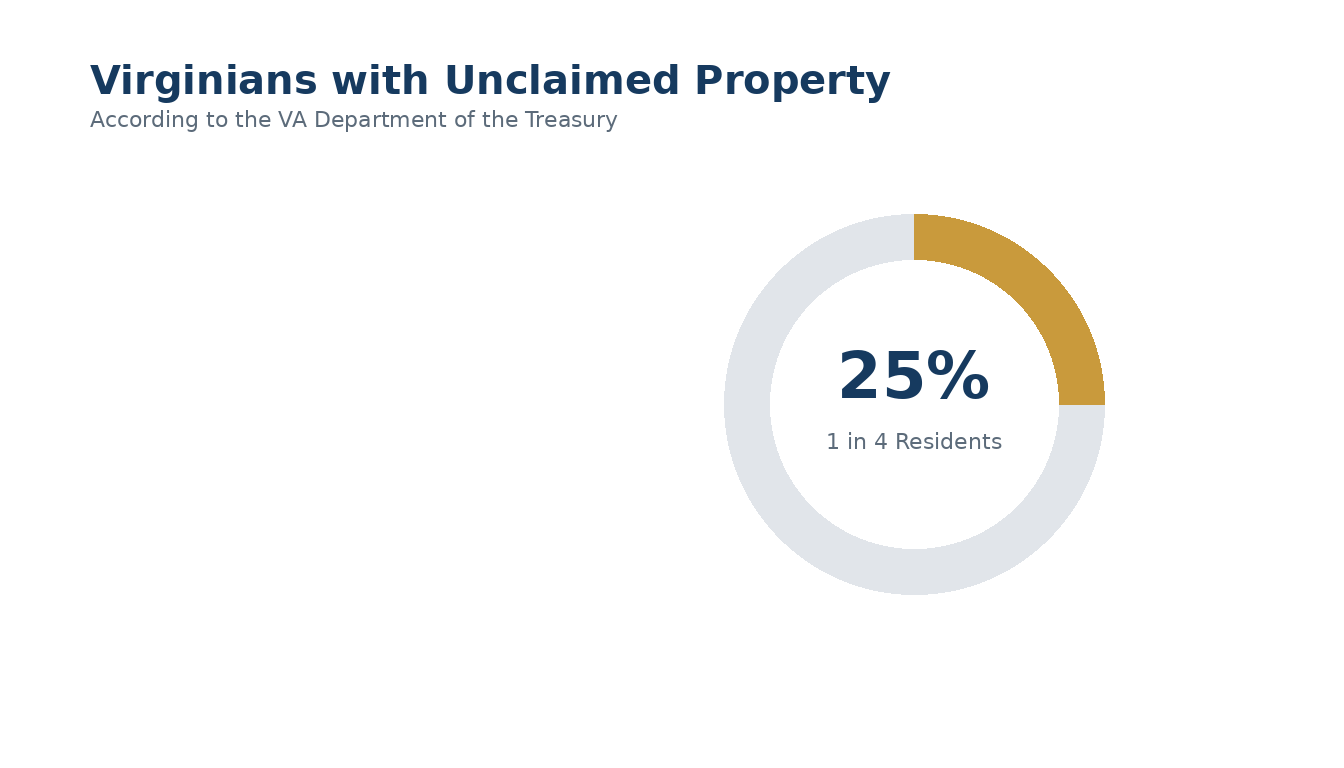
Statistically, the odds of finding money are higher than most people realize. The Virginia Department of the Treasury estimates that 1 in 4 residents has property waiting to be claimed. This means that in an average Virginia household or office, someone is almost certainly listed in the registry. The funds don’t just include cash; they can also include the contents of safe deposit boxes, which are eventually liquidated into cash while the state retains the proceeds for the original owner.
Myth 2: “If I Haven’t Claimed It by Now, the State Already Kept It”
In many areas of law, there are strict statutes of limitations that bar you from taking action after a certain amount of time. However, Virginia’s Unclaimed Property Act is designed with a “perpetuity” clause. This means the state acts as a permanent custodian of the funds. Whether the money was turned over in 1985 or 2025, it remains available for the rightful owner or their legal heirs to recover.
Unlike unclaimed IRS tax refunds, which have a strict three-year window before they are permanently lost to the U.S. Treasury, Virginia’s state-held funds never expire. This is a critical distinction. Even if you find a record for a great-grandparent who passed away decades ago, that money is still sitting in the state’s Unclaimed Property Trust Fund, earning interest that helps fund Virginia’s public schools while awaiting a claim.
The Reality is that the state actually wants to return this money. Holding billions of dollars in small accounts creates a significant administrative burden. To combat this, the Virginia Treasury uses various data-matching techniques to try and locate owners, but the primary responsibility remains with the citizen to initiate the search. If you find a listing, you are not “taking” money from the state; you are simply reclaiming your own private property.

Myth 3: “Filing a Claim is a Bureaucratic Nightmare with Endless Paperwork”
There is a persistent belief that dealing with a government agency for a refund will involve months of mailing forms back and forth. While complex claims—such as those involving multi-generational estates or corporate dissolutions—do require significant documentation, the vast majority of Virginia claims are now handled through the expedited online verification process on VAMoneySearch.gov.
The Reality is that if the state can verify your identity through your Social Security number and your current or former address, the entire process can often be completed in under ten minutes. This online verification matches the data you provide against secure third-party databases to confirm you are who you say you are. In these cases, no physical paperwork is required, and a check can be issued within a few weeks.
For claims that do require evidence, the portal allows you to upload digital copies of your documents directly. This is a significant upgrade from the old system of mailing physical photocopies. Typically, the state will ask for a copy of your current driver’s license and something that links you to the address listed on the unclaimed property record, such as an old utility bill or a tax document. Once uploaded, these are reviewed by a claims auditor who will contact you via email if anything else is needed.
Myth 4: “I Have to Pay a Search Fee or Hire a Professional to Get My Money”
This is perhaps the most dangerous myth, as it leads many Virginians to fall for predatory “finder” schemes. You may receive a letter or an email from a private company claiming they have found a large sum of money in your name and offering to recover it for a fee (often 10% to 25% of the total). While these companies are sometimes legitimate “asset finders” registered with the state, their services are almost never necessary.
The Reality is that the Virginia Department of the Treasury provides every search and claim tool for free. There is no “secret” database that professional finders have access to that you do not. By using VAMoneySearch.gov, you can find the exact same records and file the claim yourself without losing a penny of your refund to a middleman. If you are ever asked to pay an upfront fee to a “government agent” to release your funds, you are likely being targeted by a scammer.
As we emphasize in our general guide on finding unclaimed money, official government agencies will never ask you to pay via wire transfer, gift card, or cryptocurrency. In Virginia, if a finder contacts you, they are legally required to provide you with certain disclosures. However, most residents find that the DIY approach is so fast that paying a fee makes little financial sense.

How to Navigate the Official Virginia Search Portal
To start your search, navigate to the official Commonwealth portal. Avoid using general search engines to find the site, as many “ad” results will lead to third-party sites that charge fees. Always look for the .gov or the official VAMoneySearch.gov domain. Once there, you should follow a specific strategy to ensure you don’t miss any hidden funds.
First, search using only your last name and first initial. If your name is common (like Smith or Jones), you can narrow it down by adding your city. However, start broad. Many records are listed with middle initials or slight misspellings. If you have moved recently, search for your name in every Virginia city where you have previously resided. Companies often report the last known address they had on file, which could be from a decade ago.
Second, don’t forget to search for your maiden name or the names of deceased relatives. Virginia is one of the few states that makes the process of claiming as an heir relatively straightforward. If you are the legal beneficiary or the executor of an estate, you can file a claim on behalf of the deceased. You will generally need a copy of the death certificate and proof that you are the person authorized to handle the estate’s affairs.
| Claim Type | Verification Method | Estimated Timeline |
|---|---|---|
| Standard Individual | Online Verification (SSN Match) | 2 – 4 Weeks |
| Evidence Required | Document Upload (ID/Address) | 6 – 8 Weeks |
| Estate/Heir | Probate/Death Certificate Review | 10 – 12 Weeks |
| Safe Deposit Box | Physical Audit of Contents | 12+ Weeks |
Documentation Checklist: What You Actually Need
While many claims are instant, some will trigger a request for documentation. Having these items ready can shave weeks off your payout time. The Virginia Treasury is strictly audited, so they cannot release funds without a clear paper trail that connects the claimant to the reported property. If you are asked to provide evidence, the following items are the most common requirements.
Proof of Identity is the primary hurdle. A high-resolution photo of your current, unexpired driver’s license or state ID is usually sufficient. If your name has changed due to marriage or divorce, you will also need to provide a marriage certificate or court order to bridge the gap between the name on the account and the name on your ID. This is a common sticking point for many claimants that can easily be resolved with one additional upload.
Proof of Address is the second requirement. This is where people often get stuck because they no longer live at the address associated with the old account. The state doesn’t necessarily need a current bill for that old address; they need something that proves you *once* lived there. Old tax returns, a page from an old lease, or even a piece of postmarked mail can sometimes suffice. If you cannot find any proof of the old address, the claims auditor may ask for your Social Security number to verify the connection through credit header data.

Avoid These Common Mistakes During the Virginia Claim Process
The most frequent error Virginians make is failing to check for “business” names if they have ever owned a small company or been a member of an LLC. Unclaimed property isn’t just for individuals; billions are held for businesses in the form of vendor overpayments and uncashed checks. If you have ever operated a business in the Commonwealth, search for the business name exactly as it was registered with the State Corporation Commission.
Another mistake is ignoring the “Property ID” number. When you find a result, write down the Property ID immediately. If you have to step away from the computer or if your session times out, having that ID number will allow the Treasury staff to find your specific record instantly if you need to call for support. It also helps you track multiple claims if you find more than one listing for yourself or your family members.
Finally, ensure your mailing address is entered correctly on the claim form. Even though the process is digital, the Virginia Department of the Treasury typically mails physical checks for security reasons. If you move during the 6-week processing window, your check may be returned to the state, and you will have to start the verification process all over again. Always use an address where you are certain you can receive mail for the next three months.
Does Virginia have a deadline to claim money?
No. Under the Virginia Unclaimed Property Act, the state acts as a permanent custodian. Whether the funds were reported this year or twenty years ago, they remain available for the rightful owner or their heirs to claim at any time. There is no “statute of limitations” on these specific assets.
Is VAMoneySearch.gov the only official site?
Yes, VAMoneySearch.gov is the official website of the Virginia Department of the Treasury’s Unclaimed Property Division. While you may also see Virginia listings on MissingMoney.com (which is a legitimate national aggregator), the state’s own portal is the most up-to-date and provides the most direct path for filing a claim.
Can I claim money for a deceased relative in Virginia?
Yes. Virginia law allows for heirs and estate executors to claim funds. You will typically need to provide the death certificate and documentation proving your legal right to the estate, such as a will, letters of administration, or a small estate affidavit if the total value is below the state’s threshold.
Why does the state have my money in the first place?
When a business loses contact with an owner for a set period (the dormancy period), Virginia law requires that business to turn the funds over to the state Treasury. This prevents companies from keeping your money and ensures it is held in a central, searchable location for you to find for free.
For more information, you can visit the official Virginia Department of the Treasury website or access the search portal directly at VAMoneySearch.gov. You can also consult the National Association of Unclaimed Property Administrators (NAUPA) for information on property held in other states.