

Last updated: August 2026
Figures and program details can change – always verify current details on the official source before acting.
Quick answer
Dormancy periods are the specific timeframes a financial account must remain inactive before the law requires it to be turned over to the state. In 2026, most states follow a 3-year dormancy for bank accounts and a 1-year dormancy for payroll wages. Understanding these triggers allows you to claim your funds before they are escheated or immediately after they hit the state treasury.
Key takeaways
- Wages and payroll checks have the shortest dormancy periods, often just 12 months.
- Recent legislative shifts toward the Revised Uniform Unclaimed Property Act (RUUPA) are standardizing 3-year windows for most bank accounts.
- Safe deposit box contents follow longer timelines (up to 7 years) and involve physical auctions if not claimed.
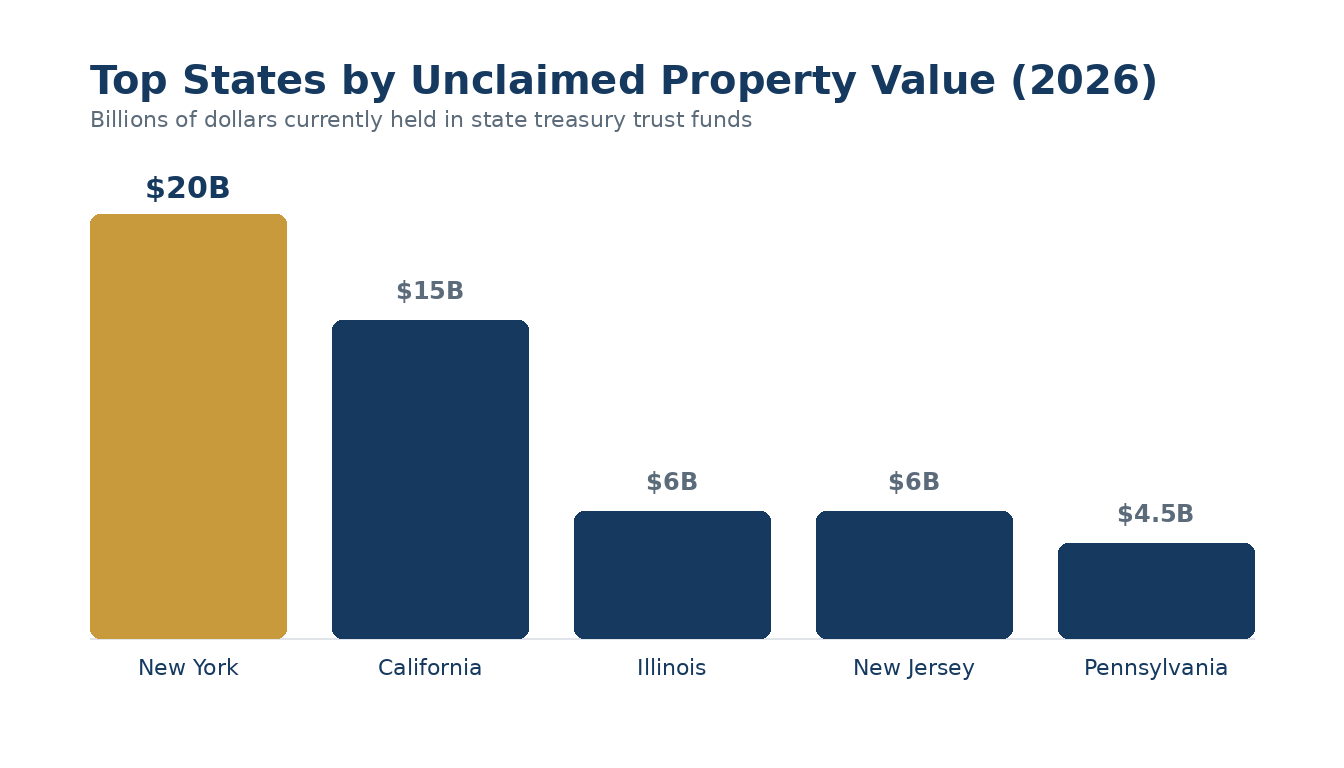
- Total funds held by states have reached record highs in 2026, with New York alone surpassing $20 billion.
The Lifecycle of an Abandoned Asset
Every dollar currently held by state treasuries began as a forgotten balance in a private institution. Whether it was a utility deposit from a college apartment or a savings account opened by a grandparent, the journey from “active” to “unclaimed” is governed by a strict legal process known as escheatment. This process is not immediate; it is triggered by a specific period of inactivity known as the dormancy period.
During this window, the financial institution—be it a bank, insurance company, or former employer—is legally required to attempt to contact you. These “due diligence” efforts usually manifest as a formal letter sent to your last known address. If that letter goes unanswered and the account remains untouched, the holder must package those funds and transfer them to the state’s unclaimed property division. In 2026, these divisions are more active than ever, managing a collective pool of assets exceeding $100 billion nationwide.
For the consumer, the dormancy period is the final warning. Once the clock runs out, your relationship with the bank ends, and your relationship with the state treasury begins. While the state holds these funds in perpetuity for you to claim, you lose the ability to earn interest on many types of accounts once they enter the state’s custody. This makes understanding the specific timelines in your state a critical financial priority.

Comparing State Dormancy Laws and Total Assets (2026 Data)
The following table compiles the most recent 2026 data on dormancy periods for the three most common types of unclaimed property, alongside the current total value of funds held by each state. Note that while most states are moving toward a standard 3-year window for banking, regional variations remain, particularly in the South and Midwest.
| State | Checking/Savings Dormancy | Wages/Payroll Dormancy | Safe Deposit Box Dormancy | Total Funds Held (2026) | Official Search Tool |
|---|---|---|---|---|---|
| New York | 3 Years | 1 Year | 3 Years | $20.0 Billion | NYS Office of Unclaimed Funds |
| California | 3 Years | 1 Year | 3 Years | $15.0 Billion | Search for Unclaimed Property (SCO) |
| New Jersey | 3 Years | 1 Year | 5 Years | $6.0 Billion | Unclaimed Property Administration |
| Illinois | 3 Years | 1 Year | 5 Years | $6.0 Billion | iCash Database |
| Pennsylvania | 3 Years | 1 Year | 3 Years | $4.5 Billion | PA Treasury Search |
| Ohio | 5 Years | 1 Year | 3-5 Years | $4.0 Billion | Ohio Unclaimed Funds |
| Texas | 3 Years | 1 Year | 3 Years | $4.0 Billion | ClaimItTexas.org |
| Massachusetts | 3 Years | 1 Year | 7 Years | $3.4 Billion | FindMassMoney.gov |
| Georgia | 5 Years | 1 Year | 5 Years | $3.3 Billion | Georgia Unclaimed Property Search |
| Florida | 5 Years | 1 Year | 3 Years | $2.0 Billion | FLTreasureHunt.gov |
| Virginia | 3 Years | 1 Year | 5 Years | $2.8 Billion | VA Money Search |
| Michigan | 3 Years | 1 Year | 3 Years | $2.2 Billion | Michigan Unclaimed Property |
| Washington | 3 Years | 1 Year | 5 Years | $1.5 Billion | WA Unclaimed Property |
| Arizona | 3 Years | 1 Year | 3 Years | $1.7 Billion | AZ Department of Revenue |
| Tennessee | 3 Years | 1 Year | 3 Years | $1.2 Billion | ClaimItTN.gov |
Understanding the Data: Why Periods Vary
As seen in the data above, there is a significant movement toward the “3-1-3” or “3-1-5” model. This refers to 3 years for general bank accounts, 1 year for wages, and 3-5 years for safe deposit boxes. Historically, many states utilized a 5-year or even 7-year dormancy period for savings accounts. However, the adoption of the Revised Uniform Unclaimed Property Act (RUUPA) by many state legislatures has accelerated the timeline. The logic is simple: the sooner the money is turned over to the state, the sooner it can be indexed in a searchable public database where the owner might actually find it.
States like Ohio and Florida maintain a 5-year dormancy for banking. In these jurisdictions, your money stays with the private bank longer, but it may also be harder to find because it isn’t listed on the central state portal during that time. If you move frequently, shorter dormancy periods are actually beneficial, as they ensure your forgotten utility deposit from an old apartment appears in a searchable registry faster.
Property Deep Dive: Wages and Payroll
Wages and payroll checks have the shortest dormancy periods across all 50 states, almost universally set at one year. This is because employment income is considered a high-priority asset that people rarely intend to abandon. If a paycheck remains uncashed for 12 months, the employer is legally obligated to escheat those funds. This often happens when an employee leaves a job and moves before their final check or a commission payment is issued.
Because the window is so short, payroll funds make up a massive percentage of “new arrivals” in state databases each year. If you have changed jobs in the last 24 months, searching your state’s database specifically for wages is a high-probability way to find a few hundred dollars. In states with high employee turnover, like California and New York, the volume of unclaimed wages processed annually is staggering.
Safe Deposit Boxes: The Physical Exception
Safe deposit boxes are the only category where the state physically takes possession of items rather than just a digital balance. Because of the logistical burden of drilling, inventorying, and storing physical goods, the dormancy periods for these boxes are often longer than for simple checking accounts. In Massachusetts, for example, the dormancy period extends to seven years.
Once the period expires, the bank drills the box in the presence of a witness and sends the contents to the state treasury. Most states, including New York and Texas, will hold the physical items for a period of 1 to 3 years before selling them at a public auction. The proceeds from the auction are then held in the owner’s name. If you believe a family member had a safe deposit box that was forgotten, you must act before the auction phase to recover the original items, such as jewelry, coins, or heirlooms.

The Due Diligence Requirement: Your Final Warning
Before any of the timelines in the table above can be completed, the holder of the property (the bank or company) must perform “due diligence.” In most states, this is triggered when the property value is $50 or more. The holder must send a letter to the owner’s last known address between 60 and 120 days before the dormancy period ends and the money is sent to the state.
These letters are often mistaken for junk mail or scams. However, a legitimate due diligence letter will clearly state the name of the institution, the account type, and the balance. It will provide a deadline by which you must contact the bank to keep the account active. If you receive such a letter, simply calling the bank or logging into your online portal is usually enough to reset the dormancy clock to zero and stop the escheatment process.
How Interest Rates Affect Your Unclaimed Funds
A critical but often overlooked aspect of dormancy is the cessation of interest. When a savings account or a certificate of deposit (CD) is escheated to the state, it typically stops earning interest. While the state holds the principal for you, the “opportunity cost” of that money sitting in a non-interest-bearing state fund can be significant over several years.
In a high-interest-rate environment, having $10,000 sitting in a state treasury for five years instead of a high-yield savings account could cost the owner thousands of dollars in lost gains. This is why financial experts recommend a “claims sweep” every six months. Even if you don’t think you’ve lost money, checking the database twice a year ensures that if an account is escheated, you recover it before the loss of compound interest becomes a major factor.

Methodology
The data presented in this resource was compiled in August 2026 by auditing the current statutes and official treasury manuals for the 15 most populous U.S. states. Primary sources include the National Association of Unclaimed Property Administrators (NAUPA), the New York State Office of the Comptroller, and the California State Controller’s Office. Total funds held are based on the most recent annual financial reports (CAFR) or public press releases issued by state treasurers for the 2025-2026 fiscal year. Dormancy periods reflect the general standard for each category; specific nuances (such as different rules for credit unions vs. commercial banks) may apply in certain jurisdictions.
Frequently Asked Questions
Can the dormancy period be extended?
No, the dormancy period is set by state law and cannot be extended by the bank or the owner. However, any “owner-generated activity”—such as a login, a deposit, a withdrawal, or even a phone call to customer service—resets the clock back to year zero.
What happens to the money if I never claim it?
In the United States, states hold unclaimed property in perpetuity. This means there is no deadline to claim your funds; the state will hold them forever (or until you or your heirs file a claim). However, physical safe deposit box contents are eventually auctioned, and only the cash proceeds remain available.
Why does my state have a 5-year period while others have 3?
Dormancy periods are a matter of state sovereignty. Some states prefer a longer period to give banks more time to find the owner, while others prefer a shorter period to get the money into a public, searchable database faster. Many states are currently transitioning from 5 to 3 years to align with the RUUPA recommendations.
Are there any types of property that never expire?
Most property types have a dormancy period, but certain assets like traveler’s checks can have dormancy periods as long as 15 years. Conversely, some items like utility deposits or commissions might have very short windows of just 6 to 12 months depending on the state.
For more information on specific state processes, visit our Unclaimed Money by State directory to find your official local portal.
Citations and Official Sources:
1. National Association of Unclaimed Property Administrators (NAUPA): unclaimed.org
2. California State Controller’s Office: sco.ca.gov
3. New York State Office of the State Comptroller: osc.state.ny.us
4. Texas Comptroller of Public Accounts: comptroller.texas.gov
5. Florida Department of Financial Services: fltreasurehunt.gov