

Last updated: July 2026
Figures and program details can change – always verify current details on the official source before acting.
Quick answer
The IRS is currently holding over $1.5 billion in unclaimed tax refunds. Most of this money belongs to people who haven’t filed a return in the last three years or whose checks were undeliverable. You can find your money by using the “Where’s My Refund?” tool on IRS.gov, ordering a tax transcript to see what you’re owed, and filing any missing returns before the strict three-year window expires forever.
Key takeaways
- The IRS typically holds over $1 billion in unclaimed refunds for individuals who failed to file a return.
- You have a strict three-year window to file a past-due return and claim your money.
- If your check was mailed but never arrived, you must update your address using Form 8822.
- The “Where’s My Refund?” tool and the IRS2Go app are the only official digital ways to track current-year payments.
Step 1: Check Your Status with the “Where’s My Refund?” Tool
The first and most direct way to locate an unclaimed tax refund is through the official IRS digital portal. If you filed a return but never received your payment, the “Where’s My Refund?” tool on the IRS.gov website is the authoritative source for your check’s status. To use this tool, you will need three specific pieces of information: your Social Security number or ITIN, your filing status (Single, Married Filing Jointly, etc.), and the exact whole-dollar amount of the refund shown on your return.
It is important to note that this tool usually covers the current tax year and the two previous years. If your check was returned to the IRS by the Post Office because it was undeliverable, the status will often explicitly state that the check was returned and provide instructions on how to update your mailing address. This is the most common reason for “lost” money that was actually processed but never reached the recipient’s hands.
For those who prefer mobile access, the IRS2Go app offers the same functionality. Both the web tool and the app are free to use. You should be wary of any third-party websites that ask for your Social Security number to check your refund status; these are often phishing attempts. Only trust links that end in .gov when dealing with federal tax information.

Step 2: Request an IRS Tax Transcript
If you suspect you are owed money but cannot remember the exact details of your past filings, you should request a tax transcript. A transcript is an official record of your tax account and can show you whether a return was filed, whether a refund was issued, and if any payments were applied to your account that you might have forgotten about. This is especially helpful if you are trying to track down money from two or three years ago.
The IRS offers several types of transcripts. The “Tax Account Transcript” is usually the most useful for finding unclaimed money because it shows any adjustments made after the return was filed, as well as the date a refund check was issued. You can request this online through the “Get Your Tax Record” portal on IRS.gov. You will need to verify your identity through the IRS’s current secure sign-in partner, which as of 2026 requires a high-level identity verification process involving a government ID.
If you cannot access the online portal, you can request a transcript by mail using Form 4506-T. While this takes longer (usually 5 to 10 business days), it is a reliable way to get the data you need without navigating the complex digital ID verification. Once you have the transcript, look for “Refund Issued” codes to see if the government attempted to pay you and if that money is still sitting in their accounts waiting for a valid address.
Step 3: File Your Missing Returns for the Three-Year Window
A massive portion of the $1.5 billion in unclaimed IRS money isn’t from lost checks, but from people who simply never filed a return because they didn’t think they earned enough money. However, even if you weren’t required to file, you may be owed a refund of taxes withheld from your paycheck or be eligible for refundable credits like the Earned Income Tax Credit (EITC).
The IRS provides a strict three-year window to claim these refunds. Under federal law, if you do not file a return within three years of the original filing deadline, the money becomes the property of the U.S. Treasury. For example, to claim a refund for the 2022 tax year (filed in 2023), you must generally file that return by the April deadline in 2026. If you miss that window, the money is gone forever, unlike state unclaimed property which is often held indefinitely.
To claim this money, you must physically mail a paper return (Form 1040) for the specific year in question. You cannot e-file most prior-year returns through standard consumer software. You will need to find the specific forms and instructions for the year you are filing, as tax laws and credit amounts change every year. Make sure you have your W-2s or 1099s for that year; if you lost them, your tax transcript (mentioned in Step 2) will provide the income data you need to fill out the form.

Step 4: Update Your Address with Form 8822
If the IRS has a check for you that was returned by the Post Office, they won’t just keep trying to mail it to the same old address. You must officially notify them of where you are now. While you can update your address when you file your next tax return, the fastest way to trigger a re-issuance of a lost check is to file Form 8822, Change of Address.
This is a simple, one-page form that you mail to the IRS office designated for your state. Once processed, the IRS systems will update, and if there is an undelivered refund associated with your Social Security number, the system will often automatically trigger a new check to be mailed to your new location. This process is much more reliable than simply relying on a mail forwarder, which often expires before the IRS processes your data.
If you have moved multiple times, it is worth filing this form even if you aren’t 100% sure a check is waiting for you. This ensures that any future correspondence or surprise refunds reach you. As we’ve seen with federal funds like unclaimed savings bonds, maintaining an accurate address with the Treasury Department is the single best way to ensure you receive what you are owed.

The Scale of Unclaimed Federal Tax Money
The amount of money the IRS holds in unclaimed refunds is staggering. Every year, the agency releases a report detailing how much money is about to expire under the three-year rule. In recent years, this total has consistently exceeded $1 billion, with the median refund sitting at nearly $900 per person. This is not “free money” in the sense of a grant; it is your own money that was over-withheld from your paychecks throughout the year.
Many people fail to claim this money because they are afraid that filing a late return will trigger an audit or result in heavy penalties. However, the IRS generally does not penalize taxpayers for filing late if they are owed a refund. Penalties are typically based on a percentage of the tax owed; if you owe $0 or are owed money by the government, there is usually no financial penalty for filing after the deadline—though you do risk losing the money entirely if you wait longer than three years.
The pool of unclaimed money also includes undelivered “Economic Impact Payments” or other stimulus credits that may have been authorized during specific economic cycles. If these were issued as tax credits but never claimed on a return, they follow the same three-year expiration rule as a standard refund. Checking your transcripts is the only way to ensure you haven’t left these significant sums on the table.
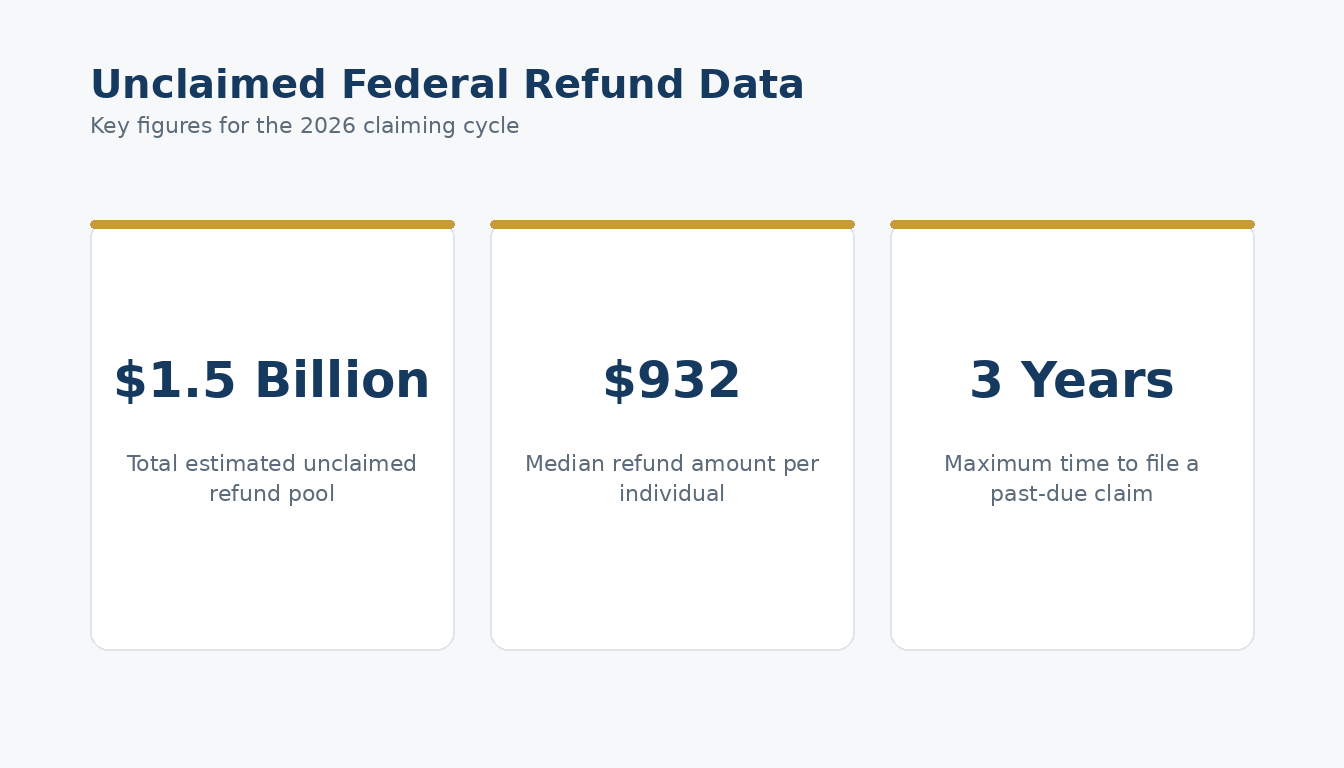
As shown in the data above, the opportunity to claim these funds is significant, but the window of time is remarkably short compared to other types of unclaimed property. While a bank account might sit in a state’s unclaimed property office for decades, the IRS effectively “seizes” unclaimed refunds back into the general treasury fund after 36 months of inactivity.
Common Mistakes When Claiming IRS Refunds
One of the biggest mistakes taxpayers make is searching state-level databases for federal tax refunds. State unclaimed property offices, which we cover in guides like our general guide to finding unclaimed money, do not hold federal IRS funds. If you search a state portal and find “Tax Refund” money, that is likely for a state income tax refund, not the federal one. You must use IRS-specific tools for federal money.
Another common error is failing to sign the return. If you file a prior-year paper return to claim an old refund but forget to sign it, the IRS will not process it. By the time they mail it back to you for a signature, your three-year window may have already closed. Always double-check that you have signed and dated the bottom of the Form 1040 and attached copies of your W-2s to the front of the return.
| Action | Purpose | Requirement |
|---|---|---|
| IRS “Where’s My Refund?” | Track a check you already filed for | SSN, Status, Amount |
| Tax Transcript | See if you are owed money from the past | Identity Verification (ID.me) |
| Form 8822 | Fix an undeliverable check issue | New Address Details |
| Form 1040 (Prior Year) | Claim money you never filed for | W-2s or 1099s |
Avoiding Refund Scams
The IRS does not initiate contact with taxpayers by email, text messages, or social media channels to request personal or financial information. This includes “notifying” you of an unclaimed refund. If you receive a text message with a link claiming you have a $1,200 refund waiting, it is a scam designed to steal your Social Security number and bank account details.
Official notification of an undelivered refund or a missing return will always come via a physical letter sent through the U.S. Postal Service. If you are unsure if a letter is real, you can verify it by calling the official IRS customer service line or by checking your tax account online at IRS.gov. Never provide your banking information to someone who calls you claiming to be from the IRS; the government already has the ability to issue a paper check if they don’t have your direct deposit info on file.
Be particularly careful with “refund recovery” services that charge a high percentage of your refund to find it for you. These services are often unnecessary because the tools provided by the IRS are free. As long as you have your identification and past income records, you can perform the search and file the claim yourself for the cost of a postage stamp.
Frequently Asked Questions
How long does it take to get an unclaimed refund?
If you are claiming an undelivered check by updating your address, it usually takes 4 to 6 weeks. If you are filing a paper return for a prior year, it can take 6 to 12 weeks for the IRS to process the manual filing and issue your payment.
Can I get my refund via direct deposit for an old return?
Generally, no. For returns filed after the original deadline (especially paper returns for prior years), the IRS typically issues a physical check by mail to ensure the security of the payment. This is why having a current address on file via Form 8822 is so vital.
What happens if I miss the three-year deadline?
Once the three-year statute of limitations expires, the law prevents the IRS from issuing a refund check or applying the credit to another year’s tax bill. The money is legally forfeited to the U.S. Government and cannot be recovered through any appeal process.
Do I have to pay taxes on my unclaimed refund?
No, the refund itself is not taxable income because it is a return of money you already earned and paid taxes on. However, if the IRS pays you interest on a delayed refund, that interest amount is considered taxable income and must be reported on your next tax return.
Official Source Links:
IRS: Where’s My Refund? Official Tool
IRS: Get Your Tax Record (Transcripts)
IRS: About Form 8822, Change of Address