
Last updated: August 2026
Figures and program details can change – always verify current details on the official source before acting.
Quick answer
In August 2026, the Federal Trade Commission (FTC) and other agencies are distributing over $1.5 billion in unclaimed class action and consumer protection refunds. Key payouts hitting mailboxes now include the Amazon Prime settlement, the Golden Home Services mortgage relief fund, and the Cash App security breach distribution. Most of these funds can be searched and claimed for free via the official FTC Refund Dashboard or the CFPB Civil Penalty Fund portal.
Key takeaways
- The FTC is currently processing active refunds for cases including Amazon Prime, Ring, and multiple credit repair scams.
- Federal settlement money is separate from state unclaimed property; you must check specific agency portals like FTC.gov and SEC.gov.
- Most 2026 settlement payouts are automatic for identified victims, but millions remain unclaimed by people who changed addresses.
- Beware of ‘settlement recovery’ firms that charge a fee; official government refunds are always distributed free of charge.
The August 2026 Settlement Wave: What is Paying Out Now?
If you have recently opened your mailbox to find a check for a few hundred dollars from an agency you don’t recognize, you aren’t alone. August 2026 marks one of the largest distribution periods for federal consumer protection settlements in recent years. As of this month, the Federal Trade Commission (FTC) has confirmed active refund cycles for victims of several high-profile scams and deceptive practices.
Notable among these is the massive $1.5 billion Amazon Prime refund program. While automatic payments were issued to many in late 2025, the claims process for those who were missed is currently entering its final payout phase for 2026. Additionally, recent news from June and July 2026 confirmed that distributions have begun for victims of the American Financial Benefits Center student loan scheme and the Golden Home Services mortgage relief scam.
Unlike state-held property, which often consists of forgotten bank accounts, these federal funds are the result of direct legal action against companies. Because these agencies often struggle to find current addresses for everyone impacted, billions of dollars sit in “distribution funds” waiting for a claimant to step forward and verify their identity.
How the FTC Refund Process Works in 2026
The FTC does not just collect fines to fund the government; their primary mission in these cases is to return money to scammed consumers. When a company settles a lawsuit, the money is typically handed over to a “Refund Administrator”—a third-party company hired by the government to handle the thousands of individual checks or digital payments.
In 2026, the FTC has streamlined this by using an interactive FTC Refund Dashboard. This tool allows you to see every active case where money is currently being sent. For example, the “Trend Deploy” and “Handy Technologies” settlements both saw new batches of checks issued in July and August 2026. If you believe you were a customer of a company listed on the dashboard, you can contact the specific administrator listed to update your contact information.
It is important to note that you never have to pay a fee to receive these funds. If a website asks for a “processing fee” or a percentage of your settlement, you are looking at a scam. Official administrators are paid by the settlement fund itself, not the victims.
The Three Major Federal Payout Pools You Should Check
While the FTC is the most famous source of settlement money, it is not the only one. Depending on the nature of the company that wronged you—whether it was a bank, a stockbroker, or a retail giant—your money could be sitting in one of three distinct federal repositories. In 2026, these pools combined hold more than $2 billion in distributable assets.
The Consumer Financial Protection Bureau (CFPB) maintains the Civil Penalty Fund. This is where money goes when a bank or credit card company is caught breaking the law but cannot easily identify all the victims. As of mid-2026, the CFPB is actively distributing funds to victims of the Cash App security breach and several payday lending schemes. Their official Payments to Harmed Consumers page is updated monthly.
Thirdly, the Securities and Exchange Commission (SEC) manages “Fair Funds.” These are specifically for investors who lost money due to market manipulation or corporate fraud. If you held shares in a company that was recently hit with an SEC enforcement action, you may be eligible for a pro-rata share of the recovery. This is particularly relevant for those who may already be searching for unclaimed pensions or 401(k) assets.
| Agency | Primary Target | Search Portal | Typical Payout Type |
|---|---|---|---|
| FTC | Scams & Deceptive Retail | FTC.gov/refunds | Paper Check / PayPal / Zelle |
| CFPB | Banks & Lending | ConsumerFinance.gov | Direct Deposit / Check |
| SEC | Investment Fraud | SEC.gov (Fair Funds) | Account Credit / Check |
Step-by-Step: Searching the Official Settlement Databases
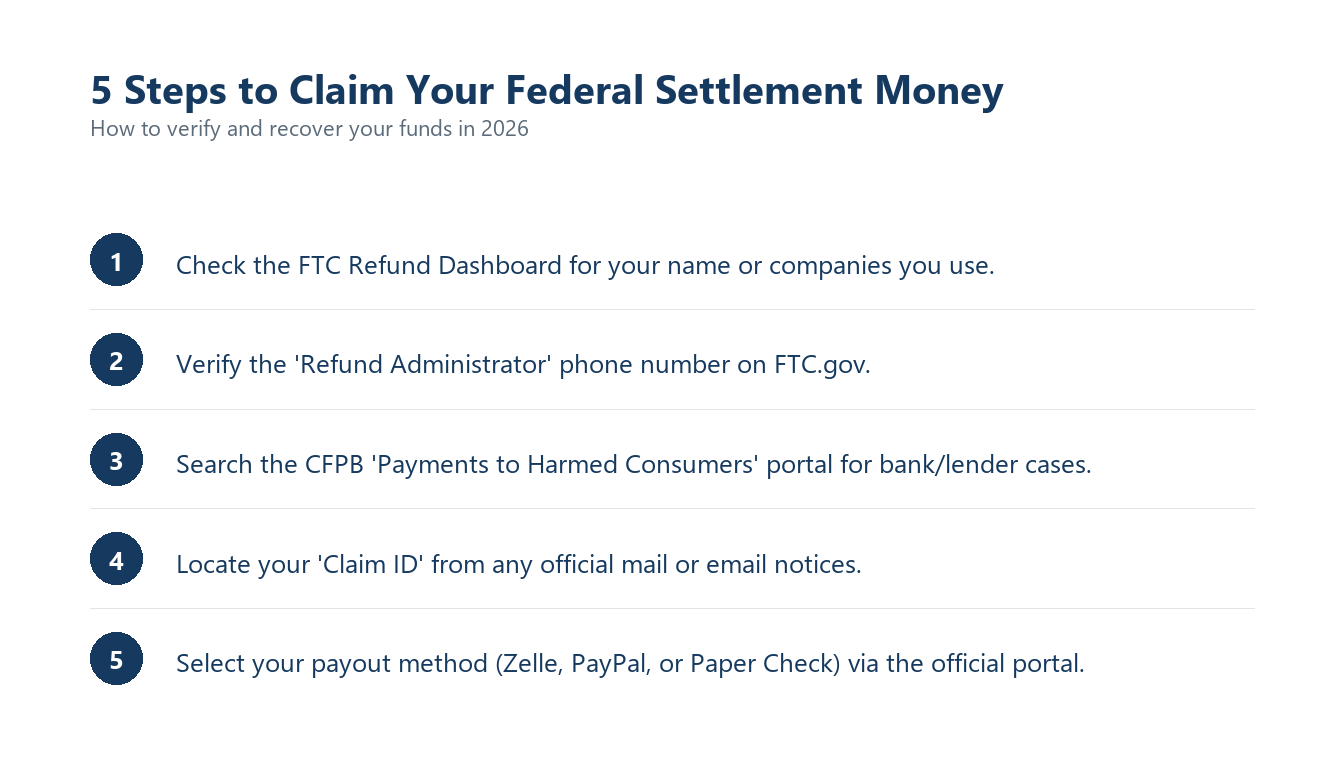
Unlike searching for your state’s unclaimed property, finding settlement money requires a bit more targeted effort because there is no single “Master Search” for all class actions. However, you can cover 90% of the possibilities by following these three steps in 2026.
First, visit the FTC Refund Dashboard and look for any companies you have done business with in the last five years. Cases like the Publishers Clearing House refund or the Ring privacy settlement have long payout tails that extend into 2026. If you find a match, look for the “Refund Administrator” name and phone number provided on the official page.
Second, check the CFPB’s list of active redress funds. In 2026, the CFPB reported that over $3.7 billion has been allocated for victim compensation since the fund’s inception. Even if you didn’t file a claim, some of these payouts are automatic based on bank records. If your address has changed, the check may be sitting in their “undeliverable” pile.
Finally, check your email for notices from names like JND Legal Administration, Rust Consulting, or Epiq Systems. These are the three most common firms hired by the government to handle these payouts. In August 2026, many of these firms are sending out digital payment links via Zelle to speed up the distribution of smaller $10 to $50 refunds.

Myth vs. Reality: The Truth About Settlement Checks
There are several dangerous myths circulating on social media in 2026 regarding “free government grants” and “class action windfalls.” It is vital to separate the real legal recovery process from the viral scams trying to harvest your data.
Myth: You need a receipt for every purchase to join a class action.
Reality: In 2026, many settlements—especially for retail products like the Sealy bedding or Beef price-fixing cases—allow for “no proof needed” claims up to a certain dollar amount. The court recognizes that most people don’t keep grocery receipts for years, so you can often file a claim based on a sworn statement under penalty of perjury.
Myth: If you missed the filing deadline, the money is gone forever.
Reality: While this is true for most private class actions, it is not always true for FTC or CFPB refunds. If the government has a surplus of funds after the initial claim period, they often run a second round of distributions or attempt to find more victims automatically. This is why checking the “Active Programs” list in August 2026 is so valuable; you might find a case that you thought was closed but is actually in a secondary payout phase.
Myth: Settlement checks are taxable income.
Reality: Generally, if the settlement is for a physical loss or a refund of money you already spent, it is not considered taxable income by the IRS. However, if the settlement includes interest or “punitive damages,” that portion may be taxable. If you are receiving a large check, such as from the IRS unclaimed refund pool or a major litigation settlement, always consult a tax professional.
Avoiding the ‘Settlement Recovery’ Scams of 2026
As settlement totals hit record highs in 2026, so do the scams. Fraudsters are now using AI to generate official-looking letters that claim you are owed thousands of dollars from a “Global Settlement Fund.” These letters often look more professional than the real ones, but they always have one major red flag: they ask for money upfront.
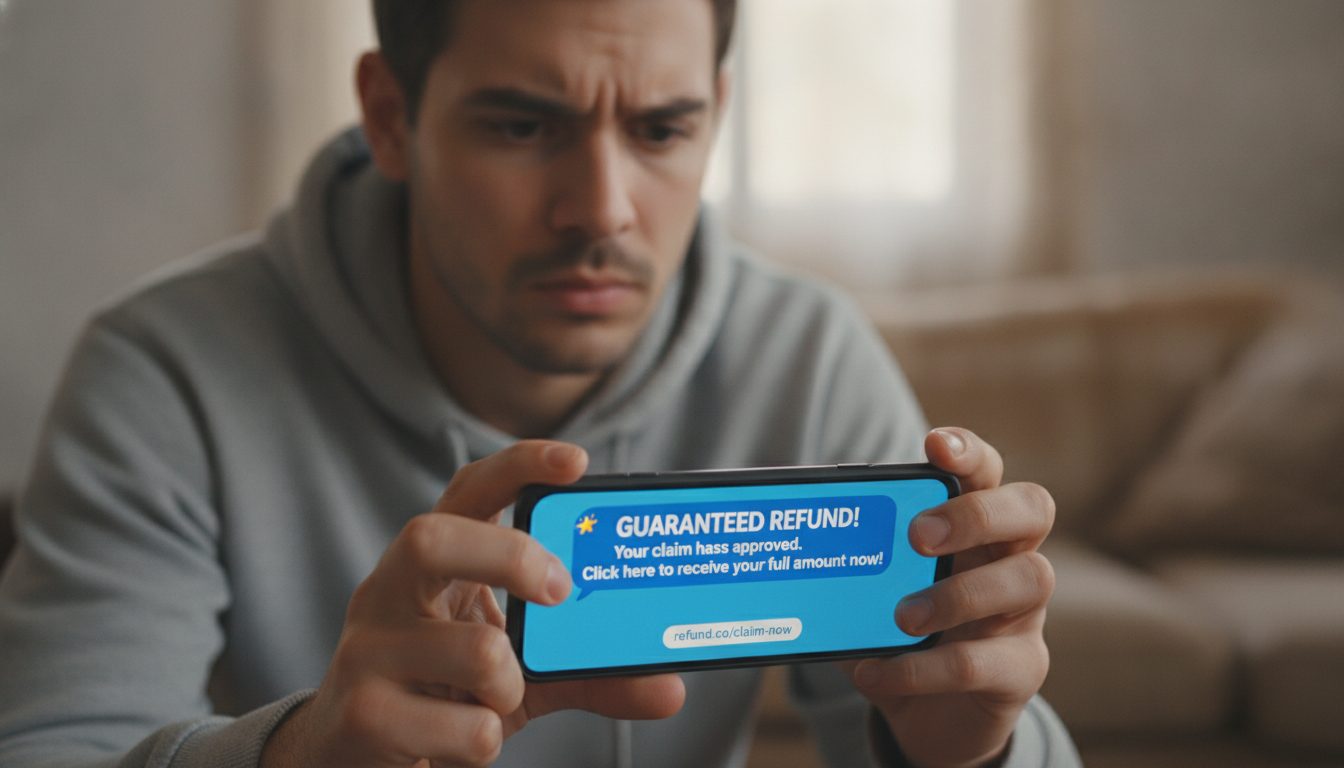
The FTC issued a specific warning in July 2026 regarding impersonators who call or text claiming to be from the “Settlement Payout Department.” These scammers may even know that you were a customer of a specific company (like Amazon or Cash App) because they buy data from breaches. They will tell you that to “verify your account,” you need to send a small fee via a gift card or cryptocurrency.
Real government agencies will never ask for payment to release a refund. They will also never ask for your full Social Security number over the phone. Most legitimate claim forms will be hosted on secure .gov websites or verified administrator domains (like .com/settlement). If you are unsure, go directly to the official agency site rather than clicking a link in a text message.
Common Documentation Needed for Large Payouts
While small “no-proof” claims are easy, larger settlements (often those over $2,500) will require more rigorous verification in 2026. This is especially true for the new round of data breach settlements where “out-of-pocket losses” are being reimbursed.
If you are claiming significant damages—such as for identity theft expenses related to a breach—be prepared to provide copies of bank statements showing the unauthorized charges, police reports, or credit monitoring bills. The 2026 Cash App settlement, for example, allows for up to $2,500 in documented losses, but only if you provide clear evidence of the financial harm.
For most people, however, the only “documentation” needed is an updated address or a valid email for a Zelle/PayPal transfer. In 2026, the move toward digital payouts has significantly reduced the amount of physical paperwork involved, but it has increased the importance of keeping your contact info current with the agencies mentioned above.
Unclaimed Settlement FAQ
How do I know if an FTC refund check is real?
Real FTC refund checks are sent by a designated administrator and will always include a clear case name and a phone number for the administrator. You can verify the case and the administrator’s name by visiting the official FTC.gov/refunds dashboard. If the check asks you to pay a fee to cash it, it is a scam.
Can I search for settlement money for a deceased relative?
Yes, legal heirs can generally claim settlement refunds owed to a deceased family member. You will typically need to provide a death certificate and proof of your status as the executor or legal heir. Contact the specific refund administrator for the case to find out their requirements for ‘Estate Claims.’
How long does it take to get a settlement payout?
The timeline varies wildly by case. After a settlement is finalized, the “claims period” usually lasts 90-180 days. Once that closes, the administrator must verify all claims, which can take another 6-12 months. In 2026, many programs are using Zelle or PayPal to issue payments within 30 days of final approval.
What is the ‘Civil Penalty Fund’ vs a Class Action?
A private class action is a lawsuit brought by individuals and their lawyers. The Civil Penalty Fund is a government-managed pot of money (run by the CFPB) that comes from fines paid by banks and lenders. The government uses this fund specifically to pay back consumers who were harmed by those companies, even if no private lawsuit was ever filed.