
Last updated: August 2026
Figures and program details can change – always verify current details on the official source before acting.
Quick answer
Unclaimed utility deposits and credit balances are among the most common types of forgotten money, often left behind when residents move without updating their forwarding address. In August 2026, state treasuries are holding billions in these funds, with many states like West Virginia and Wisconsin requiring companies to turn over utility refunds after just one year of dormancy. To claim your share, you must search the official unclaimed property database for every state where you have previously held an account for electricity, gas, water, or telecom services.
Key takeaways
- Moving is the primary cause of lost utility money, as final bills often result in small credit balances that go unmailed.
- Utility dormancy periods are often shorter (1-3 years) than bank accounts (3-5 years), meaning your money reaches the state faster.
- Municipal utilities often maintain their own internal “unclaimed funds” lists before the money is escheated to the state.
- Official state searches are always free; avoid any “finder” services that demand an upfront fee or a percentage of your utility refund.
As the August 2026 moving season hits its peak, millions of Americans are packing boxes and transferring services. However, the chaos of moving day often leads to a multi-billion dollar oversight: the forgotten utility deposit. Whether it is a security deposit paid to an electric company years ago or a credit balance from a final water bill that never found your new mailbox, these funds are legally required to be returned to you.
According to the National Association of Unclaimed Property Administrators (NAUPA), approximately 1 in 7 people in the United States have unclaimed property waiting for them. Utility refunds are a massive slice of that pie. Because utility companies lose contact with customers at a higher rate than banks, this money often flows into state coffers much faster than other asset types.
| State | Utility Refund Dormancy | Utility Deposit Dormancy | Typical Payout Time |
|---|---|---|---|
| West Virginia | 1 Year | 1 Year | 30-60 Days |
| Wisconsin | 1 Year | 1 Year | 45-90 Days |
| Texas | 3 Years | 3 Years | 90-120 Days |
| California | 3 Years | 3 Years | Varies (60+ Days) |
| Ohio | 1 Year | 1 Year | Up to 120 Days |
The ‘Moving Day’ Gap: Why Utility Money Goes Missing
The vast majority of unclaimed utility money is created the moment a customer stops service. When you close an account, the utility company calculates your final usage against your last payment. If you were on a “budget billing” plan or had a credit balance from a previous overpayment, your final bill might actually show that the company owes you money. This often happens because budget billing averages your costs over 12 months; if you move out during a season where your actual usage was lower than your average payment, you are legally entitled to the difference.
The process of “escheatment” is what moves this money from the utility company’s books to the state treasury. If the company does not have your new forwarding address, they will mail the check to your old home. When the check is returned as undeliverable, or if it sits uncashed for a specific period (the “dormancy period”), the company cannot simply keep it. By law, they must turn those funds over to the state’s unclaimed property division. In states like West Virginia and Wisconsin, this happens after just 12 months of no contact, which is significantly faster than the three-to-five-year window typically seen for savings accounts or life insurance policies.
Furthermore, many consumers forget about the initial security deposit they paid when they first established service. If you had poor credit or were a first-time renter when you opened the account, you likely paid anywhere from $50 to $300 as a safety net for the provider. If that account remained active for a decade, that deposit might have stayed on the books, forgotten, until the day you moved out. If the utility company couldn’t find you to return it, that deposit is now sitting in a state vault.
Municipal vs. Private Utilities: The Search Strategy
One of the most common mistakes claimants make is searching only the state database. While most private utility companies (like PG&E, Duke Energy, or AT&T) are required to report to the state, many municipal utilities—those run by a city or county—operate under different rules. They may hold the money in a local “unclaimed funds” database for several years before sending it to the state treasury. This is particularly common in “Home Rule” states where local governments have broader autonomy over their financial reporting.
For example, CPS Energy in San Antonio, Texas, maintains its own searchable database for unclaimed funds. Similarly, major entities like the Los Angeles Department of Water and Power (LADWP) or Seattle City Light often have internal lists that pre-date their official reports to the State Controller. If you lived in a city with a municipal utility, you should check the city’s official website or the utility’s own “unclaimed funds” page in addition to the state portal. This “double-check” method is often the only way to find money that hasn’t yet been officially escheated to the state.
Another layer to consider is the Rural Electric Cooperative (REC). These are member-owned organizations rather than investor-owned utilities. RECs often issue “Capital Credits” (also known as patronage capital). When the cooperative earns more revenue than it needs for operations, it allocates the excess to its members. If you move away and don’t provide a new address, those capital credit checks go uncashed. Many cooperatives keep these funds locally for a set period before the state law requires them to hand them over, making a direct search of the co-op’s website essential for anyone who has lived in a rural area.
As California State Controller Malia Cohen stated during the 2026 Unclaimed Property Month outreach, “taking a few minutes to visit claimit.ca.gov could mean reconnecting you or your loved ones with money that’s rightfully yours.” This sentiment applies nationwide: the effort required is minimal compared to the potential payout, especially when you factor in both state and local resources.
Telecom and Cable Refunds: The Hidden Giants of Unclaimed Property
While gas and electric companies are the most common sources, the telecom sector accounts for a massive volume of individual claims. In 2026, the churn rate in the mobile phone and high-speed internet industries remains high. When customers switch carriers to take advantage of a new promotion, they often leave behind small credits or equipment deposits.
Cable and satellite providers are notorious for requiring deposits on hardware like DVRs, modems, and routers. If you returned your equipment but the company’s automated system failed to trigger the refund of your deposit, that money eventually becomes unclaimed property. Additionally, telecom companies are frequently involved in regulatory settlements. If a state utility commission finds that a provider overcharged customers for a specific fee, the provider is ordered to issue refunds. If you have already closed your account by the time the settlement is finalized, that refund check will likely end up with the state treasurer.
Don’t overlook defunct providers. Even if your old internet provider was bought out by a larger conglomerate five years ago, the unclaimed funds associated with your old account must still be reported. The reporting is typically done under the name of the entity that held the contract at the time the money became dormant, though some states will cross-reference the names of the current parent company.
How to Search for Unclaimed Utility Deposits in 2026
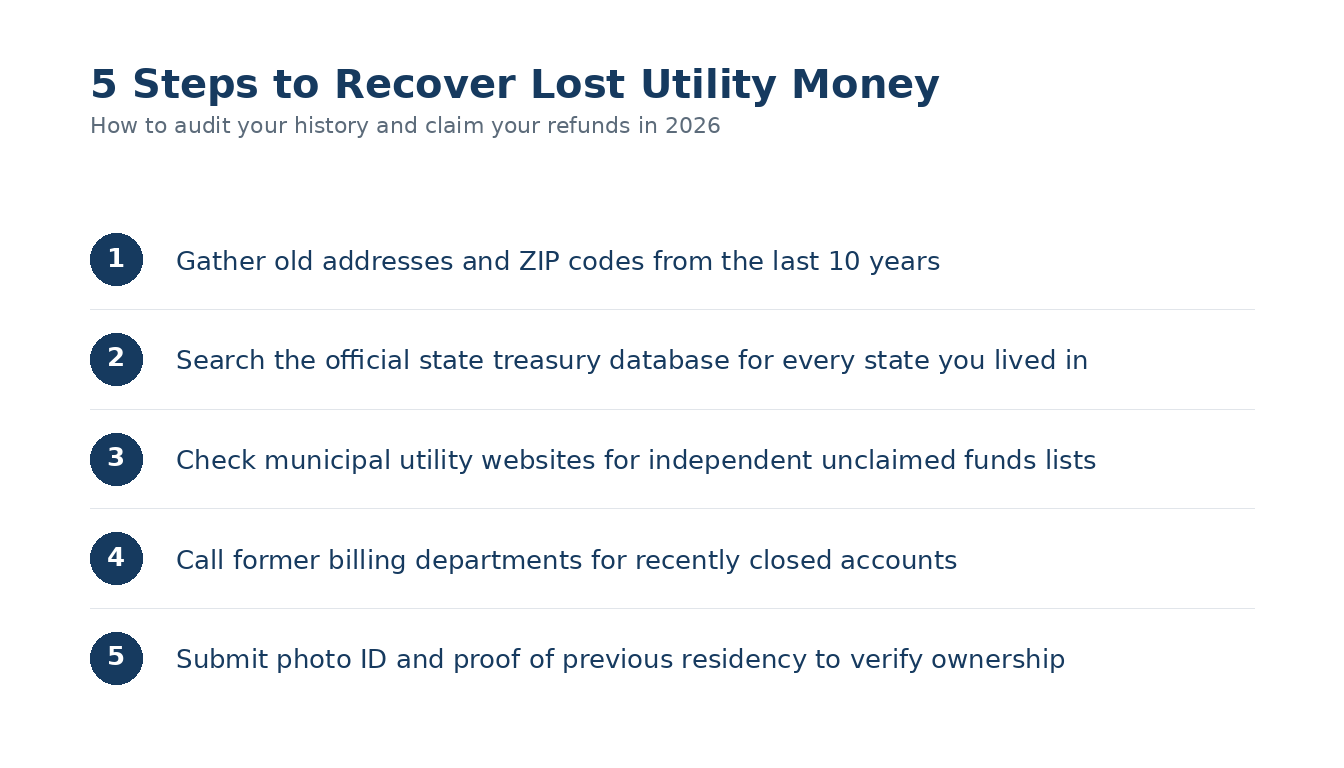
Searching for utility money is a three-tier process. Because these assets are often tied to specific physical addresses, you should gather a list of every ZIP code where you have resided over the last decade before you begin. It is also helpful to have the names of any roommates or spouses you may have shared accounts with.
- Search the National Database: Start at Unclaimed.org, the official portal of the National Association of State Treasurers. This site will direct you to the official, free search tools for every state. For a multi-state search, MissingMoney.com is the NAUPA-sponsored site that aggregates data from most (but not all) states.
- Check Every Prior State: Do not just search your current state. If you moved from Ohio to Florida three years ago, your forgotten Duke Energy refund is sitting in the Ohio Department of Commerce’s database, not Florida’s. You must search the state where the service was provided.
- Verify Local Utilities: For city-owned water or electric services, search the name of the utility plus the words “unclaimed funds” or “unclaimed property” on Google. Ensure the result is a .gov or the utility’s official .com site. If you worked from home or ran a small business, be sure to search for your business name as well, as commercial utility deposits are often larger than residential ones.
During a recent 2026 audit, the Ohio Department of Commerce reported discovering more than $675,000 in missing money during a single outreach event at the Ohio State Fair. Much of this consisted of small utility-related checks and uncashed dividends that residents had simply forgotten existed. This highlights the importance of checking regularly—even if you’ve searched in the past, new properties are escheated every single year.
Common Mistakes That Trip Up Claimants
Many people assume they are not owed utility money because they don’t remember paying a security deposit. This is a common misconception. Utility refunds often come from “over-accruals” on budget billing plans, where your estimated payments exceeded your actual usage. Another source is “retail credits” or “telecom refunds” resulting from class-action settlements or regulatory fines that were automatically credited to old, closed accounts. These credits can range from a few dollars to several hundred, but they are all legally yours.
Another frequent error is searching only under your current legal name. If you have married, divorced, or changed your name for any reason, you must search under every previous name. Utility accounts are often the last things to be updated during a major life transition, making them prime candidates for being lost under a maiden name. Similarly, if you lived with roommates and the account was in their name, the money belongs to them—but if your name was on the account as a secondary user, it’s worth checking both names. In some states, if both names were on the account, either party can claim the full amount, provided they can show proof of residence.
Finally, don’t ignore “common name” issues. If your name is Robert Smith, a state database might return hundreds of results. Do not be discouraged. Most 2026 search engines allow you to filter by city or ZIP code. Even if the database says “Amount Undisclosed,” the associated address will usually be partially visible (e.g., “12** Main St”), allowing you to identify which record belongs to you.
The Documentation You Will Need to File a Claim
Once you find a match in a state database, you must prove you are the rightful owner. For utility deposits, this can be slightly more complex than a bank account because you may no longer have a copy of a bill from ten years ago. However, most states accept a variety of secondary evidence for 2026 claims.
- Proof of Identity: A clear copy of your current driver’s license, passport, or state-issued ID. Digital uploads are now the standard for most state portals.
- Proof of SSN: Usually just the last four digits are required for the initial search, though higher-value claims (typically those over $100 or $500) may require a redacted tax document or a W-2 to verify the full number.
- Proof of Address: This is the “missing link” for utility claims. If you don’t have an old bill, you can use a past tax return, a credit report showing the old address in your credit history, or even a voter registration record. Some states even allow for a “notarized affidavit of residence” if no paper trail exists. If you are claiming a refund for a property you once owned, a copy of the deed or a property tax statement is excellent proof.
If the claim is for a very small amount (often under $50), some states have implemented an “expedited” or “fast-track” process in 2026. These systems use third-party identity verification services (similar to those used by credit bureaus) to ask you a series of multiple-choice questions about your past. If you answer correctly, the state may waive the requirement for physical documentation and issue the payment electronically.

2026 Scam Warning: How to Protect Your Data
The increase in unclaimed property awareness has unfortunately led to a rise in “finder” scams. In August 2026, many residents have reported receiving texts or emails claiming they have a “pending utility rebate” that requires them to click a link and provide their banking credentials. These messages often use high-pressure language, suggesting that the money will be “forfeited to the government” if not claimed within 24 hours.
The Texas Comptroller’s office has issued a specific warning regarding these tactics, stating that their office “will never text or call requesting your online banking credentials, secure access code or any other personally identifiable information for any reason.” If you receive a communication asking for a fee to “release” your utility refund, it is a scam. Official state claims are always free. While some states allow “certified finders” to operate, these individuals are legally capped on the percentage they can charge (usually 10-15%) and they can only collect after you receive your money. They should never ask for an upfront fee or your Social Security number over the phone. Any check will be mailed directly to you from the State Treasury or, in rare cases, sent via an official state-authorized electronic payment system—never via a third-party link in a text message.
Frequently Asked Questions
What happens if the utility company has gone out of business?
If a utility company or telecom provider merged or went bankrupt, they were still required to turn over unclaimed funds to the state before closing their books. During a merger, the acquiring company (e.g., a smaller regional provider being bought by a national giant) takes on the legal responsibility of reporting those funds. You do not need to contact the defunct company; you only need to search the unclaimed property database of the state where they provided you service. The record will often list the original company name, making it easier to identify.
How long do I have to claim a utility refund?
In almost every state, there is no deadline to claim funds once they have been turned over to the state treasury. They will hold the money in perpetuity until you or your heirs come forward. This is a principle known as “custodial escheat,” meaning the state acts as a permanent guardian of the funds. However, it is better to claim it sooner, as some states stop paying interest on certain types of accounts once they reach the state level, and the purchasing power of that $100 deposit will only decrease over time due to inflation.
Can I claim a utility deposit for a deceased relative?
Yes. If you are the legal heir or the executor of the estate, you can claim the funds. This is a common occurrence during the probate process or when children are settling the affairs of their parents. You will typically need to provide a death certificate and documentation proving your legal right to the estate, such as probate court documents, a will, or a small estate affidavit. If the relative died many years ago, the state may require proof that you are the rightful descendant through birth certificates or marriage licenses.
Why is my refund amount listed as “Under $50” or “Unknown”?
Many state databases do not show the exact dollar amount for privacy and security reasons. This prevents scammers from targeting high-value accounts and protects the privacy of the owner. In some cases, the “Unknown” status occurs because the utility company reported a bulk sum of small credits without individual breakdowns, which the state then has to verify. You will only see the exact amount once your claim has been verified and approved for payment. Don’t let a small or “unknown” label stop you; multiple small claims from different states can quickly add up to a significant sum.