
Last updated: August 2026
Figures and program details can change – always verify current details on the official source before acting.
Quick answer
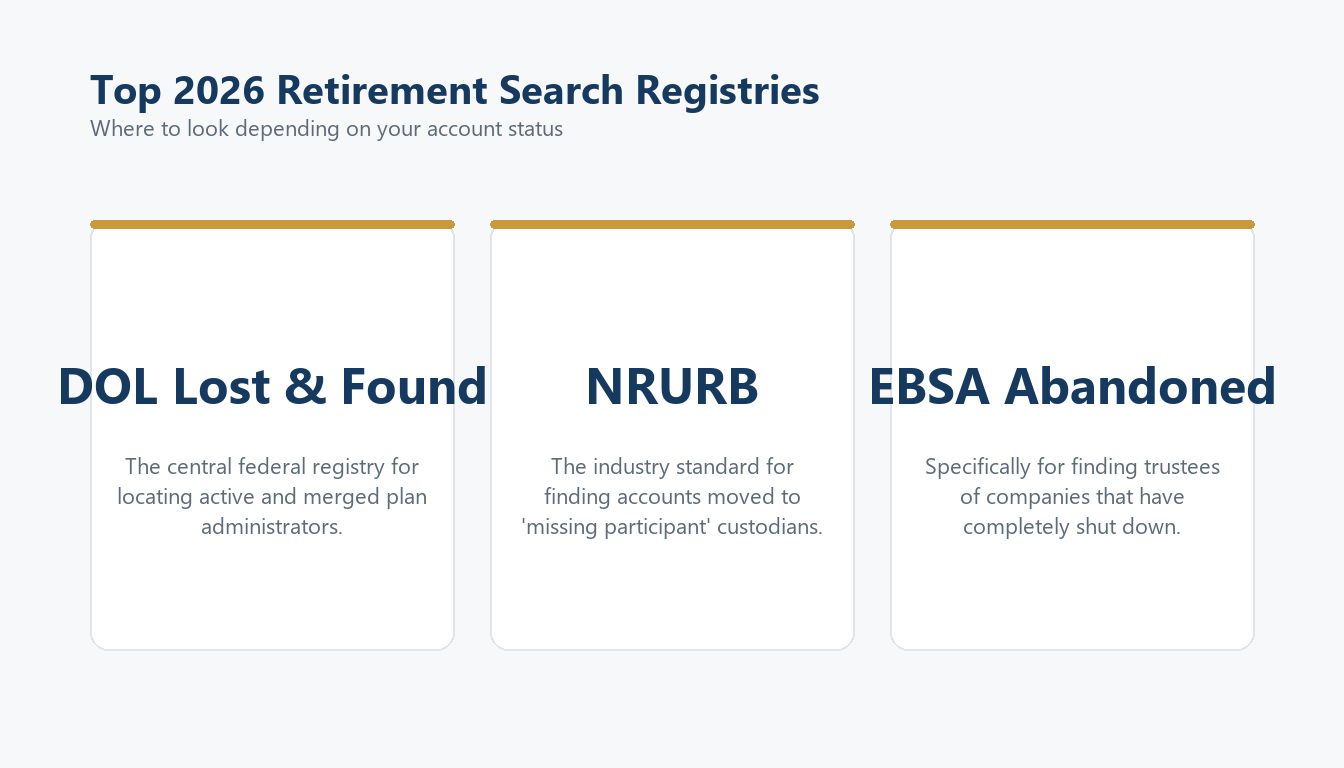
As of 2026, the Department of Labor has fully launched the ‘Retirement Savings Lost and Found’ database, a central federal registry mandated by the SECURE 2.0 Act to help workers locate forgotten 401(k) accounts. If you have ever left a job with a balance under $7,000, your funds were likely moved to a ‘missing participant’ custodian like Inspira Financial or PenChecks. You can recover these assets by auditing your career history and searching the official DOL Abandoned Plan database or the National Registry of Unclaimed Retirement Benefits (NRURB).
Key takeaways
- The SECURE 2.0 Act’s ‘Lost and Found’ database is now the primary tool for locating 401(k)s from former employers.
- Accounts under $7,000 are often ‘force-distributed’ into auto-rollover IRAs, which do not appear in standard state unclaimed property searches.
- If your former employer went out of business, the Department of Labor’s Abandoned Plan database can help you find the court-appointed trustee holding your money.
- Always search the NRURB and private custodians like Inspira Financial, which hold millions in ‘missing participant’ accounts.
The 2026 Retirement Audit: Why Your 401(k) Isn’t Where You Left It
In the modern workforce, the average American changes jobs every 4.2 years. This mobility has created a multi-billion dollar problem: ‘orphan’ 401(k) accounts. When you leave a company, your retirement savings don’t always stay in the original plan, and they almost never follow you automatically to your next employer. Instead, they enter a complex ecosystem of custodians, trustees, and third-party administrators who may have lost your contact information years ago.
As of August 2026, the Department of Labor estimates that billions of dollars remain in abandoned or forgotten 401(k) plans. This isn’t just due to forgetfulness; it is a byproduct of corporate consolidation. When Company A buys Company B, the 401(k) plan is often merged. If you worked for Company B twenty years ago, your records might not have transitioned perfectly to Company A’s new digital portal. Unlike a lost utility deposit or an uncashed paycheck, these funds rarely end up in a state’s treasury department. Instead, they sit in private ‘missing participant’ accounts or with third-party custodians, shielded from standard unclaimed property searches by federal ERISA (Employee Retirement Income Security Act) protections.
This guide provides a systematic audit of your career history. By using the newly matured federal tools and the private registries that handle ‘force-out’ distributions, you can reclaim retirement assets that may have been growing (or losing value to fees) for decades. This is particularly urgent in 2026, as inflation and rising administrative fees can slowly erode the purchasing power of accounts that sit in low-yield ‘safe harbor’ investments.
Step 1: The Federal ‘Lost and Found’ and the Abandoned Plan Search
The most significant development for retirement claimants in 2026 is the full implementation of the ‘Retirement Savings Lost and Found’ database. Established under Section 303 of the SECURE 2.0 Act of 2022, this registry was designed specifically to bridge the gap between workers and their forgotten plan administrators. Unlike previous iterations, the 2026 version of the portal allows for more granular searches by Company EIN (Employer Identification Number), which is found on your old W-2 forms.
According to the official Employee Benefits Security Administration (EBSA), the goal of this tool is to provide a single, searchable portal where participants can find the contact information for the administrator of any plan they may have participated in. This is particularly vital for companies that have merged, changed names, or relocated. The database now includes data fed directly from annual Form 5500 filings, which are the ‘tax returns’ of retirement plans.
If your former employer has completely ceased operations, you must use the EBSA Abandoned Plan Search. When a company goes bankrupt or simply dissolves without a successor, the plan is considered ‘abandoned.’ The DOL then appoints a Qualified Termination Administrator (QTA) to wind down the plan and distribute the assets. Finding the QTA is the only way to release your funds. In many cases, the QTA is a large financial institution like Fidelity or Schwab, but they cannot release the funds until you affirmatively prove your identity and provide updated rollover instructions.
Additionally, the Pension Benefit Guaranty Corporation (PBGC) expanded its Missing Participants Program to include defined contribution plans like 401(k)s. If a plan is terminated and the administrator cannot find you, the money may be transferred to the PBGC. As of 2026, their searchable database is a mandatory second stop for any serious retirement audit.
The $7,000 ‘Auto-Rollover’ Trap: Where Small Accounts Go to Hide
One of the most common reasons people lose track of a 401(k) is the ‘force-out’ rule. In 2024, the threshold for these mandatory distributions was raised. If you left a job with a balance between $1,000 and $7,000, your employer had the right to remove you from the company plan to reduce administrative costs and lower their per-head insurance premiums.
Under federal law, these funds must be placed into an ‘auto-rollover’ Individual Retirement Account (IRA) in your name. Because these accounts are private contracts between the employer and a custodian, they do not ‘escheat’ to the state treasury for a long time—sometimes never. They simply sit with a custodian, often earning very low interest in money market funds while being charged monthly maintenance fees that can range from $5 to $15. For a $1,500 account, these fees can consume the entire balance over a decade.
As noted in our guide to federal registries, these accounts are the primary source of ‘unclaimed’ retirement money. To find them, you must check the databases of the major force-out custodians. Historically, Millennium Trust Company (now Inspira Financial) and PenChecks have handled the vast majority of these distributions. When you search their portals, you are looking for a “Qualified Cold Account” or a “Safe Harbor IRA.”
Insider Tip: The 1099-R Trail
If you suspect you have a lost 401(k), search your tax records for Form 1099-R. Even if you didn’t receive the money, the custodian would have generated this form if they moved your money into an auto-rollover IRA. Look specifically for Distribution Code ‘H’ (Direct rollover of a qualified plan to a Roth IRA) or Code ‘G’ (Direct rollover to a non-Roth IRA). The ‘Payer’ listed on that 1099-R is the custodian holding your cash today, regardless of where you worked at the time.
How to Audit Your Career History: A Step-by-Step Walkthrough
Finding a lost 401(k) requires more than just a name search; it requires a chronological audit of your employment. Many people forget seasonal jobs or brief tenures early in their careers where a small retirement balance might have accumulated. Follow these steps to ensure no account is left behind:
- List every employer since age 18: Use your Social Security ‘Earnings Record’ (available at ssa.gov) to find the names of every company that ever reported wages for you. This record is the definitive roadmap of your career.
- Identify ‘Orphan’ periods: Note any job where you worked for more than a year and the company offered a retirement plan. Even if you didn’t actively contribute, the company might have provided a ‘profit-sharing’ or ’employer match’ contribution. Under many vesting schedules, you may have become 100% vested in employer contributions after 3 or 5 years.
- Search the National Registry: Use the National Registry of Unclaimed Retirement Benefits (NRURB). This is a secure, free database where employers and custodians register the names of participants they cannot locate. It acts as a “lost and found” for the private sector.
- Verify Company Status: If a company no longer exists, use the Secretary of State’s website for the state where they were headquartered to see who they merged with. For example, if you worked for a regional bank that was acquired by a national chain, your 401(k) likely moved to the acquiring company’s plan.
- Search the EFAST2 Database: The Department of Labor’s EFAST2 system allows you to look up the “Form 5500” for any company. By reading the most recent filing, you can find the name of the Plan Trustee and the current Plan Administrator’s phone number, even if the original office where you worked has closed.

The Process Timeline: From Leaving a Job to Claiming Your Cash
Understanding the timeline of a ‘lost’ account helps you know where to look. Most 401(k) accounts follow a specific path after you stop working for the sponsor company, moving from an active state to a custodial state.
In the first 30 to 90 days after your departure, the company will usually send a ‘distribution notice’ to your last known address. If you have moved and do not respond, the clock starts on the ‘missing participant’ process. If your balance is under the $7,000 threshold, the plan sponsor will typically initiate a force-out distribution within 6 to 12 months. They are legally allowed to do this to keep the plan’s participation numbers accurate for IRS compliance.
Once the funds move to an auto-rollover IRA, they stay with that custodian indefinitely. It is only if the account remains inactive for the state’s specific ‘dormancy period’ (often 3 to 5 years after the owner reaches age 72 or 73) that the funds might finally be turned over to a state unclaimed property division as cash. However, because ERISA often preempts state law, many accounts remain with private custodians for 40+ years, far past the owner’s retirement age.
| Account Phase | Typical Timeline | Where to Search |
|---|---|---|
| Active/Dormant | 0-1 Years after Job End | Former Employer HR Dept |
| Auto-Rollover | 1-5 Years after Job End | NRURB / Private Custodians |
| Abandoned Plan | Variable (Post-Liquidation) | DOL EBSA Database |
| Escheated Property | Post-Age 73 + Dormancy | State Unclaimed Property Portals |
Common Mistakes When Searching for Retirement Funds
The most frequent error claimants make is assuming that a search of ‘MissingMoney.com’ is sufficient. While that site is excellent for uncashed checks or old bank accounts, 401(k) assets are governed by ERISA law, which often exempts them from being turned over to states for decades. A search of state records might return $50 in uncashed dividends while missing a $25,000 retirement account sitting with a custodian in another state.
Another common mistake is failing to check for ‘Demutualization’ funds. If your 401(k) was held with a life insurance company (like MetLife, Prudential, or John Hancock) that went from being owned by policyholders to being a publicly traded company, you may be owed additional stock or cash from that transition. These assets are often held in separate “General Accounts” and are separate from your 401(k) balance, requiring a distinct claim process.
Finally, many people stop searching if the company they worked for has filed for Chapter 11 bankruptcy. In most cases, 401(k) assets are held in a separate trust and are not reachable by the company’s creditors. Even if the company disappears, your money usually does not; it just needs a new administrator to find you. The only real risk is if the company failed to deposit your contributions into the trust—a crime that the DOL’s EBSA office specifically investigates.
The Reclaim Protocol: Transferring Your Found Assets Safely
Once you successfully locate a lost account, the work isn’t over. You must move the money without triggering a massive tax bill. In 2026, the IRS remains strict about the 60-day rollover rule. If you receive a check made out to you personally, the custodian is required to withhold 20% for federal taxes. You then have only 60 days to deposit the full amount (including the 20% you didn’t receive) into a new IRA to avoid penalties.
The safest method is a “Direct Rollover” or “Trustee-to-Trustee Transfer.” You should open an IRA at your current preferred brokerage (such as Vanguard, Fidelity, or Charles Schwab) and provide them with the contact information for the “Lost and Found” custodian you discovered. Your new brokerage will often handle the paperwork for you, ensuring the check is made out to the new institution “For the Benefit Of (FBO)” your name. This keeps the money within the tax-advantaged retirement umbrella and prevents any accidental 10% early withdrawal penalties.
Red Flags: Avoiding 401(k) ‘Recovery’ Scams
As the SECURE 2.0 database gains popularity in 2026, scammers have increased their efforts to target retirees. A common tactic involves an ‘official-looking’ email or letter claiming they have found your lost 401(k) and require a 10% to 15% ‘recovery fee’ to release it. They may use names that sound similar to government agencies, such as the “Federal Retirement Recovery Bureau.”.
The Department of Labor and legitimate custodians will never ask for a percentage of your retirement funds upfront. The search tools provided by the DOL and the NRURB are free. If someone asks for your full Social Security number or your bank login credentials over the phone to ‘help you search,’ hang up immediately. Legitimate custodians will only ask for sensitive information through their own secure, encrypted portals or via notarized mail-in forms.
Real recovery of 401(k) funds involves you contacting the custodian directly, providing a notarized claim form, and typically receiving a check or a direct rollover into a current IRA. There are no ‘secret’ fees or ‘government processing’ charges required to access your own retirement savings. The only legitimate fees are the standard administrative costs that the plan may have charged while the account was dormant.
How do I find a 401(k) from a company that no longer exists?
Start by searching the Department of Labor’s Abandoned Plan database. If the company went out of business, the DOL likely appointed a trustee (a Qualified Termination Administrator) to handle the remaining funds. You should also check the ‘Retirement Savings Lost and Found’ database to see if the plan was merged into another existing company. If the company was large, their 401(k) might have been taken over by the Pension Benefit Guaranty Corporation (PBGC) through their missing participants program. Always check the PBGC’s searchable database alongside the DOL’s tools.
What happens to my 401(k) if the balance was very small?
If your balance was under $7,000, your employer likely moved it into an ‘auto-rollover’ IRA with a third-party custodian to get the account off their books. These accounts are still in your name but are held at companies like Inspira Financial or PenChecks. These custodians invest the money in very conservative, low-yield vehicles to protect the principal, but high administrative fees can slowly drain the balance. You must contact these custodians directly or search the National Registry of Unclaimed Retirement Benefits (NRURB) to find the specific account number associated with your Social Security number.
Is there a deadline to claim an old 401(k)?
Unlike some tax refunds, there is no federal deadline to claim your 401(k) assets. The money is yours by law. However, time is your enemy due to inflation and administrative fees. Furthermore, if the account remains inactive until you reach the age for Required Minimum Distributions (RMDs)—which is 73 or 75 depending on your birth year—the custodian may be forced to withhold taxes and eventually turn the remaining funds over to the state as unclaimed property. Once it becomes state property, it stops growing and can have complex tax implications when you finally claim it as cash.
Why isn’t my 401(k) showing up on my state’s unclaimed money website?
Most 401(k) plans are protected by federal ERISA laws, which allow them to remain with the plan administrator or a private custodian indefinitely. They only become ‘unclaimed property’ at the state level if they have been dormant for several years after you reach age 73 (the RMD age) or if the plan has been officially terminated and the administrator has exhausted all options. Most “missing” 401(k)s are in a state of ‘limbo’ where they are known to the federal government or a private custodian but have not yet triggered the legal requirements to be handed over to a state treasury.