
Last updated: August 2026
Figures and program details can change – always verify current details on the official source before acting.
Quick answer
As of August 2026, the U.S. Department of Labor (DOL) is holding over $170 million in unclaimed back wages for more than 189,000 workers nationwide. This money comes from federal investigations into labor violations—like unpaid overtime or minimum wage errors—that many employees never even knew occurred. To find your share, you must search the official “Workers Owed Wages” (WOW) database, as these federal funds are not listed in standard state unclaimed property portals.
Key takeaways
- The DOL WOW database currently holds $170M+ in recovered wages from federal law enforcement actions.
- Federal back pay is only held for 3 years before it is permanently transferred to the U.S. Treasury.
- Recent 2026 settlements in Tennessee, California, and Michigan have added millions in new claimable funds.
- The National Credit Union Administration (NCUA) is a secondary source for lost funds from past workplace credit unions.
The Invisible Paycheck: Why Millions Go Unclaimed
Most people associate “unclaimed money” with an old utility deposit or a forgotten savings account found in a state database. However, there is a massive pool of “invisible” money that never reaches those state sites: federal back pay. When the Department of Labor’s Wage and Hour Division (WHD) investigates a company and finds they underpaid staff, they recover those funds on behalf of the workers.
The problem is that by the time a federal investigation concludes—which can take years—many employees have moved, changed phone numbers, or left the industry entirely. If the DOL cannot locate you, they don’t just send the money to your state treasury; they hold it in a specific federal registry for a limited window of time. If you don’t claim it within that window, the money is gone forever.
In August 2026, the scale of this pool is staggering. With over $170 million waiting to be claimed, the average recovery for an individual worker often exceeds $1,000. Unlike state-level uncashed checks, which represent money you *knew* you had, these funds often represent money you were *cheated* out of without your knowledge.
Step 1: The Early-Career Audit (DOL WOW Database)
The most important tool in your career audit is the Workers Owed Wages (WOW) system. This is the official federal portal for any back pay recovered under the Fair Labor Standards Act (FLSA). Because the DOL has ramped up enforcement in the hospitality, construction, and healthcare sectors in early 2026, thousands of new names are added to this list every month.
To perform this audit, you should search for every employer you have worked for in the last five years. Even if you believe you were paid correctly, a federal audit may have discovered systemic errors in how your former employer calculated “regular rate of pay” for overtime or failed to include performance bonuses in your time-and-a-half calculations.
For example, in June 2026, a major multi-trade contractor in Tennessee was ordered to pay $1.7 million in back wages to 1,666 workers because incentive bonuses were excluded from overtime math. Many of those workers may still be unaware that a check is waiting for them in the WOW system. You can begin your search at the official Workers Owed Wages portal.

The “Three-Year Clock” on Federal Wage Claims
Time is the greatest enemy of a wage claim. While state unclaimed property often remains available for decades, federal back pay has a strictly enforced expiration date. When the Wage and Hour Division recovers money, they are legally required to hold it for exactly three years while attempting to find the rightful owner.
Once that three-year period expires, any funds that have not been successfully claimed are transferred to the U.S. Treasury. At that point, the money is essentially “closed out” and can no longer be retrieved by the worker. This makes regular audits of your career history essential, especially if you have worked in high-violation industries.
The timeline below illustrates the typical lifecycle of a federal wage recovery. If your former employer was investigated two years ago, you are already in the final stretch of your opportunity to claim that cash.
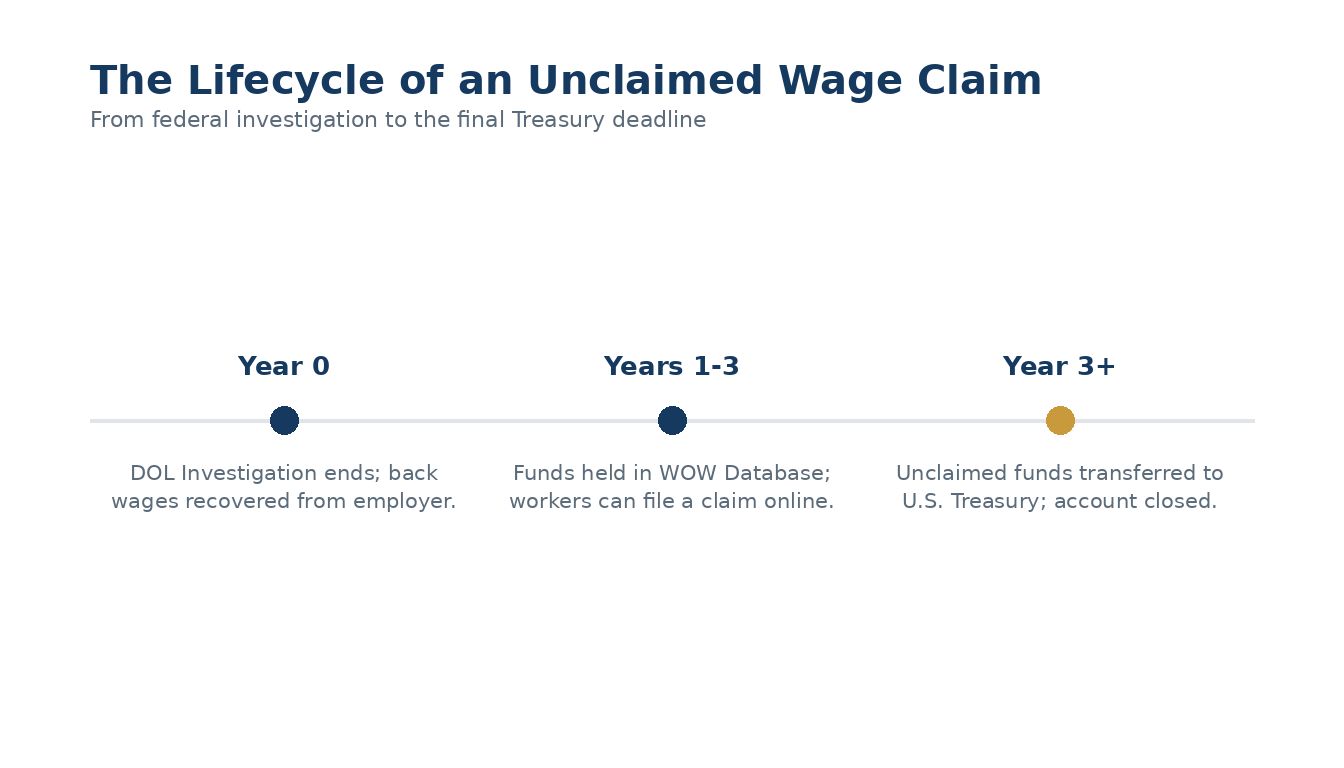
This strict deadline is why many labor advocates refer to unclaimed wages as a “leaking bucket.” Every year, millions of dollars that could have helped families pay down debt or build savings are instead absorbed into the general federal budget because the owners simply didn’t know to check the WOW database.
Step 2: The Mid-Career Audit (NCUA Unclaimed Shares)
As you progress in your career, you may have joined a credit union through a past employer. If that credit union was later liquidated or merged, and you had a small balance left in a share account, that money often ends up with the National Credit Union Administration (NCUA). Like the DOL, the NCUA maintains its own separate registry that is frequently missed by state searches.
As of August 2026, the NCUA is holding millions in “unclaimed deposits” from failed or liquidated institutions. These are not just savings accounts; they can include dividend payments, security deposits, or even specialized workplace insurance payouts that were never delivered because of a bad address.
You should check the NCUA Unclaimed Deposits list if you ever lived in a state with a high concentration of credit unions, such as Ohio, Texas, or California. The process requires searching for your last name and verifying your identity through a member verification form. Unlike the DOL, these funds can sometimes be recovered even years after the liquidation, though earlier is always better.

Major 2026 Wage Settlements You Might Have Missed
To help you determine if you should be searching today, here are some of the most significant federal wage recoveries finalized in the first half of 2026. If you worked for these companies or in these specific regions during the investigation periods, you likely have money waiting.
| Entity/Employer | Location/Region | Amount Recovered | Workers Impacted |
|---|---|---|---|
| The State Group Industrial | Tennessee | $1.7 Million | 1,666 |
| Expresso Forwarding Inc. | California/Mexico Border | $1.08 Million | 24 |
| Leo’s Coney Island Franchises | Detroit Metro, Michigan | $515,000 | 143 |
| Major Tech Firm (DOJ Initiative) | National | $18.5 Million | Undisclosed |
The Detroit-area settlement involving Leo’s Coney Island is particularly noteworthy for August 2026, as it involves multiple locations in Clarkston, Dearborn, Livonia, and Sterling Heights. If you worked for any of these franchises in the last three years and were paid straight-time instead of overtime, your share of that $515,000 is likely sitting in the WOW database right now.
Similarly, the $18.5 million DOJ settlement focused on “Protecting U.S. Workers” targets recruitment and hiring practices at a large tech firm. This is part of a broader federal push in 2026 to ensure that domestic workers are not deterred or underpaid compared to visa-holding counterparts, resulting in significant back-pay distributions.
Common Mistakes: Why Valid Claims Get Rejected
Filing a claim for federal back pay is free, but it does require precision. One of the most common mistakes is failing to provide the specific documentation the DOL needs to verify your identity against the employer’s old payroll records. Because the employer may have had incorrect information for you originally, you must “bridge the gap” with your own records.
When you find your name in the WOW system, the DOL will send you a “Back Wage Claim Form.” You will need to upload this form along with a copy of your Social Security card, a W-2 from that specific employer, or a pay stub. If you no longer have your W-2, you can often request a transcript from the IRS, as covered in our IRS unclaimed tax refunds guide.
Another pitfall is the “Name Variation” error. If you have married, divorced, or used a nickname at work, the DOL database might list you under a name you no longer use. Always search by the name exactly as it appeared on your paycheck at that specific job. If the name is misspelled in the database, you can still claim it, but you will need to provide additional proof of identity.
The “Department of Labor” Scam: Red Flags to Watch For
Whenever large-scale settlements like the $18 million DOJ tech recovery make the news, scammers follow closely behind. In August 2026, we are seeing a rise in “Labor Board” phishing scams. These typically arrive via email or text, claiming that you have a “mandatory wage settlement” waiting, but requiring you to pay a “processing fee” or “tax deposit” first.
The real Department of Labor will *never* ask you for money to process a back-pay claim. There are no fees, no filing costs, and no “expedited processing” charges. If a website asks for your credit card number to search the WOW database, you are on a scam site. The official search is always a .gov address and is always free to use.
Furthermore, be wary of anyone calling you claiming to be a “federal wage auditor.” While the DOL may contact you if they have your current address, they will typically direct you to the official webapps.dol.gov portal to complete your claim securely. For more on protecting yourself, see our guide on how to find unclaimed money and spot scams.
A Final Career Audit Checklist
To ensure you haven’t left money on the table, use this checklist to guide your search process. This is especially vital if you have worked in the “Gig Economy” or in service-heavy sectors where violations are most frequent.
- Search the WOW Database: Check every employer from the last 5 years at webapps.dol.gov/wow/.
- Verify Previous Addresses: Ensure you are searching names associated with all past residencies.
- Check the NCUA: If you used a credit union at a previous job, search for “unclaimed shares” on the NCUA site.
- Gather Old Paperwork: Keep digital copies of W-2s or final pay stubs to make the verification process faster.
- Mark Your Calendar: Set a reminder to check the WOW system every 12 months, as new investigations are settled constantly.
By taking these steps, you are doing more than just searching for “found money.” You are ensuring that the hours you put in at your past jobs are fully compensated according to federal law. In an era of high inflation and economic shifts, that $1,000 “invisible paycheck” could make a world of difference for your household budget.
Frequently Asked Questions
Is the WOW database the same as my state’s unclaimed property site?
No. State sites generally hold uncashed checks. The WOW database holds money recovered through federal investigations into labor law violations. You must check both to be thorough.
What happens if I find my name but don’t have my old W-2?
You can still file a claim. The DOL will accept other forms of proof, such as a Social Security card and a valid ID, though having an old pay stub or W-2 makes the 8-10 week processing time much smoother.
How long does it take to get a check from the DOL?
Once you submit your Back Wage Claim Form and your identity is verified, the Department of Labor typically processes the payment and mails a check within 8 to 10 weeks.
Why is there a 3-year limit on claiming these wages?
Federal law requires the DOL to attempt to find workers for three years. After that, the statutes dictate that unclaimed funds must be surrendered to the U.S. Treasury’s general fund, making them unrecoverable.