

Last updated: August 2026
Figures and program details can change – always verify current details on the official source before acting.
Quick answer
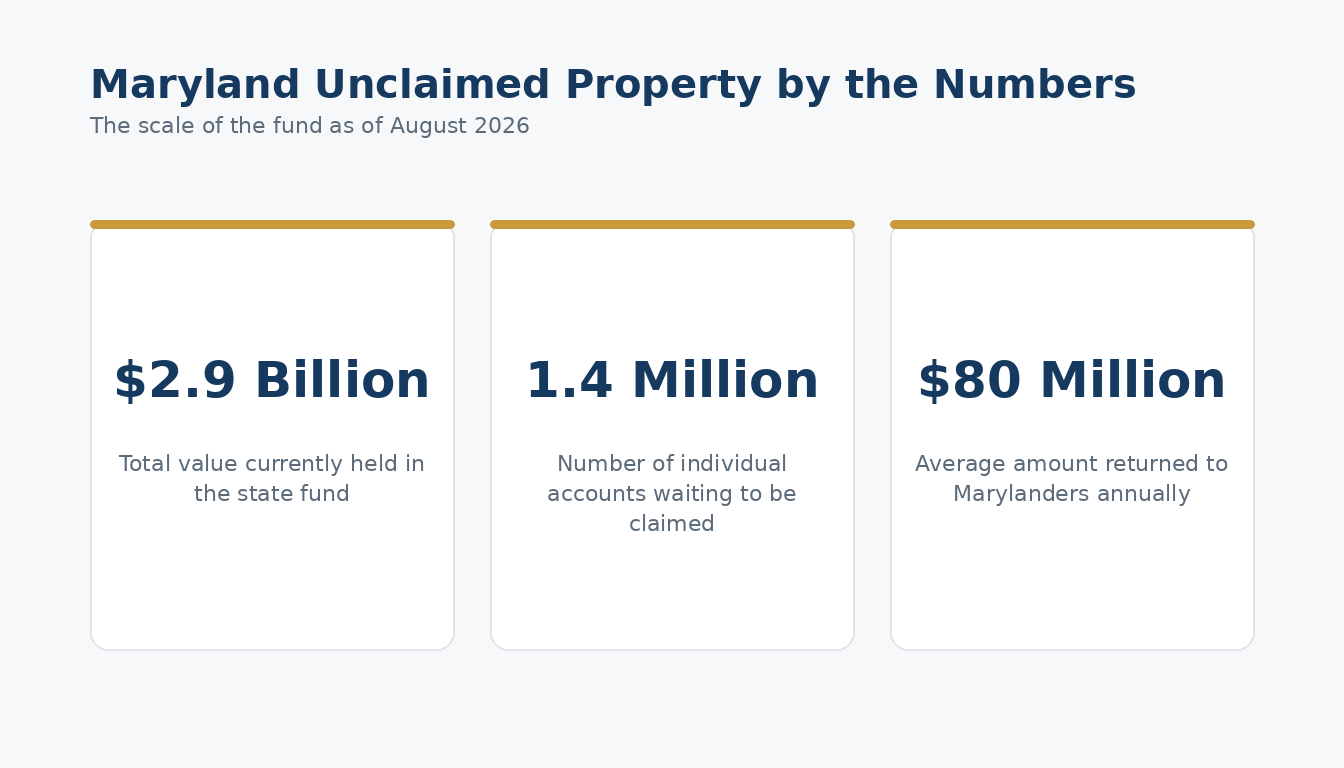
Maryland is currently holding over $2.9 billion in unclaimed property across roughly 1.4 million accounts. In August 2026, the Maryland Comptroller’s Office is aggressively pursuing its ‘outreach’ mandate, returning over $80 million annually. Residents can search the official database for free via the Maryland Taxes portal and file most claims under $5,000 through an expedited digital process.
Key takeaways
- Maryland holds nearly $3 billion in forgotten bank accounts, uncashed checks, and insurance payouts.
- The state’s ‘Honoring the Service’ initiative prioritizes returning funds to Maryland veterans.
- Maryland law caps ‘professional finder’ fees at 15%, but you can claim for free directly.
- Digital claims under $5,000 are now processed significantly faster than legacy paper filings.
The $2.9 Billion Maryland Backlog: Why So Much Money is Unclaimed
In the state of Maryland, the Comptroller’s office serves as the legal guardian for billions of dollars in forgotten assets. As of August 2026, that total has swelled to over $2.9 billion. This is not taxpayer money; it is private capital—forgotten utility deposits from Baltimore Gas and Electric (BGE), uncashed paychecks from old jobs in Bethesda, and dormant savings accounts from banks across the Chesapeake.
Under the Maryland Uniform Unclaimed Property Act, businesses are required to turn over financial assets to the state after a period of inactivity, known as the ‘dormancy period.’ For most assets in Maryland, this period is three years. If a bank or insurance company cannot find you after 36 months of no contact, they must legally transfer the cash to the Comptroller for safekeeping.
The scale of this fund is staggering when viewed per capita. With roughly 1.4 million individual accounts currently listed in the state’s database, nearly one in four Maryland households may have a valid claim waiting to be filed. Despite the Comptroller returning tens of millions of dollars every year, the pool continues to grow as new reports are filed by businesses every autumn.
Maryland’s ‘Outreach’ Mandate: How the State Finds You in 2026
Unlike many states that simply host a database and wait for you to find them, Maryland has a specific statutory requirement to be proactive. Every year, the Comptroller’s Office publishes the names of new property owners in local newspapers across all 23 counties and Baltimore City. This ‘outreach’ effort is one of the largest public disclosure projects in the state government.
In 2026, this outreach has evolved beyond newspaper ink. The Comptroller’s Office now utilizes data-matching programs to identify current addresses for owners of larger accounts. However, these automated efforts often struggle with maiden names, common surnames, or residents who have moved out of state. This is why a manual search remains the most reliable way to ensure you aren’t part of the $2.9 billion backlog.
A distinctive part of Maryland’s current strategy is the ‘Honoring the Service’ initiative. This program focuses specifically on identifying unclaimed assets belonging to Maryland veterans and their families. By cross-referencing state veteran records with unclaimed property files, the office has successfully returned millions in military back pay and life insurance dividends that might have otherwise sat idle for decades.
How to Search the Official Maryland Unclaimed Property Database
To begin your search, you must ignore the third-party ‘search fee’ sites and go directly to the official source. The Comptroller of Maryland provides a free, public-facing search tool that allows you to scan the entire $2.9 billion database in seconds. To get the best results, you should search not just your current name, but any previous names or nicknames you have used.
The official search portal requires only a last name to start, but adding a first name and a city will help narrow down the results, especially if you have a common surname. In Maryland, the database also includes ‘tangible’ property, such as the contents of forgotten safe deposit boxes. If the state has sold the physical items at auction, they hold the cash proceeds in your name indefinitely.
When searching, pay close attention to the address listed next to a name. It is common to find money linked to a college apartment or a childhood home you haven’t lived in for twenty years. If you find a match, the system will allow you to ‘add’ the property to a digital cart and begin the claim process immediately through the official Maryland Unclaimed Property Search tool.

Step-by-Step Walkthrough: Filing a Claim in Maryland
Once you identify property that belongs to you, the claim process in Maryland follows a specific hierarchy based on the value of the asset. For claims under $5,000, the state has introduced an ‘e-claim’ system that can often be completed without mailing in physical documents. You will need to provide your Social Security number and answer several identity-verification questions powered by state records.
For claims exceeding $5,000, or those involving deceased relatives, a paper claim form is usually required. This form (Form COT/ST 300) must be signed and accompanied by specific proofs. Maryland is strict about ‘proof of connection’ to the old address. If the property is linked to an address from 1995, you may need to provide an old utility bill, a school transcript, or a tax return showing you once lived there.
The state’s processing time has improved significantly. In 2026, digital ‘e-claims’ are typically approved within 15 to 30 days. Paper-based claims involving complex estates or large sums can take 60 to 90 days. You can track the status of your claim through the same portal where you initiated the search, using the claim ID provided at the time of filing.
Myth vs. Reality: Debunking Maryland Property Misconceptions
One of the most persistent myths in the Old Line State is that ‘the government keeps the money if you don’t claim it within seven years.’ In reality, Maryland serves as a perpetual custodian. There is no statute of limitations on your right to claim these funds. Whether the money was turned over in 1986 or 2026, the state will return it to the rightful owner or their heirs upon proof of ownership.
Another common misconception is that the state only holds ‘small’ amounts of money, like $5 or $10. While thousands of accounts are indeed for small utility refunds, the Maryland database frequently contains individual accounts worth over $50,000. These larger sums often come from forgotten life insurance policies, matured certificates of deposit (CDs), or unliquidated stock portfolios.
Finally, many residents believe they need to hire a ‘professional finder’ to recover their money. These finders often send official-looking letters in the mail offering to ‘locate’ your funds for a fee. Under Maryland law, these investigators are prohibited from charging more than 15% of the total value recovered. However, you can achieve the exact same result for free by using the official Maryland Comptroller website.
Maryland Dormancy Periods: The Timeline of Lost Money
Understanding when money becomes ‘unclaimed’ can help you prevent it from reaching the state in the first place. In Maryland, the clock starts ticking the moment a piece of mail is returned as undeliverable or a check remains uncashed. The duration of this clock—the dormancy period—varies by the type of asset you own.
| Property Type | Dormancy Period (Years) | Common Examples |
|---|---|---|
| Wages & Salaries | 1 Year | Uncashed final paychecks, commissions |
| Bank Accounts | 3 Years | Savings, checking, and matured CDs |
| Utility Deposits | 3 Years | BGE, Pepco, or water utility refunds |
| Insurance Payouts | 3 Years | Life insurance benefits, premium refunds |
| Stocks & Dividends | 3 Years | Forgotten brokerage accounts |
As covered in our national dormancy comparison guide, Maryland’s three-year window is standard for the Mid-Atlantic region. If you have an account that has been inactive for two years, making a simple $1 deposit or even logging into the online portal is often enough to ‘reactivate’ the account and stop the transfer to the state.

Required Documentation for Maryland Heirs and Estates
A significant portion of Maryland’s $2.9 billion fund belongs to residents who have passed away. In these cases, the right to claim the money passes to the legal heirs. This is the most complex type of claim and requires the most documentation. If you are claiming on behalf of a deceased relative, you must first prove that you are the person legally entitled to the funds.
If the estate was never formally opened, or if it was closed years ago, you may be able to use a ‘Small Estate’ affidavit if the total value of the unclaimed property is under $50,000. For larger amounts, you may need to provide a copy of the Will and ‘Letters of Administration’ from the Register of Wills in the Maryland county where the owner resided. This process ensures the state doesn’t accidentally pay the wrong relative.
Regardless of the amount, all heir claims require a certified copy of the death certificate. Maryland also requires proof that the deceased person actually lived at the address associated with the property. Gathering these documents can take time, but the Comptroller’s Office provides a dedicated ‘Estate’ unit to help guide families through these multi-generational recoveries.

The ‘Pro-Tip’ for Maryland Residents: Don’t Forget the Stocks
Maryland is home to thousands of corporate headquarters and a highly active investing population. Consequently, a massive percentage of the $2.9 billion fund is held in the form of corporate stock and dividends. When a brokerage firm or a corporation loses track of a shareholder, they don’t just send the cash—they ‘escheat’ the actual shares of stock to the state.
In many cases, the Maryland Comptroller will liquidate (sell) these shares soon after receiving them. This means that if you claim your stock ten years later, you will receive the cash value of the shares at the time they were sold, not the current market value. To avoid missing out on market gains, it is vital to search the database at least once a year, particularly if you have moved or changed brokerage firms.
If the shares have not yet been sold, Maryland can often transfer the actual stock back to your current brokerage account. This is a powerful way to recover lost wealth that has been compounding in the state’s custody. Always check the ‘Property Type’ description in your search results; if it says ‘Securities’ or ‘Dividends,’ you may be looking at a significant investment recovery.
Avoiding Maryland Unclaimed Property Scams
As the $2.9 billion fund makes headlines, scammers are increasingly targeting Marylanders with sophisticated phishing schemes. A common 2026 scam involves a text message or email claiming to be from ‘The Maryland Comptroller’ stating that you have a ‘pending stimulus’ or ‘unclaimed refund’ that requires you to click a link and provide your bank details.
The Comptroller’s Office will never contact you via text message to initiate a claim. Furthermore, the state will never ask you to pay an ‘upfront fee’ or ‘insurance tax’ to release your funds. Any request for payment via gift card, wire transfer, or cryptocurrency is a definitive sign of a scam. The official claim process is entirely free, and any legitimate fees (such as those for professional finders) are deducted only after the money is recovered.
If you receive a suspicious communication, do not click any links. Instead, navigate manually to the official website at marylandtaxes.gov and use their secure contact form to verify the message. Protecting your identity is just as important as recovering your cash.
Is there a deadline to claim money in Maryland?
No. Maryland acts as a permanent custodian of unclaimed property. There is no deadline for the original owner or their legal heirs to file a claim. The state holds the funds in perpetuity until the rightful owner is found.
How long does it take to get a check from the Maryland Comptroller?
For simple digital claims (e-claims) under $5,000, you can expect a check within 15 to 30 days. For paper claims, estate-based claims, or amounts over $5,000, the process typically takes between 60 and 90 days due to manual verification requirements.
Does Maryland pay interest on unclaimed property?
Generally, no. Maryland does not pay interest on funds held in the unclaimed property database. You receive the exact amount that was turned over to the state by the original business or financial institution.
Can I claim property for a family member who is still living?
You can help a living family member search and prepare their claim, but they must sign the final claim form and provide their own identification. You can only sign on their behalf if you have a legally recognized Power of Attorney (POA) that explicitly grants you the authority to handle their financial affairs.