

Last updated: July 2026
Figures and program details can change – always verify current details on the official source before acting.
Quick answer
As of 2026, the U.S. Treasury holds over $33 billion in matured, uncashed savings bonds that have stopped earning interest. The Treasury’s own “Treasury Hunt” search tool was discontinued on September 30, 2025, so matured-bond searches now go through state unclaimed property programs at unclaimed.org. Older paper bonds you already physically hold, or bonds you know exist but can’t find, still go through the Treasury’s FS Form 1048 or 1522 process.
Key takeaways
- Over $33 billion in U.S. savings bonds are currently matured and no longer earning interest.
- The Treasury’s digital “Treasury Hunt” search tool was permanently discontinued on September 30, 2025, under the SECURE 2.0 Act — matured bond data was handed off to individual states instead.
- To search for a bond you don’t have in hand, start with your state’s unclaimed property database via unclaimed.org, not TreasuryDirect.
- Series E, EE, and I bonds all have different “interest cliffs” ranging from 30 to 40 years.
- If you have lost physical paper bonds, you must file FS Form 1048 with the Bureau of the Fiscal Service.
While most people are familiar with searching state databases for utility deposits or forgotten bank accounts, a massive pool of wealth remains hidden at the federal level. Unlike state-held property, which is often consolidated into searchable portals, U.S. savings bonds represent a unique challenge because they are debt obligations of the federal government that eventually stop growing.
When a bond reaches “final maturity,” it stops earning interest entirely. This creates a “dead asset” that loses value every year relative to inflation. In 2026, the volume of these uncashed, matured bonds has reached an all-time high, prompting the Bureau of the Fiscal Service to shift its search process from a federal self-service tool to direct cooperation with state unclaimed property offices.
The Matured Bond Landscape: Comparing Series E, EE, and I
The first step in recovering these funds is understanding exactly what you (or your ancestors) might have owned. Savings bonds have evolved significantly over the decades, and the rules for when they stop paying interest — and how you find them — depend entirely on the Series letter printed on the document.
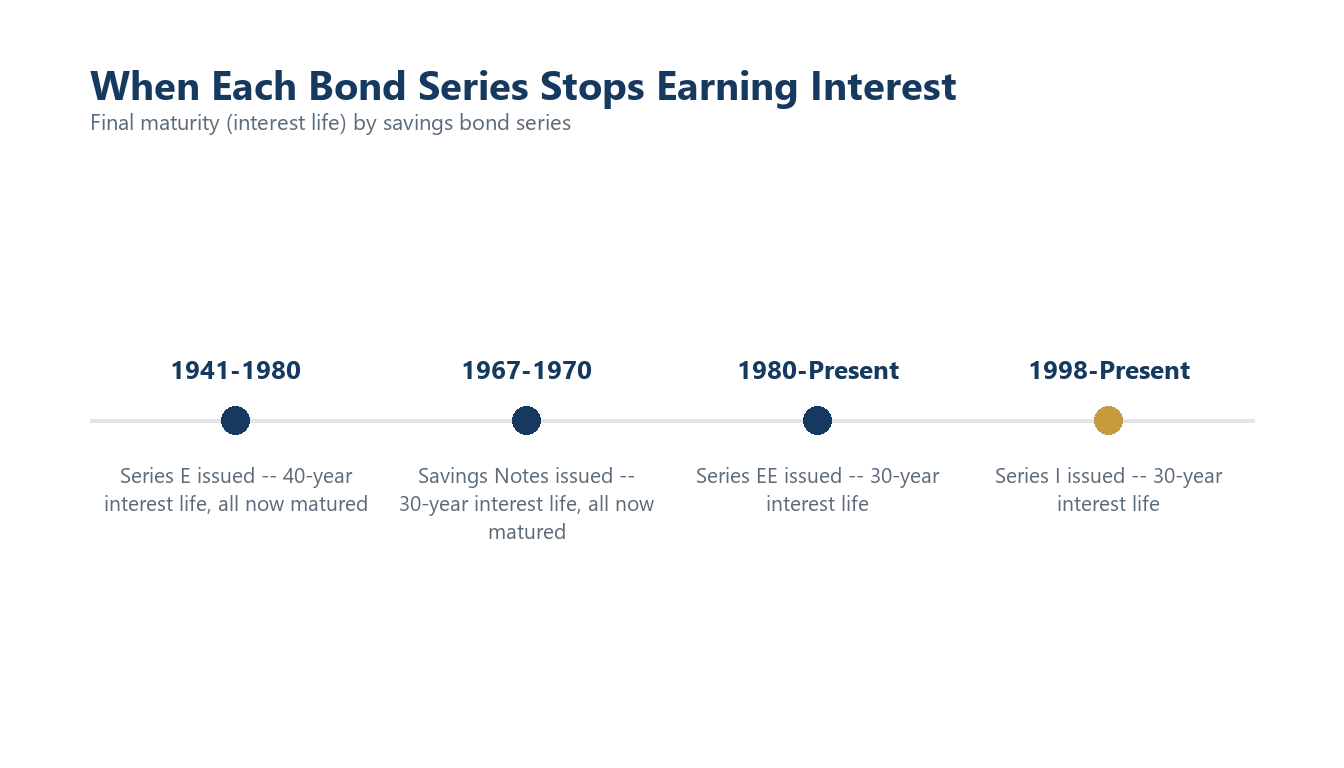
| Bond Series | Common Issue Dates | Interest Life | Search Method |
|---|---|---|---|
| Series E | 1941 – 1980 | 40 Years | Form 1048 (Paper Search) |
| Series EE | 1980 – Present | 30 Years | State unclaimed property search (unclaimed.org) |
| Series I | 1998 – Present | 30 Years | State unclaimed property search (unclaimed.org) |
| Savings Notes | 1967 – 1970 | 30 Years | Form 1048 (Paper Search) |
As shown in the table above, the oldest bonds — Series E — have all reached final maturity as of 2026. This means if you find a Series E bond in a shoebox today, it has likely been sitting stagnant for decades, earning zero additional cents for the holder. These are the most common “lost” assets found in estates and attics.

Many claims begin with a physical discovery. Perhaps you are clearing out a relative’s home or looking through an old safety deposit box and find a stack of crisp, colorful paper with “United States Savings Bond” printed across the top. These physical documents are increasingly rare, but they are still valid for redemption.
If you have the physical bond in hand, the process is relatively straightforward: you can often take it to a local bank if you are a member, though many banks have stopped processing paper bonds in recent years. In that case, you use FS Form 1522 to mail the physical bond directly to the Bureau of the Fiscal Service with a signed request for payment.
Series EE and I bonds are more likely to turn up through a records search than a paper find, since many were issued during the transition to electronic record-keeping. However, any EE bond issued before July 1996 is now reaching its 30-year maturity limit, meaning a wave of these bonds is currently hitting the “interest cliff” this year.
The Rising $33 Billion “Dead Interest” Problem
The scale of unclaimed federal debt is staggering. While state programs like New York’s $20 billion fund often make headlines, the U.S. Treasury’s stockpile of uncashed bonds is unique because it is purely composed of personal savings that have been forgotten by families across all 50 states.
As of early 2026, the estimated total of matured, uncashed savings bonds has surpassed $33 billion. This figure has grown steadily as more “Baby Boomer” era bonds hit their 30-year and 40-year expiration dates without being redeemed at banks or through a formal claim.
The growth shown above is largely due to the passage of time. Every month, thousands of bonds issued in the 1980s and 1990s reach their final maturity. Once a bond stops earning interest, the Treasury moves it into a different accounting category, but the money remains available for the owner to claim indefinitely.
Searching State Unclaimed Property Databases (Treasury Hunt Was Discontinued)
For years, the Bureau of the Fiscal Service ran a self-service search tool called “Treasury Hunt” where you could enter a Social Security Number and check for matured, unredeemed bonds. As of September 30, 2025, that tool is no longer available. Under the SECURE 2.0 Act, the Treasury changed how it handles unredeemed securities: instead of running its own public search portal, it now shares matured-bond data directly with individual states’ unclaimed property programs.
In practice, this means the search itself has moved. To check whether you or a family member has a matured bond on record, start at unclaimed.org, the free national directory run by the National Association of Unclaimed Property Administrators (NAUPA), and search the state where the original purchaser lived at the time of purchase (or where the bond was likely issued). From there you’ll be routed to that state’s official search portal.
It’s still true that a bond only shows up once it’s “matured” — stopped earning interest. If you own a bond issued in 2005 that is still earning interest, it won’t appear in any unclaimed property search yet, because it isn’t considered stagnant or unclaimed.
If a search returns a match, the state site will not hand over the dollar amount immediately. Instead, it walks you through filing a formal claim, coordinating with the Treasury on your behalf. This added layer of security is designed to prevent identity thieves from fishing for high-value bondholders using stolen personal information.
Lost Bonds and the Form 1048 Gauntlet
What if a state database search comes up empty, but you are certain bonds were purchased? This often happens with bonds issued before 1974, which are not always indexed in state unclaimed property systems. In these cases, you go straight to the Treasury’s own paperwork process rather than a search portal.
FS Form 1048 (“Claim for Lost, Stolen, or Destroyed United States Savings Bonds”), available on the TreasuryDirect forms page, is the official document used to trigger a manual search of Treasury archives. This form requires specific details: the approximate dates of purchase, the names and SSNs of the owners, and the denominations of the bonds if known.

Filing this form requires a “Certified Acknowledgment” or a signature from a financial institution official. You cannot simply sign it and mail it; the government needs to verify your identity to prevent fraudulent claims on someone else’s savings. This is similar to the documentation requirements we detailed in our guide on how to find unclaimed money in 2026.
Once you have identified a bond through a state database search or submitted a lost-bond claim with Form 1048, the waiting game begins. The Bureau of the Fiscal Service is a massive federal agency, and their processing times can vary based on the volume of claims.
For bonds you physically hold, mailing in FS Form 1522 tends to move faster since there’s no ownership dispute to resolve. However, state-routed claims and lost-bond searches through Form 1048 are a much slower process, since a state agency and the Treasury both have to sign off.
As of mid-2026, the current processing time for a “Lost Bond” search (Form 1048) is approximately 3 to 6 months. If the claim involves a deceased owner and requires estate documentation, the timeline can stretch to 9 months. Patience is required, but unlike private companies, the Treasury will never “keep” the money; it remains there until the paperwork is correct.

Claiming Bonds for Deceased Relatives and Heirs
A significant portion of the $33 billion currently sitting with the Treasury belongs to individuals who have passed away. For heirs, the process of claiming these bonds is more complex but entirely possible. The Treasury follows the laws of the state where the bondholder lived at the time of their death.
If the bond names a “co-owner” or a “beneficiary” (POD – Payable on Death), the survivor can usually claim the funds by providing a certified copy of the death certificate. The bond automatically becomes the property of the survivor, bypassing the probate process entirely.
If no beneficiary is named, the bonds become part of the decedent’s estate. In this case, the court-appointed executor or administrator of the estate must handle the claim. If the estate was small and never went through formal probate, the Treasury provides simplified forms (such as FS Form 5336) for “special cases” to allow the rightful heirs to collect the funds without hiring a lawyer.
The Interest Cliff: When Savings Bonds Stop Growing
The most common mistake bondholders make is assuming a bond is like a fine wine that gets better with age forever. This is a myth. Every savings bond has a “final maturity date.” Once that date passes, the bond is essentially a piece of paper representing a fixed amount of cash that is slowly losing its purchasing power.
For example, a Series EE bond purchased in June 1996 will stop earning interest in June 2026. If you hold onto that bond until 2030, you aren’t gaining more money; you are simply giving the government an interest-free loan while your money sits idle. This is why checking the “Interest Life” column in the comparison table above is critical for your financial health.
Many investors who check our federal registry guide for pensions often forget to look at their old paper bonds. In many cases, the value of several matured $100 bonds can add up to a significant windfall that can be rolled into a modern, interest-bearing account or used for current expenses.
Common Pitfalls and “Bond Finder” Scams to Avoid
Because there is so much money at stake, scammers have developed sophisticated “Bond Finder” schemes. These often involve an unsolicited letter or email claiming that “records show” you are the heir to a large sum of matured savings bonds. They will offer to help you claim the money for a fee, or ask for your Social Security number to “verify” the account.
The U.S. Treasury does not send unsolicited emails to bondholders. They do not hire private investigators to find you. Any service that asks for a percentage of your bond value (a “finder’s fee”) should be treated with extreme caution. You can search for free through your state’s official portal at unclaimed.org and file every claim for free directly through TreasuryDirect.gov.
Another common mistake is sending your only physical copy of a bond to the Treasury without keeping a record. Always take a high-quality photo or scan of both the front and back of any bond before mailing it. Note the serial number, the series, and the issue date. If the mail is lost, these records are your only proof that the bond existed.
Frequently Asked Questions
Can I cash a savings bond at my local bank in 2026?
It depends on the bank. While many major national banks used to cash paper bonds for customers, many have phased out this service. It is always best to call your local branch first. If they cannot help, you must mail the bonds to the Bureau of the Fiscal Service for redemption using FS Form 1522.
What happens if I find a bond that belonged to a grandparent?
If the grandparent is deceased, you can claim the bond if you are the named beneficiary or the legal heir to their estate. You will need a death certificate and, in some cases, documentation showing you are the authorized person to settle their affairs. The Treasury provides specific forms for heirs to use.
Do I have to pay taxes on unclaimed savings bonds?
Yes. The interest earned on U.S. savings bonds is subject to federal income tax, though it is exempt from state and local taxes. When you cash a matured bond, the Treasury will issue a 1099-INT form showing the total interest earned over the life of the bond. You must report this on your federal tax return for the year you cashed it.
Is the “Treasury Hunt” tool still available for searching bonds?
No. Treasury Hunt was permanently discontinued on September 30, 2025. Searches for matured, unredeemed bonds now go through your state’s unclaimed property program via unclaimed.org instead of a Treasury-run search tool. If you already know bonds exist but can’t locate them (rather than searching to see if any exist), you still file directly with the Treasury using Form 1048.