

Last updated: August 2026
Figures and program details can change – always verify current details on the official source before acting.
Quick answer
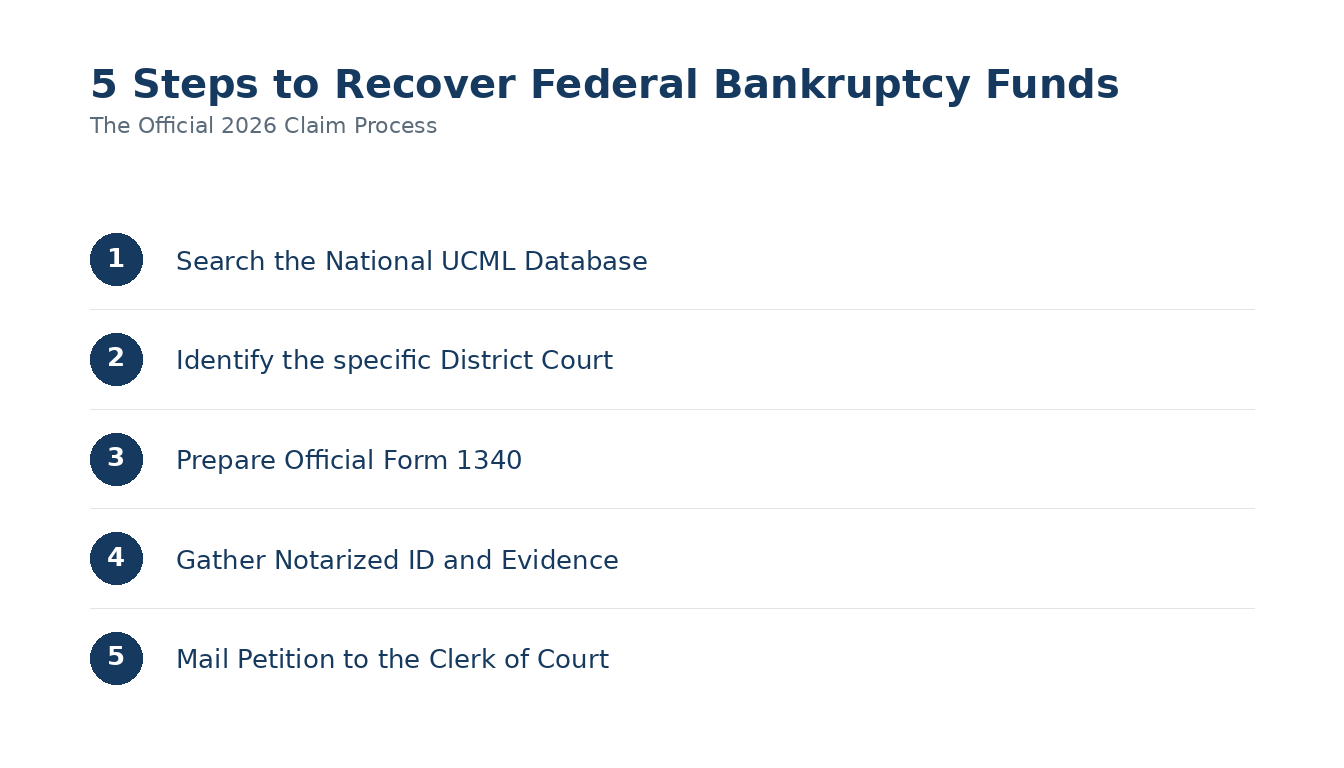
Unclaimed bankruptcy funds are distributions intended for creditors that were never cashed or delivered, often totaling over $400 million nationwide. These funds sit in a “federal silo” and do not appear in state unclaimed property searches; you must search the official U.S. Bankruptcy Unclaimed Funds Locator (UCML) at uscourts.gov and file Official Form 1340 with the specific district court to recover your money for free.
Key takeaways
- Bankruptcy funds are held by federal courts, not state treasuries, making them invisible to sites like MissingMoney.com.
- Most funds arise from undeliverable checks in Chapter 7 and Chapter 13 cases that closed years ago.
- The Southern District of Florida and other courts updated to Official Form 1340 in mid-2026 to streamline digital applications.
- Individuals, defunct businesses, and heirs can all claim these funds with proper notarized identification.
The ‘Federal Silo’: Why Your State Search Missed This Money
If you have spent hours auditing your name on state unclaimed property databases, you may still be missing a significant portion of your financial history. There is a common misconception that all forgotten cash eventually flows to state treasuries like the New York Comptroller or the California State Controller. However, money originating in the federal court system—specifically bankruptcy distributions—exists in a separate “silo.”
Bankruptcy laws are administered by federal courts in 94 judicial districts across the United States. When a case concludes, the trustee attempts to distribute the remaining assets to creditors. If those checks are returned as undeliverable or remain uncashed for more than 90 days, the law requires the trustee to deposit those funds with the Clerk of the Court. Because these are federal proceedings, the money never enters the state escheatment system.
As of August 2026, estimates suggest the U.S. Treasury holds more than $404 million in these uncollected bankruptcy dividends. This pool of capital is often referred to as “homeless money” because it belongs to individuals and businesses who may not even realize they were considered “creditors” in a legal sense.

Myth vs. Reality: Debunking Bankruptcy Payouts
Understanding the difference between state-level property and federal court funds is the first step to a successful recovery. Many claimants give up because they assume a bankruptcy case from ten years ago is “dead and gone.”
Myth: If I didn’t file a formal claim during the bankruptcy, there is no money for me.
Reality: While filing a proof of claim is the standard way to get paid, many people are automatically listed as creditors by the debtor. If the trustee had enough assets to pay out even a small percentage, a check was likely cut in your name. If you moved during the years the case was active, that check is likely sitting in the court’s registry.
Myth: These funds eventually expire and go to the government.
Reality: Under 28 U.S.C. § 2042, any claimant entitled to unclaimed funds held by the court may petition for their return. There is generally no statute of limitations on these funds; they are held in perpetuity until the rightful owner or their legal heir comes forward.
The 2026 Audit: Using the Unclaimed Funds Locator (UCML)
In 2026, the Administrative Office of the U.S. Courts continues to maintain the primary tool for these searches: the U.S. Bankruptcy Unclaimed Funds Locator. This centralized database allows you to search across multiple districts at once, a major improvement over the old system where you had to check each district court website individually.
To perform a proper audit, you should not only search for your current legal name but also any former business names, maiden names, or the names of deceased relatives. The system is sensitive to exact matches, so try variations of names (e.g., “John Smith” and “J. Smith”) to ensure you capture all potential records.
According to official instructions from the Southern District of Florida, which updated its protocols in June 2026, “Every applicant is responsible for attaching detailed documents in support of their claim,” highlighting that the search is only the first step. Once a match is found, the UCML will provide the case number and the specific court holding the funds. This is vital information because the actual claim must be filed with that specific court, not a central federal agency.
The search interface also allows you to filter by “Amount Not Less Than.” If you are a professional or a business auditing high-value assets, you can prioritize results that justify the notarization and mailing costs associated with the federal filing process.
Are You a ‘Forgotten Creditor’? Common Scenarios
Most people do not consider themselves “creditors” until they see their name in a court database. However, the definition of a creditor in a bankruptcy case is broad. You might have unclaimed money waiting if you fall into one of these common 2026 recovery categories:
- Retail Gift Card Holders: When a major retail chain goes bankrupt, gift card holders are technically unsecured creditors. Payouts for these cards are often just a few dollars, but in aggregate, they account for millions in unclaimed court funds.
- Former Employees: If a company closed while owing you a final paycheck, commissions, or reimbursed expenses, those funds were likely deposited with the court if the check mailed to your old office address bounced back.
- Vendor Overpayments: If you or your small business accidentally overpaid a utility or service provider that subsequently entered Chapter 11 or Chapter 7 bankruptcy, that refund may be sitting in the registry.
- Utility Deposits: Security deposits for businesses that moved or shut down frequently end up in the bankruptcy silo if the provider was part of a larger corporate restructuring.
One specific 2026 tip for heirs: searching for a deceased parent’s name can often reveal distributions from corporate bankruptcies that occurred decades ago but only recently finished their multi-year liquidation process. Bankruptcy cases, especially complex Chapter 11 reorganizations, can take 5-10 years to reach a “final distribution” phase.

The Documentation ‘Golden Key’: Filing Form 1340
Once you locate a match in the UCML, the process shifts from a digital search to a formal legal petition. The universal standard for this is **Official Form 1340 (Application for Payment of Unclaimed Funds)**. While each court has its own “local” version, the core requirements are virtually identical across the 94 districts.
The Administrative Office of the U.S. Courts provides specific guidance on the “Instructions for Filing Applications for Payment of Unclaimed Funds.” As cited in current USCourts.gov guidance, the court unit is solely responsible for maintaining the search criteria and disposition procedures. This means you must follow the specific rules of the court where the money is held.
| Claimant Type | Mandatory Documentation | Verification Method |
|---|---|---|
| Individual | Photo ID, SSN/TIN, Proof of Address | Notarized Signature |
| Successor/Heir | Death Certificate, Probate Order | Certified Copies |
| Defunct Business | Articles of Inc., Proof of Authority | Corporate Seal/Notary |
| Funds Locator | Power of Attorney, Fee Disclosure | Court Approval Required |
The most common reason for a claim being rejected is a failure to provide proof of the “Right to Funds.” If you are claiming money for a business that no longer exists, you must prove you were the authorized officer at the time of dissolution. If you are an heir, the court will require a “Small Estate Affidavit” or a probate court order showing you are the legal successor to the creditor’s assets.
Common Mistakes to Avoid in Bankruptcy Claims
Unlike state searches, which are often fully automated and paperless, federal court claims are still heavily reliant on physical paperwork and verification. This leads to several common pitfalls that can delay your payout by months.
- Filing with the Wrong Court: Even if you live in California, if the company that owed you money filed for bankruptcy in the District of Delaware, you must file your claim in Delaware.
- Missing the AO 213P Form: To actually get the check issued, most courts require a “Request for Taxpayer Identification Number and Certification” (Form AO 213P). Without this, the Treasury cannot process the payment.
- Incomplete Notarization: Federal courts are strict about identity verification. A simple photocopy of an ID is rarely enough; the application signature must be witnessed by a notary public to satisfy federal security standards.
- Ignoring the 14-Day Rule: As noted in Southern District of Florida instructions, “The Clerk will disburse funds not earlier than 14 days after entry of an order.” Do not expect a check the day you mail the form.
A specific 2026 insider tip: If the amount you are claiming is under $1,000, some courts offer an expedited “small claim” process that requires less secondary documentation. Always check the “Local Rules” section of the specific court’s website before preparing your packet.
The Payout Timeline: What Happens After You File
Recovering money from a federal court is a multi-stage process that involves both the judiciary and the executive branches of government. Once you mail your application to the Clerk of the Court, it undergoes a formal review process.
First, the Clerk’s office verifies that the funds are actually still in the registry and haven’t been claimed by someone else. Then, the application is often forwarded to the U.S. Attorney for the district for a “Notice of Review.” If no objections are raised, a judge will sign an “Order Granting Application for Payment of Unclaimed Funds.”
After the order is signed, there is a mandatory waiting period—often 14 days—to allow for any appeals or corrections. Finally, the Court instructs the U.S. Treasury to issue a check. From start to finish, the 2026 average timeline for a bankruptcy fund recovery is 6 to 12 weeks. While this is slower than the 10-day “Fast Track” systems seen in some states, the amounts found in bankruptcy cases are often significantly higher than average state-held utility refunds.

Avoiding the ‘Finder’ Trap: Real Scams vs. Official Sites
Because the Bankruptcy Unclaimed Funds Locator is a public database, it is often mined by third-party “funds finders” or “tracers.” These individuals may contact you via mail or phone, claiming they have found a “judgment” or “settlement” in your name and offering to recover it for a fee, often 25% to 50% of the total.
While some finders are legitimate businesses, they are never necessary. You have the legal right to file Form 1340 yourself for $0 in fees. Furthermore, many states and courts have “fee caps” that limit what these tracers can charge. In some jurisdictions, finders are prohibited from even contacting you until the money has been sitting in the registry for over 24 months.
Be particularly wary of any “finder” who asks for money upfront. No legitimate government official or court clerk will ever ask you to pay a “processing fee” or “taxes” before they release your funds. If you receive a solicitation, your first step should be to ignore the caller and perform your own search on the official UCML database to see if the money is actually there.
Unclaimed Bankruptcy Funds FAQ
Why don’t these funds show up on MissingMoney.com?
MissingMoney.com and state treasuries only track property that has been escheated to the state. Bankruptcy funds are federal assets held by the U.S. Courts and the Treasury Department under federal law, so they remain in a separate registry that state databases cannot access.
Is there a deadline to claim these bankruptcy dividends?
Generally, no. Under federal law, these funds are held in trust for the owner indefinitely. However, as decades pass, proving the “Successor in Interest” for a defunct company or a deceased relative becomes significantly more difficult as records disappear, so it is best to claim them as soon as they are identified.
Do I need a lawyer to file a claim for bankruptcy funds?
No. Most courts specifically state that individuals are not required to hire an attorney to claim funds they are entitled to. The process is designed to be accessible to the public using Official Form 1340, though complex corporate claims may occasionally benefit from legal review.
What if the court holding my money has closed or merged?
The federal judiciary has undergone several restructurings over the years. If a specific district court has merged (e.g., a divisional office closing), the records and funds are transferred to the new regional headquarters. The UCML database is updated nightly to reflect these administrative changes.