

Last updated: August 2026
Figures and program details can change – always verify current details on the official source before acting.
Quick answer
Georgia is currently holding over $1.4 billion in unclaimed property, ranging from uncashed checks to safe deposit box contents. Residents can search for their name for free through the official Georgia Department of Revenue portal at https://dor.georgia.gov/unclaimed-property-program. Claims are processed directly by the state with no service fees required.
Key takeaways
- The Georgia Department of Revenue holds a record $1.4 billion in assets belonging to current and former residents.
- A significant 2026 data update includes thousands of uncashed state tax rebate checks from the last three fiscal years.
- Official searches are always free; the state never charges a percentage to return your own money.
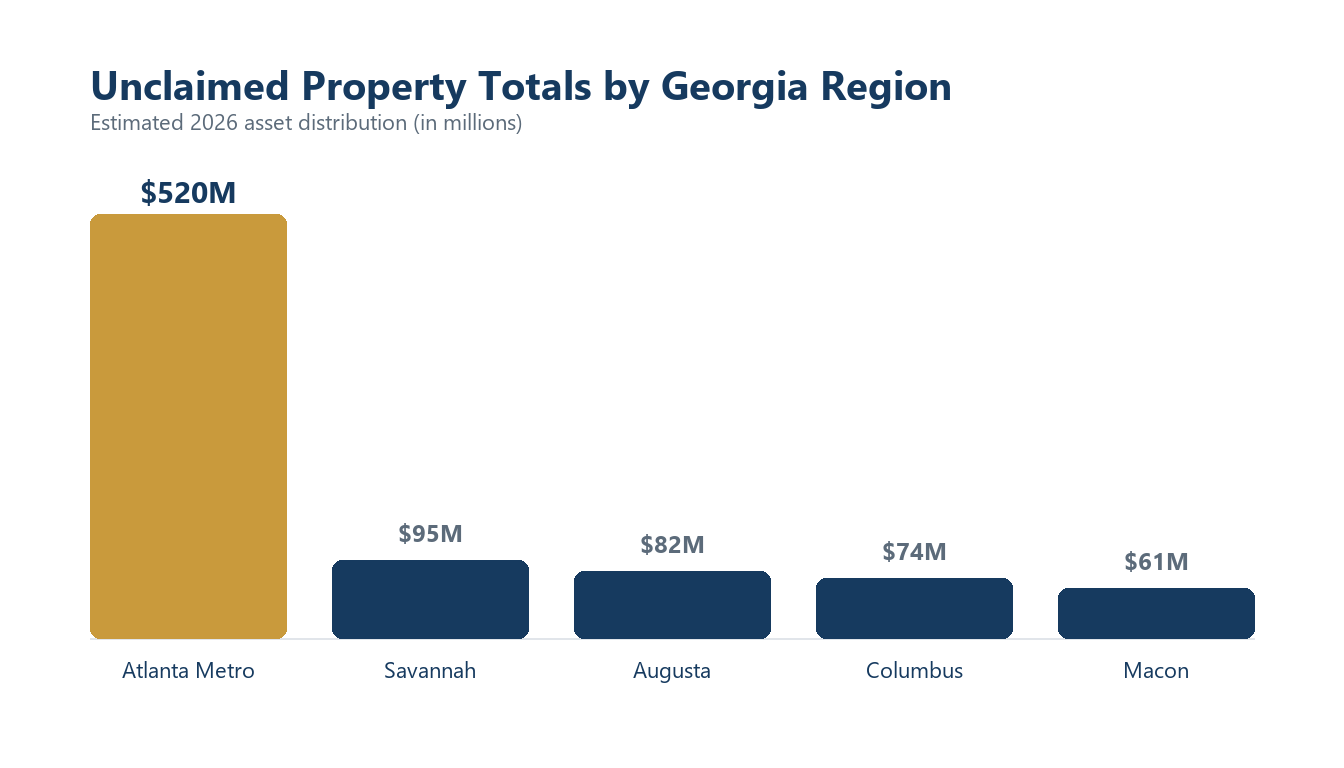
- The Atlanta metropolitan area currently accounts for nearly 40% of the state’s total unclaimed property pool.
The 2026 Landscape of Georgia’s Unclaimed Billions
As of August 2026, the state of Georgia is sitting on a mountain of forgotten wealth that has reached a historic milestone. The total value of assets held by the Georgia Department of Revenue (DOR) has surpassed $1.4 billion, a figure driven higher by recent shifts in how businesses report dormant accounts and a surge in uncashed state payments.
This pool of money isn’t a government surplus; it is private property that the state is legally required to protect until the rightful owner or their heirs come forward. From the coastal streets of Savannah to the tech hubs of Alpharetta, every corner of the Peach State is represented in this massive digital vault.
The 2026 audit reveals that while the total dollar amount is staggering, the average claim size remains surprisingly accessible for the typical resident. While some accounts hold six-figure windfalls from forgotten stock portfolios, the majority consist of utility deposits, uncashed payroll checks, and insurance refunds that average between $50 and $250.
Geographic Breakdown: Where the Money is Concentrated
Data from the most recent reporting cycle suggests that your physical location in Georgia—or where you lived ten years ago—is a strong indicator of whether you have money waiting. Predictably, the highest concentration of unclaimed funds follows the population centers along the I-75 and I-85 corridors.
Atlanta remains the “capital” of unclaimed property, with over half a billion dollars linked to Fulton and DeKalb County addresses. However, rural Georgia is not immune; smaller counties often see significant unclaimed sums from agricultural cooperatives, old land-line telephone deposits, and forgotten mineral royalty payments that have accrued over decades.
Interestingly, college towns like Athens and Valdosta show a high volume of smaller claims. This is largely attributed to students moving frequently and failing to update their forwarding addresses with apartment complexes, utility providers, and former employers, leading to hundreds of thousands of small, uncashed security deposits.
The 2026 “Tax Rebate” Ripple Effect
A unique development in 2026 involves the influx of uncashed checks stemming from Georgia’s various tax rebate initiatives passed in recent years. Legislation like HB 162 and subsequent surplus returns resulted in millions of checks being mailed to residents across the state.
Inevitably, thousands of these checks were sent to old addresses, lost in the mail, or simply tucked into a drawer and forgotten. Under Georgia’s unclaimed property laws, these state-issued checks eventually “void” and the funds are turned over to the Unclaimed Property Program for safekeeping.
If you were a Georgia taxpayer between 2023 and 2025 but didn’t receive a specific rebate or surplus check you were expecting, the Department of Revenue’s search tool is now the primary way to recover those funds. This 2026 update marks one of the largest single-category additions to the database in the program’s history.

Identifying Your Assets: What Georgia is Holding
Many residents mistakenly believe that unclaimed property only refers to bank accounts from failed financial institutions. In reality, the Georgia Department of Revenue handles a vast array of intangible property types, as well as the physical contents of abandoned safe deposit boxes.
Common assets currently in the vault include dormant savings and checking accounts, uncashed dividends, and matured certificates of deposit. We also see a high volume of “credit balances,” which occur when a consumer overpays a credit card or medical bill and the company is unable to locate them to issue a refund.
Beyond cash, Georgia also manages tangible items. When a safe deposit box at a Georgia bank goes unpaid for several years, the bank eventually sends the contents to the DOR. This can include everything from heirloom jewelry and rare coins to military medals and historical documents, all of which are cataloged and held for the owner.
| Asset Type | Typical Dormancy Period | 2026 Reporting Status |
|---|---|---|
| Payroll and Wages | 1 Year | High Volume |
| Utility Deposits | 2 Years | Increasing |
| Insurance Payouts | 3 Years | Steady |
| Bank Accounts | 5 Years | Highest Value |
| Safe Deposit Contents | 5 Years | Physical Storage |
The Georgia Search Protocol: A Step-by-Step Walkthrough
Finding your money in Georgia is a straightforward process, but it must be done through the correct official channel. To begin, navigate to the official Georgia Department of Revenue Unclaimed Property page. This is the only authorized portal for state-level searches in Georgia.
Once on the site, you will use the search tool to enter your last name or the name of your business. If you have a common name, such as Smith or Jones, it is highly recommended to include your first name and even a middle initial to narrow the results. The system will then display a list of matches including the owner’s name and the last known address on file.
If you find a match, you will select the item to add it to your “cart” (don’t worry, there is no cost) and proceed to the claiming phase. You will be asked to identify your relationship to the property—whether you are the original owner, an heir, or a corporate officer—and provide basic contact information to generate a claim number.

Documentation: Proving the Money is Yours
Because the state is tasked with protecting these funds, they require concrete evidence that you are the rightful owner before releasing a check. For most simple claims, this starts with a copy of your current government-issued photo ID and proof of your Social Security number.
The most common hurdle in Georgia claims is proving a connection to the “last known address” listed in the database. If the address on the claim is a home you lived in ten years ago, you may need to provide an old utility bill, a tax return, or a piece of mail that links your name to that specific street address.
In 2026, many claimants can take advantage of the state’s digital upload system. Instead of mailing physical copies to the Atlanta processing center, you can often scan or take a clear photo of your documents and upload them directly to the Georgia Tax Center (GTC) portal, which significantly accelerates the verification process.
Legacy Claims: Recovering Assets for Heirs
A significant portion of Georgia’s $1.4 billion pool belongs to individuals who are now deceased. These funds do not vanish; they become part of the individual’s estate. If you are the legal heir or the executor of an estate, you have the right to claim these funds on behalf of the deceased.
Claiming for a family member requires additional documentation. In addition to your own ID, you will typically need to provide a copy of the owner’s death certificate and documentation proving your legal authority to act on behalf of the estate. This might include a copy of the will or “Letters of Administration” from a Georgia probate court.
If the estate was small and did not go through formal probate, Georgia law provides specific affidavits that can be used for claims under a certain dollar threshold. These forms allow heirs to collect smaller sums without the expense of a full court proceeding, ensuring that family legacies aren’t eaten up by legal fees.
Avoiding the Georgia “Recovery” Scams
The rise in unclaimed property totals has unfortunately led to a rise in sophisticated scams targeting Georgia residents. These often take the form of official-looking letters or emails claiming that you have a large sum of money waiting, but requiring an “upfront fee” or “processing tax” to release it.
The golden rule in Georgia is simple: The state will never charge you a fee to return your money. If someone contacts you offering to help you recover funds for a percentage of the total, they are likely a “private finder.” While some finders are legitimate businesses, they are performing a service you can easily do yourself for free on the DOR website.
Be especially wary of any communication that asks for your full Social Security number or bank account details over the phone. Always initiate the contact yourself through the official .gov domain. If you receive a suspicious solicitation, you can report it to the Georgia Consumer Protection Division to help protect other residents.
Red Flag Checklist: Spotting Georgia Claims Scams
- The “Upfront” Request: Any person asking for money before you receive your claim check is a scammer.
- High-Pressure Tactics: Claims that your money will be “seized by the state” if you don’t act within 24 hours are false; Georgia holds most property indefinitely.
- Unofficial Domains: Check the URL. If it doesn’t end in .gov, it is not the Georgia Department of Revenue.
- Social Media Solicitations: State agencies do not reach out via Facebook or Instagram DMs to inform you of unclaimed property.
Timeline: What to Expect After Filing
Once you have submitted your claim and uploaded your documents, the waiting game begins. In 2026, the Georgia Department of Revenue aims to process standard, well-documented claims within 90 days. However, more complex claims—such as those involving safe deposit boxes or multi-generational estate issues—can take significantly longer.
You can track the status of your claim through the same portal where you filed. The system will generally show stages such as “Received,” “Under Review,” and “Approved.” If the auditor requires more information, they will typically send a letter or email detailing exactly what is missing.
Once approved, the state issues a check and mails it to your current address. It is important to realize that for security reasons, Georgia does not typically offer direct deposit for unclaimed property payments. Keep an eye on your mailbox for an envelope from the Georgia Department of Revenue once your claim status moves to “Paid.”

Looking for another state? See our full state-by-state unclaimed money directory to find your state’s official search portal.
Frequently Asked Questions
How do I search for unclaimed money in Georgia for free?
The only official and free way to search is through the Georgia Department of Revenue’s website at https://dor.georgia.gov/unclaimed-property-program. Avoid any third-party sites that ask for payment or a percentage of your claim.
What is the most common type of unclaimed property in Georgia?
Uncashed checks, specifically payroll checks and utility deposits, make up the highest volume of individual claims. In 2026, uncashed state tax rebate checks are also a major contributor to the list.
Is there a deadline to claim my money from the state of Georgia?
No. Georgia is a “custodial” state, meaning they hold the property indefinitely until the rightful owner or their heirs claim it. There is no statute of limitations on your right to recover these funds.
Can I claim property for a relative who has passed away?
Yes. If you are the legal heir or executor, you can file a claim. You will need to provide the death certificate and probate documents or a small estate affidavit to prove your legal right to the assets.
For further information on general unclaimed property rules, you may want to read our guide on unclaimed property dormancy periods to see how Georgia compares to other states in 2026. If you have moved recently, you might also be interested in checking the unclaimed money search portals for other states where you previously resided.
Official Sources:
1. Georgia Department of Revenue – Unclaimed Property Program
2. National Association of Unclaimed Property Administrators (NAUPA)