

Last updated: August 2026
Figures and program details can change – always verify current details on the official source before acting.
As of August 2026, the Pension Benefit Guaranty Corporation (PBGC) is holding over $500 million in unclaimed pension benefits for more than 80,000 workers. These funds come from terminated “defined benefit” plans. You can search the official database for free at PBGC.gov using your name, company name, or state. Most claims are processed within 30 to 90 days once verified.
Key takeaways
- The PBGC protects “defined benefit” (traditional) pensions, not 401(k)s, which are handled separately by the DOL.
- Corporate mergers and bankruptcies are the #1 cause of “zombie” pensions being moved to the federal Missing Participants Program.
- The SECURE 2.0 “Retirement Savings Lost and Found” database is now fully operational in 2026 to help bridge the gap between agencies.
- You will need an SSA-L99 form or a similar career history audit to prove eligibility for older, legacy plans.
The 2026 Retirement ‘Lost and Found’ Reality
For decades, the American retirement landscape was built on the promise of the traditional pension. But as companies merged, rebranded, or entered bankruptcy, the digital trail of those promises often evaporated. In August 2026, the scale of this disconnect is staggering: the Pension Benefit Guaranty Corporation (PBGC) remains the custodian of nearly half a billion dollars in “missing participant” funds.
Unlike a forgotten bank account or a utility deposit, a lost pension isn’t just a one-time windfall; for many, it represents a lifetime of monthly checks that were earned but never triggered. The 2026 landscape has changed significantly with the full implementation of the SECURE 2.0 Act, which mandated a more aggressive federal approach to finding these lost workers. If you worked for a mid-to-large-sized corporation between 1974 and today, there is a statistical possibility that a portion of your career history has been ‘warehoused’ in the federal Missing Participants Program.
This guide provides the technical roadmap for auditing your own career history. We will navigate the specific federal registries that sit outside the usual state-level unclaimed property searches, focusing on the PBGC’s unique role as the insurer of last resort for the American worker.

The Anatomy of a ‘Zombie’ Pension
How does a pension actually go missing? It rarely happens because a company simply forgets to pay. Instead, it is usually the result of a “Plan Termination.” When a company goes out of business or decides to end its traditional pension plan, it must distributed all assets. If the company cannot find a former employee to pay them their share, they are legally required to transfer those funds to the PBGC.
In many cases, the worker moved, changed their name after marriage, or the company’s payroll records were corrupted during a software migration in the 1990s. These are often referred to as “zombie” pensions because they remain legally alive in the federal database even if the original company is long dead. According to the PBGC’s own internal reporting, the average unclaimed pension benefit is roughly $6,250, though some individual accounts reach into the six-figure range.
The PBGC doesn’t just hold the money; they act as a forensic accountant. As stated on the official PBGC Missing Participants page, the agency is tasked with connecting people to “defined benefit” plans—those that promise a specific monthly reach in retirement—rather than the “defined contribution” plans like 401(k)s that most modern workers are familiar with.
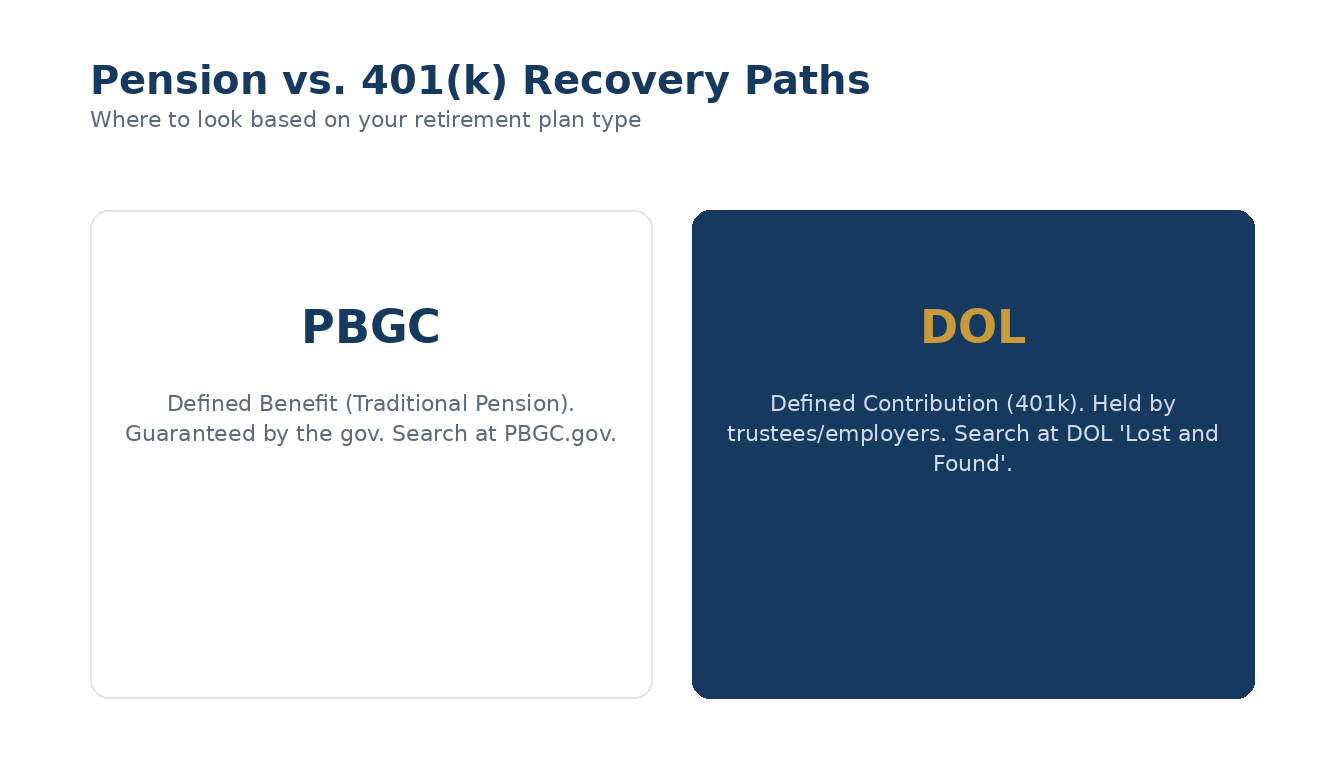
Defined Benefit vs. Defined Contribution: The Recovery Gap
One of the most common mistakes claimants make in 2026 is searching the wrong federal agency. You must understand the difference between the PBGC and the Department of Labor (DOL) to find your money. This is the “Recovery Gap” that often leads to dead ends.
Myth: All retirement money is found in the same place.
Reality: If your retirement was a 401(k), it is likely an “abandoned plan” held by a private trustee or the DOL. If it was a traditional pension (the kind where you didn’t choose the investments), it is held by the PBGC. As we covered in our guide to unclaimed 401(k)s, the search processes are entirely different.
If you aren’t sure which one you had, look at your old paystubs. If you see “401(k) Contribution,” you’re looking for a defined contribution plan. If you see no deduction but the company promised a “years of service” benefit, you are likely looking for a PBGC-protected pension. In 2026, the PBGC has expanded its Missing Participants Program to include some terminated 401(k)s, but the vast majority of their database remains traditional pensions.
SECURE 2.0 and the 2026 ‘Lost and Found’ Update
The year 2026 marks a turning point in pension recovery due to the full deployment of the Retirement Savings Lost and Found database. This tool, created under the SECURE 2.0 Act, was designed to be a “one-stop-shop” for workers to find their lost accounts. It acts as a digital bridge between the Social Security Administration, the DOL, and the PBGC.
Under Section 303 of the Act, the Department of Labor was required to consolidate plan information from decades of filings. This means that even if the PBGC doesn’t have your money yet, the 2026 Lost and Found tool can tell you which insurance company or bank currently holds the “annuity” your old employer purchased for you. You can find detailed technical breakdowns of these requirements in the DOL SECURE 2.0 Fact Sheet.
This inter-agency cooperation is vital because many companies “de-risk” their pensions by buying insurance contracts. In these cases, the money isn’t at the PBGC; it’s with a private insurer like Prudential or MetLife. The 2026 database is the first time these private contracts have been made searchable alongside federal holdings.

The ‘Missing Participant’ Audit: Step-by-Step
If you suspect you have a pension from a former employer, do not wait for the government to find you. While the PBGC does conduct periodic outreach, their data is only as good as your last known address. Follow this specific 2026 audit protocol:
- Access the PBGC Search Tool: Navigate to the official “Search for Unclaimed Pensions” portal. You do not need to create an account to perform an initial search. You can search by your last name or the name of the company.
- Search for the ‘Plan Name’ specifically: Many people search for their own name and find nothing. Instead, search for the name of the company as it existed when you worked there. Corporate name changes (e.g., searching for “Sears” vs. “Kmart”) are a major hurdle.
- The ZIP Code Filter: If your name is common, the PBGC tool will allow you to filter by the state where the plan was located. This is usually the state where the company’s headquarters was situated, not necessarily where you lived while working.
- Check the ‘Potential Private Benefit’ list: If your name doesn’t appear in the PBGC database, search the Social Security Administration’s records for a “Potential Private Retirement Benefit.” When you file for Social Security, the SSA often flags if a former employer reported that you were “vested” in a pension.
A common mistake is assuming that a “no results” hit means the money is gone. It often just means the plan hasn’t been terminated yet. If the company is still in business, your money is with the company’s current pension administrator, not the PBGC.
The ‘Golden Key’ Documents for 2026 Claims
Filing a claim with the PBGC is free, but it requires specific verification. Because pension benefits are often calculated based on “years of service” and “final average salary,” the more documentation you have, the faster your payout. If you are missing these, your claim can stall for months.
The most important document is the SSA-L99 (Social Security Benefit Information). This document provides a year-by-year breakdown of your earnings and the employers who reported them. Since many pensions are 30+ years old, this is the definitive proof that you worked the required “vesting period” (usually 5 to 10 years) to qualify for the money.
| Document Type | Why It Matters | Where to Find It |
|---|---|---|
| SSA-L99 / Earnings Record | Proves years of service for vesting | Social Security Administration |
| Summary Plan Description (SPD) | Defines the formula for your payout | Old HR files or DOL e-Fast search |
| Form W-2 (Legacy) | Confirms the specific entity that employed you | Personal tax records or IRS transcripts |
| Marriage Certificate | Required for survivor benefits/name changes | County Clerk’s Office |
In 2026, the PBGC has moved to a “digital first” verification system. You can now upload these documents through a secure portal rather than mailing physical copies, which has reduced the average verification time from 6 months down to roughly 45 days.
Pension Payout Timelines: What to Expect
Once you are identified as a missing participant, you have two primary options: a lump sum or an annuity. This is a critical financial decision. In 2026, the PBGC’s “De Minimis” threshold is $7,000. If your total benefit is less than this amount, the PBGC will generally pay you a single lump sum check. If it is more than $7,000, you can choose to receive monthly payments for the rest of your life.
The processing timeline generally follows this path:
- Initial Discovery: 5 minutes (via the online search tool).
- Inquiry Submission: You fill out a contact form providing your SSN and current address.
- Benefit Determination: 30-60 days. The PBGC calculates your specific benefit amount based on the plan’s old rules.
- Final Election: 15 days. You receive a packet in the mail (or digital portal) asking how you want to be paid.
- Payment Issuance: 30 days after the election form is processed.
If you are claiming a pension for a deceased relative, the timeline can double. You will need to provide a death certificate and proof that you are the named beneficiary or the legal heir. For more on this specific process, see our guide on unclaimed property for deceased relatives.
Scam Warning: The ‘Pension Recovery’ Red Flags
Because pension amounts can be significant, they are a prime target for scammers. In 2026, “Pension Poaching” scams have become more sophisticated, often using AI-generated letters that look identical to official PBGC correspondence. Keep these rules in mind to protect your identity and your retirement funds.
The PBGC will never ask you to pay a fee to recover your pension. As a federal agency, their services are entirely free. If a “recovery specialist” or “pension locator” contacts you and asks for a percentage of the find (often 10% to 30%), you are likely dealing with a private “finder” or a scammer. You can do everything they do for free at PBGC.gov.
Additionally, the PBGC will never ask for your Social Security Number over the phone in an unsolicited call. If you receive a call claiming to be from the PBGC, hang up and call their official toll-free number (1-800-400-7242) to verify the inquiry. Official correspondence will almost always come via the U.S. Postal Service or through the secure portal you initiated.

Unclaimed Pension FAQ
Does the PBGC search include 401(k) plans?
Generally, no. The PBGC primarily handles “defined benefit” pensions. However, since 2018, their “Missing Participants Program” has allowed some 401(k) plan administrators to transfer forgotten accounts to the PBGC when a company closes. You should search both the PBGC and the DOL’s Abandoned Plan database to be safe.
What if my former employer is still in business but the pension is gone?
If the company is still active, they may have simply frozen the plan or transferred it to an insurance company. In this case, the PBGC will not have your money. You should contact the company’s Human Resources department or search the “Department of Labor Form 5500” database to find the current plan administrator.
Can I claim a pension from 40 years ago?
Yes. There is no expiration date for claiming a pension held by the PBGC. As long as you were “vested” (meaning you worked long enough to earn a legal right to the benefit), the money remains in the federal trust until you or your beneficiaries claim it.
How much does it cost to use the PBGC search?
The service is 100% free. The PBGC is a federal government agency funded by insurance premiums paid by employers; they never charge workers a fee to search for or recover their own earned benefits.