

Last updated: July 2026
Figures and program details can change – always verify current details on the official source before acting.
Quick answer
Massachusetts is currently holding over $3.4 billion in unclaimed funds. You can search for your name for free at the official state website, FindMassMoney.gov. If you find an asset, you can file a claim online or via mail; the state never charges a fee for this service and holds the money indefinitely until it is claimed by the rightful owner or heir.
Key takeaways
- The Massachusetts State Treasury holds $3.4+ billion in forgotten assets, ranging from uncashed payroll checks to dormant stocks.
- There is no time limit to claim your funds; the Commonwealth holds them in perpetuity for you or your heirs.
- Search only through the official FindMassMoney.gov portal to avoid predatory “finder” fees and scams.
- Claims for deceased relatives are common but require additional probate or death certificate documentation.
How Your Search Begins on FindMassMoney.gov
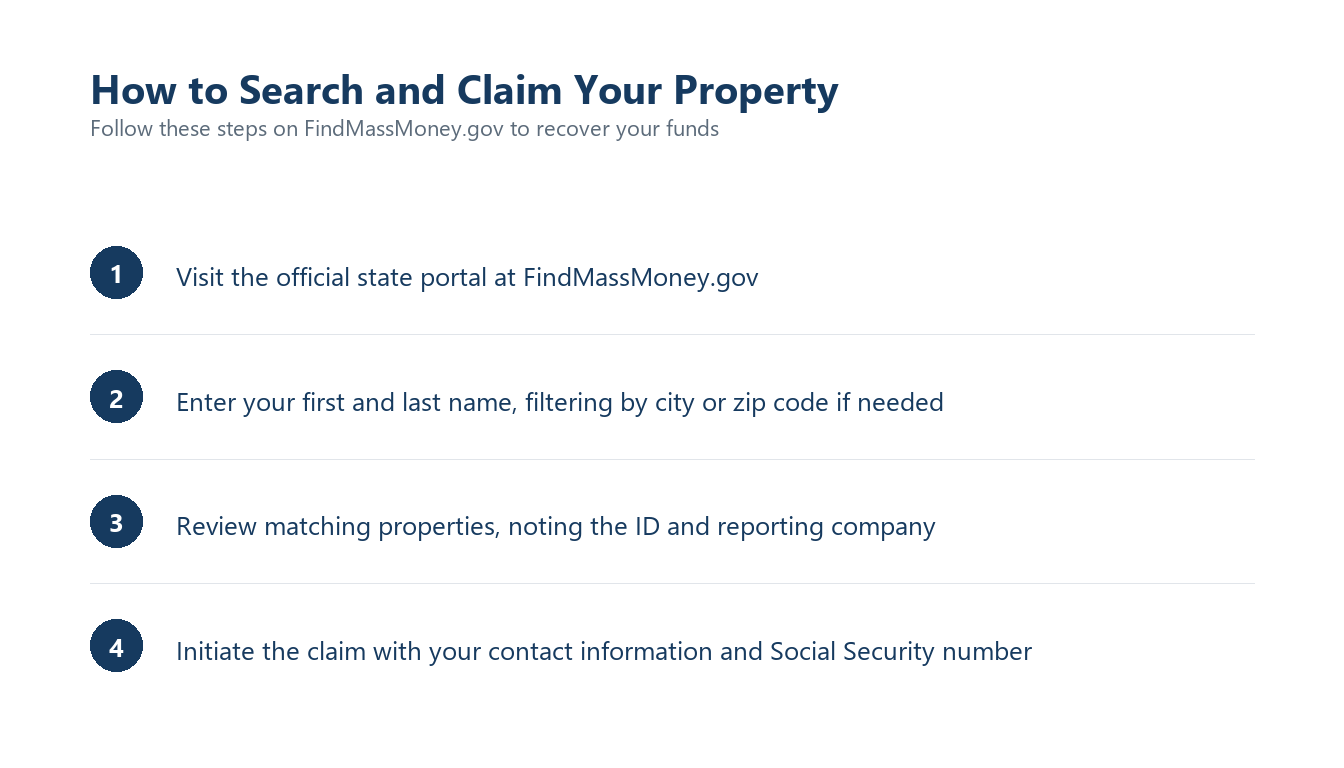
Imagine you are sitting at your desk in Boston, or perhaps you moved away from Worcester years ago. Out of curiosity, you decide to search your name. Say a search turns up $2,400 under your name—a forgotten utility deposit or an old payroll check. What happens next? How do you actually get that money back into your bank account? Your journey begins with a free online search. Finding out if you have forgotten assets waiting for you in the Bay State is a simple, straightforward process. Follow this step-by-step walkthrough to navigate the database and initiate your claim:
- Visit the Portal: Navigate to the official state portal at FindMassMoney.gov. Unlike some third-party search engines, this site is free and provides real-time access to the state’s database.
- Enter Your Details: Start by entering your last name and first name. If you have a common name, you can filter by city or zip code to narrow the results.
- Review the Matches: If you find a match, the system will display a property ID and a general description of the asset, such as “Uncashed Check” or “Dividends.” It will also show the name of the company that reported the funds, which can help you verify if the claim is legitimately yours.
- Initiate the Claim: Once you select your properties, you will be prompted to provide your current contact information and Social Security number to initiate the claim. While the online process is streamlined for simple cash claims, high-value assets or complex stock transfers may require additional steps.
Gathering Your Proof and Navigating the Notary Rules
Once you submit the claim for your $2,400, the verification phase begins. Before the State Treasurer will cut a check, they must verify your identity to prevent fraudulent claims. For a standard claim, you will typically need to provide a copy of a government-issued photo ID and proof of your Social Security number.
Proving you lived at the address associated with the property is often the most challenging step for older claims. Useful documents include old utility bills, tax returns, or even a piece of postmarked mail that shows your name and the old address listed in the database. If you are claiming property on behalf of a business, you will need to provide documentation of your authority to act for that entity, such as an EIN number or articles of incorporation. Organizing these documents early can significantly reduce the processing time, which usually takes several weeks.

Because your hypothetical claim of $2,400 exceeds a certain dollar threshold—often $1,000 or more—Massachusetts will require your claim form to be notarized. This is a standard security measure to ensure that the person signing the document is truly who they claim to be.
You can find a notary at most local banks, UPS stores, or town clerk offices. In Massachusetts, many banks provide this service for free or for a nominal fee to their customers. Once the document is notarized, you must mail the original hard copy to the Unclaimed Property Division in Boston; digital copies are usually not accepted for high-value claims. If you are filing from outside of Massachusetts, a notary from your current state is perfectly acceptable. Just ensure the notary’s stamp is clear and their commission has not expired, as the Treasurer’s office will reject documents with illegible seals or expired credentials.

But what if the database reveals that the $2,400 belongs to a deceased relative instead of you? A significant portion of the $3.4 billion fund belongs to individuals who have passed away. In Massachusetts, these assets can be claimed by the legal heirs or the executor of the estate. This process is more involved than a personal claim and requires specific legal paperwork. You will generally need to provide a death certificate and documentation showing your relationship to the deceased. If the estate went through probate, you might need a copy of the “Letters of Authority” issued by the Probate and Family Court. In cases where the value is low, Massachusetts may allow for a simplified process, but for larger sums, the state strictly adheres to inheritance laws. If you are unsure of your status as an heir, consulting the official state directory for Massachusetts legal resources can be a helpful starting point.
Behind the Scenes: From State Laws to Your Mailbox
As you wait for your paperwork to process, you might wonder why Massachusetts is holding your $2,400—or any of the other common types of forgotten property—in the first place. The entire operation of the unclaimed property division is governed by Massachusetts General Laws Chapter 200A. Under these rules, the dormancy period for most property types is three years. This means if you leave a bank account untouched and the bank cannot reach you by mail, they are legally obligated to send that money to the state after 36 months of inactivity.
The Division of Unclaimed Property, managed by the Office of the State Treasurer, acts as a temporary custodian to ensure the money isn’t simply absorbed by a corporation’s bottom line. Massachusetts currently oversees one of the most robust unclaimed property programs in the United States, with a total fund value exceeding $3.4 billion. These funds are not “government money”; rather, they represent private property that has been turned over to the state because the original owner could not be located. Because of the state’s dense population and history as a financial hub, the average claim value in Massachusetts often trends higher than the national average.
Uncashed payroll checks are remarkably common, often resulting from a final paycheck that was mailed to an old address after an employee left a job. Utility deposits are another frequent entry. When you move out of an apartment and close your electricity or gas account, companies often issue a refund for your initial deposit. If that check is returned as undeliverable, it eventually ends up in the state’s hands. Stocks, bonds, and mutual funds represent some of the highest-value claims. If a brokerage loses contact with you, they may liquidate your positions and send the cash to the state, or transfer the shares themselves. This is particularly common with older life insurance policies or forgotten 401(k) accounts from early in a career.
One unique aspect of the Massachusetts program is that it includes tangible property. This includes the contents of safe deposit boxes, which are eventually auctioned off if the owners are not found, though the cash proceeds from those sales are held forever for the owner to claim. If a bank hasn’t received rent for several years and cannot contact the owner, the physical items—jewelry, coins, stamps, and collectibles—are sent to the state. The state holds the items for a period of time before selling them at a public auction. However, the story doesn’t end there. The state keeps the cash proceeds from the sale forever. If you discover that your grandfather’s safe deposit box was auctioned in 2015, you can still claim the full dollar amount that the items fetched at auction. The database will usually list these entries under the bank’s name. If you see a listing that says “Safe Deposit Box Contents,” you should act quickly to file a claim, especially if the items haven’t been auctioned yet, as you may be able to recover the physical heirlooms themselves.
If you have lived or worked across state lines, you should also keep in mind that FindMassMoney.gov only searches property held within the Commonwealth. It does not track federal assets like IRS tax refunds, U.S. Treasury bonds, or military benefits. For those, you must look toward federal registries. Many Massachusetts residents have forgotten pension funds from out-of-state employers or life insurance policies from companies that have since merged. As we discussed in our guide on federal registries people never check, these require a different set of tools and search protocols. By combining a state-level search with a federal check, you ensure that no stone is left unturned. Massachusetts is often the most lucrative starting point, but it is only one piece of the puzzle if you have lived or worked in multiple states or for large national corporations.
When looking at the New England landscape, Massachusetts stands out as the primary hub for unclaimed assets. This is largely due to the concentration of insurance companies, mutual fund providers, and tech firms headquartered within the Commonwealth, all of which are subject to strict reporting laws. For residents who have moved across state lines, it is often worth checking neighboring databases as well. However, the sheer volume of assets held by the Massachusetts Treasurer dwarfs the combined totals of several nearby states, making it the most critical registry for New Englanders to monitor.
As illustrated, the $3.4 billion held in Boston represents a massive pool of liquidity compared to the funds held in Hartford, Providence, or Concord. This underscores why the Massachusetts search portal should be your first stop if you have lived anywhere in the Northeast.
Unlike a few other states that have rolled out fully automatic “money match” programs that mail a check with no claim form required, Massachusetts has not adopted one — the Treasurer’s office does send outreach mail to owners it can identify, but you still need to file a claim yourself to actually get paid. Don’t wait for a surprise check to show up; you should still perform a manual search. Even a well-run outreach effort misses older assets or properties where the name on file has a slight misspelling or a middle initial that doesn’t match current records.

Protecting Your Payout from Finder Scams
While you wait for your $2,400 check, you must stay alert to potential red flags. The existence of $3.4 billion in “free money” attracts scammers. You may receive a letter, email, or social media message from someone claiming they have found money in your name—perhaps referencing your exact asset—and offering to recover it for a 10% to 30% “finder’s fee.”
While some of these “asset locators” are legal businesses, they are entirely unnecessary. Massachusetts law limits the fees these finders can charge, but more importantly, you can perform the exact same search and filing yourself for $0. The state’s official website will never ask for your credit card or a payment to process your claim.
Be particularly wary of any communication that uses high-pressure tactics or asks for your full Social Security number over the phone. Official correspondence from the Massachusetts State Treasurer will generally come via physical mail on official letterhead and will direct you back to the .gov website.
| Feature | Official State Search | Private Finder Services |
|---|---|---|
| Cost | 100% Free | 10% to 30% Fee |
| Website Extension | .gov | .com or .org |
| Access to Data | Direct & Real-time | Third-party or delayed |
| Security | Secure Government Encryption | Varies; risk of data sale |
Frequently Asked Questions
Does Massachusetts charge a fee to search for money?
No, the official search through FindMassMoney.gov is entirely free. The state also does not charge any commission or administrative fees to process your claim and return your funds.
How long does it take to get a check from Massachusetts?
Once your claim is approved, most checks are mailed within 30 to 90 days. Complex claims involving stocks, safe deposit box contents, or estates may take longer due to additional verification steps.
Is there a deadline to claim my money in the Bay State?
No. Massachusetts holds unclaimed property in perpetuity. Whether the money was turned over last year or thirty years ago, it remains available for the original owner or their legal heirs to claim at any time.
What happens if I find money for a company that is out of business?
You can still claim the money if you can prove you were the rightful owner at the time the funds were generated. This often requires providing old employment records or contracts showing your relationship with the defunct company.