

Last updated: August 2026
Figures and program details can change – always verify current details on the official source before acting.
Quick answer
Tennessee is currently holding over $1.2 billion in unclaimed property. Residents can search the official ‘Claim It TN’ database at ClaimItTN.gov to find forgotten utility deposits, uncashed paychecks, and insurance refunds. Most simple claims in 2026 are processed in as little as 10 to 14 days for free.
Key takeaways
- The Tennessee Treasury holds more than $1.2 billion in lost assets for current and former residents.
- The official ‘Claim It TN’ portal allows for expedited ‘Evidence-Free’ claims on smaller, verified amounts.
- Tennessee law caps professional finder fees at 10%, though the official state search is always free.
- Dormancy periods for most Tennessee assets range from one to five years before they must be turned over to the state.
The Tennessee ‘Fast-Track’ Timeline: From Search to Payout
In August 2026, the Tennessee Department of Treasury has optimized its processing engine to handle a record volume of claims. The journey from discovering a lost asset to receiving your funds has been streamlined into a predictable cycle that most residents can complete in under two weeks. This acceleration is largely due to the integration of real-time identity verification systems that cross-reference Department of Safety records with the Unclaimed Property database.
The process begins the moment you enter your name into the official database, where the system immediately flags your property for either ‘Standard’ or ‘Fast-Track’ verification. For many Tennesseans, the state’s modern data-matching technology allows for an ‘Evidence-Free’ claim, where your identity is verified through public records rather than physical paperwork. If your property is valued under the state’s internal automated threshold—often applied to utility refunds or small bank balances—you may be able to complete the entire process without uploading a single document.
Once a claim is initiated, the Treasury’s Unclaimed Property Division performs a secondary audit to ensure no competing claims exist. This involves checking for liens, child support offsets, or other state obligations that might legally supersede the claimant’s right to the full amount. If your claim meets the criteria for automated approval, the payout is typically authorized within 72 hours, with a physical check or electronic transfer arriving shortly thereafter. For those opting for direct deposit, the timeline is even tighter, frequently resulting in funds appearing in bank accounts within 10 business days of the initial search.
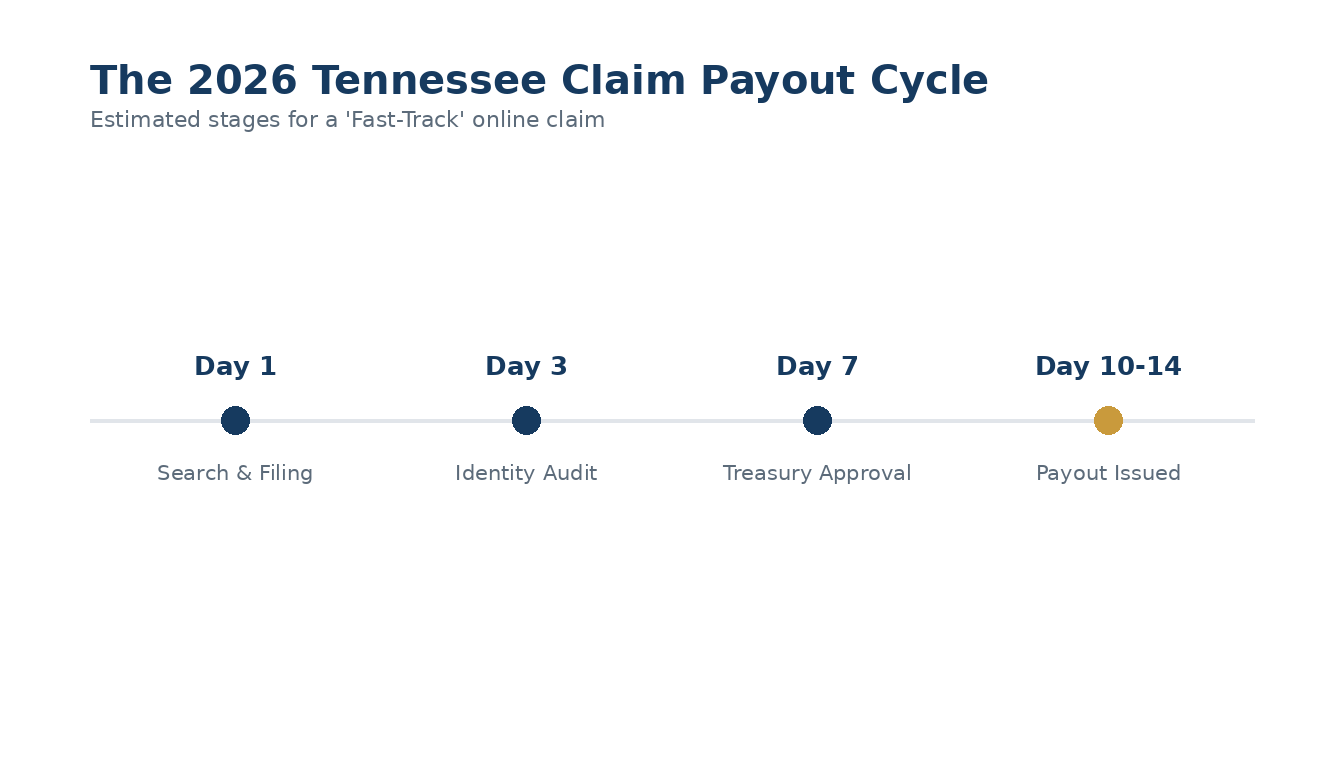
State Treasurer David H. Lillard, Jr. has emphasized the importance of this efficiency, stating that the goal is to “return this money to its rightful owners as quickly as possible” to help stimulate the local economy. This focus on speed is a direct response to the growing $1.2 billion pool of assets that continues to expand annually. By reducing the bureaucratic friction of the claims process, the Treasury has seen a marked increase in the total dollar amount returned to the public year-over-year.
A Geographic Audit: Where Tennessee’s $1.2 Billion is Hidden
While the $1.2 billion total is a statewide figure, the concentration of unclaimed money often aligns with Tennessee’s major metropolitan hubs. Shelby County, home to Memphis, frequently leads the state in the total number of unclaimed accounts, followed closely by Davidson County (Nashville) and Knox County. The high density of corporate headquarters in these regions contributes significantly to the accumulation of uncashed checks and vendor credits.
These urban centers generate higher volumes of unclaimed assets due to the high frequency of residential moves and business turnovers. When a resident moves from an apartment in Germantown to a home in Collierville, a final utility deposit or a stray paycheck often fails to follow them to their new address. In the fast-paced Nashville rental market, security deposits and overpaid water bills frequently fall through the cracks of the forwarding address system, eventually defaulting to the state’s custody after the statutory dormancy period.
Rural counties in Middle and East Tennessee also hold significant totals, though these often consist of smaller, more numerous accounts like uncashed dividend checks from local cooperatives or forgotten insurance premiums. For example, in counties like Greene or Lawrence, many residents may be unaware of agricultural subsidies or co-op payouts that were mailed to old PO boxes or family farm addresses. Regardless of your location, the legal requirement for businesses to report these funds remains the same across all 95 counties, ensuring that a resident in rural Perry County has the same access to their funds as someone in downtown Chattanooga.

How to Navigate the ‘Claim It TN’ Official Search Portal
To begin your search, you must use the official Tennessee portal at ClaimItTN.gov. Unlike third-party sites that may charge a fee, this state-run resource is free and provides direct access to the most current records held by the Department of Treasury. The portal is updated frequently, often weekly, to reflect new reports submitted by holders such as banks, insurance companies, and utility providers.
The search interface requires only your last name and first initial, though adding your city or zip code can help filter results if you have a common name. It is highly recommended to search for variations of your name, including maiden names, middle initials, and even common misspellings that a former employer might have recorded. Don’t forget to search for variations like “A. Smith” or “Alex Smith” if your legal name is Alexander. The system also allows for a “Property ID” search if you have received a notification letter from the state containing a specific reference number.
If you find a match, the portal will allow you to add the property to a digital ‘cart’ and proceed to the filing stage. This cart system is particularly useful if you find multiple small amounts—such as three different utility refunds from different years—as it allows you to file them all under one master claim number. You will be asked to provide your Social Security number and current contact information to initiate the verification process, which is encrypted and managed by the Tennessee Department of Treasury. At this stage, the system will determine if your claim qualifies for the “Fast-Track” processing based on the accuracy of the data match.
Tangible Assets: From Safe Deposit Boxes to the Auction Block
While most of Tennessee’s $1.2 billion exists as “intangible” currency—bank balances, stocks, and uncashed checks—a portion of the fund consists of tangible property. This most commonly originates from safe deposit boxes that have been abandoned or for which the rent has gone unpaid for at least three years. When a bank in Tennessee closes an abandoned box, the contents are inventoried and eventually turned over to the Treasury.
The Treasury does not have the physical space to store the contents of every abandoned safe deposit box indefinitely. Periodically, the state holds public auctions to convert these physical items into cash. These auctions often include rare coins, jewelry, and historical collectibles. The proceeds from the sale are then held in the owner’s name, meaning that if your grandfather’s gold watch was auctioned, you can still claim the cash value of that sale even decades later.
It is important to note that certain items are handled with extra care. State Treasurer Lillard has prioritized the return of military medals and decorations. Tennessee law and Treasury policy prohibit the auctioning of military honors; instead, the state maintains a dedicated effort to locate the veterans or their next of kin to return these irreplaceable items. If you believe a family member’s military honors were left in a forgotten safe deposit box, the ‘Claim It TN’ search is the first step in the recovery process.
The ‘Evidence-Free’ Threshold: When You Don’t Need Paperwork
One of the most significant updates to the Tennessee claim process in 2026 is the expansion of the ‘Evidence-Free’ threshold. For many claims under a specific dollar amount—often those involving simple utility refunds or uncashed checks—the state can verify your ownership using only your Social Security number and historical address data. This is part of a broader “government at the speed of life” initiative designed to reduce the friction of reclaiming small-dollar assets.
This automated verification removes the traditional ‘audit roadblock’ of finding old paystubs or utility bills from a decade ago. If the information you provide in your claim matches the data reported by the holding company perfectly, the system may bypass the request for physical documentation entirely. For example, if a former employer in Jackson reported a $150 uncashed paycheck under your SSN, and you currently live at an address verified by the DMV, the system can instantly confirm the match.
However, if the claim is for a high-value asset, such as unclaimed stocks or mutual funds, or if the property belongs to a deceased relative, you should expect to provide official identification. This is a safeguard designed to prevent identity theft and ensure the funds reach the correct heir. High-value claims often require a notarized claim form and a copy of a government-issued photo ID to ensure the highest level of security before the state releases significant sums of money.

Common Mistakes: What Trips Up Tennessee Claimants
Even with a streamlined system, several common errors can delay a Tennessee unclaimed property payout by weeks or even months. The most frequent mistake is providing an incomplete address history. When the Treasury audits a claim, they look for a “link” between your current location and the address the holding company had on file ten years ago. Providing every address you’ve lived at since you began your professional life in Tennessee can significantly speed up the approval.
Another common hurdle is the ‘Maiden Name Gap.’ Many residents search only their current legal name and forget to check the names they used while in college or during previous marriages. Since property is tied to the name on the original account, these assets remain invisible to a standard search. If you lived in an apartment in Knoxville under a different surname in 2018, that is the name you must search to find your security deposit refund.
Finally, many claimants fail to check for businesses they may have owned or operated. In Tennessee, unclaimed property can be held under a business EIN just as easily as a personal SSN. If you ran a small LLC, a family-owned shop, or a freelance business in the past, performing a separate search for the business entity name is essential. This includes “Doing Business As” (DBA) names, as vendor credits and overpayments are often issued to the trade name rather than the owner’s personal name.
| Property Type | Tennessee Dormancy Period | Common Source |
|---|---|---|
| Unclaimed Wages | 1 Year | Uncashed Final Paychecks |
| Utility Deposits | 1 Year | Electric, Water, Gas Refunds |
| Bank Accounts | 3 to 5 Years | Savings and Checking Balances |
| Life Insurance | 3 Years | Death Benefits and Annuities |
| Safe Deposit Boxes | 3 Years | Contents of Unpaid Lockers |
The Business Owner’s Guide: Checking for Corporate Assets
While the focus of ‘Claim It TN’ is often on individuals, Tennessee businesses are actually some of the largest owners of unclaimed property in the state. From small retail shops in Murfreesboro to large manufacturing plants in Chattanooga, companies often lose track of utility deposits, insurance premium refunds, and credit balances with vendors. These assets stay on the books of the holding company until the dormancy period expires, at which point they are remitted to the Treasury.
To search for business assets, use the same portal but enter the company name in the search field. If your business has a common name, use the city filter to narrow the results. For larger corporations with multiple subsidiaries, it is vital to search for every legal entity name used in the state. Once a business claim is initiated, the Treasury will typically require proof of authorization, such as a letter on company letterhead signed by an officer or a copy of the company’s organizational documents, to ensure the person claiming the funds has the legal right to do so.
Additionally, businesses have their own responsibilities under the Tennessee Uniform Unclaimed Property Act. They must perform “due diligence” by attempting to contact the owner of the property before turning it over to the state. This usually involves sending a letter to the owner’s last known address for any property valued at $50 or more. Staying compliant with these reporting requirements is just as important for Tennessee business owners as checking the database for their own lost funds.
Tennessee Dormancy Rules: The Countdown to the Treasury
Understanding the ‘Dormancy Clock’ is vital for managing your finances in Tennessee. Under the Uniform Unclaimed Property Act, businesses are required to turn over assets to the state after a specific period of inactivity, known as the dormancy period. This clock begins on the date of the last contact between the owner and the holder or the date the check was originally issued.
For most liquid assets like uncashed wages or utility refunds, this clock is relatively short, often just one year. This means if you leave a job in Nashville in June 2025 and never pick up your final check, that money will likely be reported to the state by the fall of 2026. This rapid turnaround is designed to get the money into the state’s protected custody as quickly as possible, where it is more likely to be found by the owner than if it remained in an old employer’s payroll system.
Other assets, such as bank accounts or unclaimed life insurance benefits, have longer dormancy periods, typically ranging from three to five years. These funds are held by the original institution for several years before being transferred to the state’s custody. Once the money reaches the Treasury, it is held in the Unclaimed Property Trust Fund. Importantly, Tennessee is a “custodial” state, meaning they never take permanent ownership of the funds. They act as a perpetual custodian, holding the money indefinitely until claimed by the rightful owner or their heirs.
Protecting Yourself: Tennessee Scam Red Flags
As the Tennessee unclaimed property fund grows, so does the activity of ‘unclaimed money’ scammers. These individuals often use social media, unsolicited mail, or even text messages to convince residents that they have a massive windfall waiting. They often use official-sounding names like the “Tennessee Asset Recovery Division” to gain trust, but their end goal is always the same: to get your personal financial information or an upfront payment.
In Tennessee, any legitimate claim through the official Department of Treasury is entirely free. The state never charges a fee to search for or recover your own money. If you receive a call asking for your credit card number, a wire transfer, or a prepaid gift card to ‘release’ your funds, hang up immediately and report the contact to the Tennessee Division of Consumer Affairs. The Treasury will never contact you via social media or text message to demand payment for a claim.
While Tennessee law does allow professional ‘finders’ (also known as investigators) to assist with claims, their fees are strictly capped at 10% of the recovered amount. These finders must be registered and are legally prohibited from contacting you about property that has been held by the state for less than 24 months. This two-year “waiting period” is a consumer protection measure designed to give you a window to find and claim the money yourself at no cost before a professional solicitor can intervene. If you are contacted by a finder, always ask for their state registration and remember that you can still file the claim yourself for free at ClaimItTN.gov.

Tennessee’s ‘Proactive’ Outreach in 2026
In an effort to reduce the $1.2 billion balance, the Tennessee Treasury has increased its proactive outreach efforts. This includes matching Treasury records with other state databases, such as the Department of Safety and Homeland Security and the Department of Revenue, to find current addresses for owners of lost property. This data-matching allows the state to send “Notice of Unclaimed Property” letters directly to people who might not even know they have money waiting.
If the state successfully matches your identity and current address with a high degree of certainty, they may send a letter directly to your home informing you of the funds. These letters will always direct you back to the official ClaimItTN.gov website and will never ask for payment. If you receive one of these letters, it is not a scam—it is the result of the state’s modern effort to be a more active participant in returning funds rather than waiting for residents to find them.
This regional focus often extends to community events. In 2026, the Treasury has scheduled several ‘Claim It’ events at county fairs and community centers across the state, from the Appalachian Fair in Gray to the Delta Fair in Memphis. These events allow residents to search the database with the help of state staff and initiate claims on the spot. In many cases, if you have your photo ID with you at these events, the state staff can verify your identity immediately, further shortening the payout timeline. Keeping an eye on the official Tennessee Treasury social media pages or local news outlets can help you find when a mobile search unit will be in your area.
Looking for another state? See our full state-by-state unclaimed money directory to find your state’s official search portal.
Frequently Asked Questions
How long does Tennessee hold unclaimed property?
Tennessee holds unclaimed property indefinitely. There is no statute of limitations on your right to claim these funds, and the state will continue to hold the money until the rightful owner or a legal heir comes forward to claim it. Even if the property was turned over to the state twenty or thirty years ago, the value is preserved for you. However, it is important to note that while the state holds the principal amount, they do not generally pay interest on the funds while in their custody, so it is in your best interest to claim the money as soon as possible.
Is there a fee to search for unclaimed money in Tennessee?
No, the official search and claim process through the Tennessee Department of Treasury is 100% free. Any website or individual asking for an upfront fee is likely a scammer, as Tennessee law only permits professional finders to take a percentage after the money is recovered. The official state portal at ClaimItTN.gov does not require a credit card or any form of payment to search the database or file a claim. If you encounter a site that looks like the official one but asks for payment, double-check the URL to ensure it ends in ‘.gov’.
What documents do I need to file a claim in Tennessee?
For many small claims that qualify for “Fast-Track” processing, you may only need your Social Security number and address history. For larger or more complex claims, such as those over $2,000 or involving stock certificates, you may be asked to provide a copy of your driver’s license, proof of your Social Security number (like a redacted W-2 or Social Security card), and documentation linking you to the address where the property originated (like an old utility bill or bank statement). The ‘Claim It TN’ portal will provide a specific checklist of required documents once you initiate your claim based on the type and value of the asset.
Can I claim property for a family member who has passed away?
Yes, Tennessee allows heirs to claim property belonging to deceased relatives. You will typically need to provide a death certificate and documentation proving you are the legal heir, such as a will, an order from a probate court, or a small estate affidavit. If the estate was never probated, Tennessee has specific “Affidavit of Heirship” forms that can be used for smaller amounts. This process ensures the money is distributed according to Tennessee’s inheritance laws. For more details on this process, see our guide to inherited assets.