
Last updated: August 2026
Figures and program details can change – always verify current details on the official source before acting.
Quick answer
Key takeaways
- Safe deposit boxes enter ‘unclaimed’ status after 3 to 5 years of inactivity or unpaid rent.
- Once the state receives the property, a countdown begins before items are sold at auction.
- Military medals are a rare exception and are almost never sold by state treasuries.
- You can still claim the cash value of auctioned items decades after the sale.
The 2026 Auction Clock: Why Urgency Matters for Tangible Assets
While most people think of unclaimed property as uncashed checks or forgotten bank balances, some of the most valuable assets held by the government are physical. In 2026, state treasuries across the U.S. are managing a massive influx of ‘tangible property’—the industry term for the contents of safe deposit boxes that have been drilled and emptied by banks due to inactivity.
Unlike a forgotten $500 savings account, which the state will hold in cash form indefinitely, physical heirlooms are subject to the ‘Auction Clock.’ Because state vaults have limited physical space, laws in almost every jurisdiction allow the Treasurer or Comptroller to sell items like jewelry, rare coins, and collectibles at public auction. Once an item is sold, the original owner loses the heirloom forever, though they retain a permanent right to claim the net proceeds from that sale.
The timeline for this process is surprisingly fast. In many states, the auction cycle begins just 12 to 24 months after the state takes possession of the box contents. If your family had a safe deposit box that was last accessed in 2021 or 2022, that property is likely hitting state auction blocks in late 2026. Understanding how to intercept this process is the difference between recovering a grandmother’s engagement ring and receiving a check for its ‘melt value’ years later.
The Drilling Process: How Your Heirlooms Reach the State
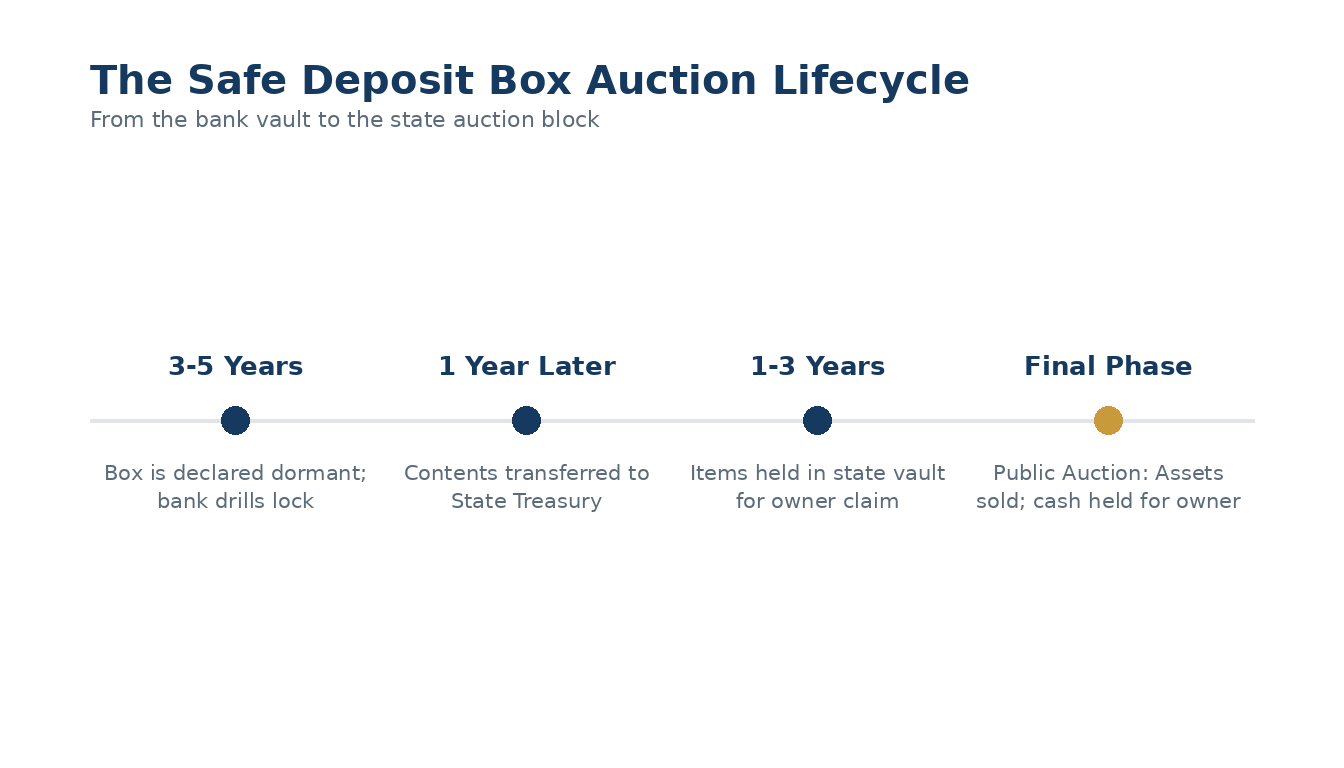
A safe deposit box doesn’t just disappear into a government vault overnight. The journey begins at the bank level, usually triggered by two events: the expiration of the lease agreement or a multi-year period where the rental fee remains unpaid. Under most state laws, such as those governed by the National Association of Unclaimed Property Administrators (NAUPA) standards, the dormancy period for these boxes is typically three to five years.
Once the dormancy period expires, the bank is legally required to ‘drill’ the box. This is performed in the presence of at least two bank employees or a notary to ensure an accurate inventory. Every item—from loose diamonds to a child’s birth certificate—is cataloged. The bank then holds these items for an additional ‘holding period’ (often one year) before shipping them to the State Treasurer’s office.
It is important to note that the bank often deducts ‘drilling fees’ and unpaid rent from any cash found inside the box before sending the balance to the state. If no cash is present, the state may eventually deduct these costs from the proceeds of the auction. As of 2026, the average drilling and administrative fee is roughly $150 to $300, which is why small claims are sometimes exhausted before they even reach the state level.
The Military Medal Exception: A Permanent Safeguard
One of the most important developments in unclaimed property law over the last decade involves military honors. Recognizing the irreplaceable sentimental value of Purple Hearts, Bronze Stars, and other service medals, many states have passed specific legislation to exempt these items from the Auction Clock. In states like Texas and California, the law specifically forbids the state from selling military medals.
Texas Comptroller Glenn Hegar has frequently highlighted this distinction, noting that the goal for these specific items is ‘return at any cost’ rather than liquidation. According to the Texas Comptroller’s official guidance, military medals are held in a separate, permanent inventory while the state conducts proactive outreach to veterans’ organizations and family genealogists to find the rightful heirs.
If you are searching for a deceased relative’s military history, the unclaimed property database is an overlooked resource. Many veterans kept their original discharge papers (DD-214) and medals in safe deposit boxes that were eventually abandoned. In 2026, these items remain some of the only tangible assets that will never be sold, waiting indefinitely for a descendant to come forward.
How to Search the ‘Tangible Property’ Inventory
Searching for a safe deposit box requires a slightly different approach than searching for a lost paycheck. Most state portals, including the California State Controller’s Search, allow you to filter results by ‘Property Type.’ When searching, look for codes like ‘SD’ or ‘Safe Deposit’ and descriptions that mention ‘Tangible’ or ‘Box Contents.’
When you find a match, the database will often show a generic description like ‘Jewelry’ or ‘Coins’ rather than a detailed photo. This is a security measure to prevent fraudulent claims. To prove ownership, you will generally need to provide the original safe deposit box key or, more commonly, proof that you were the authorized renter or the legal heir of the estate. Because these claims involve physical shipping and insurance, the processing time in 2026 is often longer than cash claims—typically 90 to 120 days.
If the search indicates the property has already been sold, do not stop your claim. The state is legally required to hold the ‘Net Proceeds’ of the sale in your name forever. Even if the auction happened in 1995, you can still claim the cash today. Many families find that a box containing ‘miscellaneous papers’ actually held stock certificates that the state liquidated, resulting in a claim worth thousands of dollars in today’s currency.
Myth vs. Reality: The Truth About Government Auctions
There are several dangerous misconceptions about safe deposit boxes that lead people to ignore their potential claims. Addressing these myths is the first step toward a successful recovery.
Myth: “The bank keeps the jewelry if I don’t pay the rent.”
Reality: Banks are prohibited from keeping the contents of a safe deposit box for their own profit. They must turn all items over to the state after the legal dormancy period. The only thing the bank can keep is the specific amount owed for rent and the physical cost of drilling the lock.
Myth: “The government sells everything for pennies on the dollar.”
Reality: States use professional auction houses (often via platforms like eBay or specialized jewelry auctions) to ensure ‘Fair Market Value.’ For example, the California State Controller’s Office holds regular auctions where items are appraised and sold to the highest bidder to maximize the proceeds held for the owner.
Myth: “If I lost the key, I can’t claim the box.”
Reality: Most unclaimed boxes have already been drilled by the time they reach the state. You do not need the physical key to file a claim; you need ‘Evidence of Ownership,’ such as a bank statement showing the rental, the original lease agreement, or a death certificate and probate documents if you are the heir.
Comparing Asset Treatment: What the State Keeps vs. Sells
Not every item in a safe deposit box is treated the same. State treasuries must prioritize items with financial value while managing the disposal of junk. This table outlines how different items are typically handled in the 2026 unclaimed property cycle.
| Item Category | Dormancy Period | State Action | Auction Timeline |
|---|---|---|---|
| Jewelry & Gold | 3–5 Years | Appraised & Inventoried | Sold after 1–3 years |
| Collectibles (Stamps/Coins) | 3–5 Years | Professional Valuation | Sold in specialized cycles |
| Stock Certificates | 3 Years | Converted to Book Entry | Liquidated immediately (usually) |
| Wills & Deeds | 3–5 Years | Held for a limited time | Often destroyed if not claimed |
| Military Medals | Varies | Permanently Shelved | Never sold (Most states) |
Avoiding ‘Treasure Finder’ Scams and Auction Fraud
The tangible nature of safe deposit boxes makes them a prime target for ‘finder’ scams. In 2026, a common tactic involves scammers sending letters or emails claiming they have located a ‘box of gold’ or ‘valuable heirlooms’ belonging to your deceased relative. These scammers often use real names found in public death notices to make the claim seem legitimate.
The biggest red flag is a request for an upfront fee to ‘release’ the items from the state. Official state agencies—whether it is the New York Comptroller or the Florida Bureau of Unclaimed Property—will never charge you an upfront fee to search for or claim your property. While professional ‘investigators’ or ‘finders’ are legally allowed to charge a commission (usually capped by state law at 10% to 15%), they only get paid after you receive your property, never before.
Furthermore, be wary of websites that look like official auction portals but ask for membership fees to ‘view’ the unclaimed jewelry inventory. Real state auctions are either conducted through well-known, public third-party auctioneers or through the state’s own transparent government website. If you are asked to pay just to look at what the state is holding, you are being targeted by a scam.

Common Mistakes in Safe Deposit Box Recovery
Many claimants fail to recover their property due to simple administrative errors. Avoiding these pitfalls can significantly speed up your 2026 payout.
- Failing to search maiden names: Safe deposit boxes are often held for decades. If your mother or grandmother rented a box in the 1960s, it will likely be listed under her maiden name or a former married name.
- Ignoring ‘Zero Value’ listings: Some databases list property as having ‘No Value’ because it consists of documents. However, these documents could be life insurance policies or deeds to property that are worth a fortune.
- Incomplete Heirship Proof: If the owner is deceased, the state requires a complete ‘Table of Consanguinity’ or a probate court order. Simply being the oldest child is rarely enough to claim physical jewelry without a legal right to the estate.
- Wait-and-See Approach: Because of the Auction Clock, waiting even six months can mean the difference between getting a family heirloom back and getting a check for its scrap metal value.
How long do I have to claim the contents of a safe deposit box?
You have an indefinite amount of time to claim the value of the property. However, you typically only have 1 to 3 years after the state receives the items to claim the physical objects themselves before they are sold at auction.
What happens to the personal photos and letters inside the box?
Items with no commercial value, such as personal letters and photos, are held by the state for a short period (often 1 year) and then destroyed if not claimed. States do not have the resources to store non-financial personal effects permanently.
Can I claim a box that belonged to my grandparent?
Yes, if you are the legal heir. You will need to provide a death certificate, proof of your identity, and documentation showing that the estate has been settled or that you are the rightful successor under your state’s small estate laws.
Will the state notify me if they have my safe deposit box?
By law, banks must attempt to notify you at your last known address before turning the property over to the state. However, if you moved without updating your address, the state will simply list the property in their public database and wait for you to find them.