

Last updated: August 2026
Figures and program details can change – always verify current details on the official source before acting.
Quick answer
Billions in life insurance benefits remain unclaimed because beneficiaries are unaware the policies exist or the insurance companies cannot locate the heirs. You can recover these funds for free using the NAIC Life Insurance Policy Locator Service and the VA’s insurance database. Most claims are processed within 30 to 60 days once the proper death certificate and beneficiary identification are provided. In many cases, even if a company has gone out of business, state guaranty associations ensure that these benefits are eventually reachable by the rightful heirs.
Key takeaways
- Insurance companies must turn over unpaid benefits to the state after a dormancy period (typically 3-5 years).
- The NAIC Policy Locator is the primary national tool for finding private policies, acting as a central clearinghouse for search requests.
- Veterans have a dedicated federal search tool for unclaimed VA life insurance dividends and policy proceeds.
- Avoid ‘policy tracers’ who charge high percentages; these searches are free to perform yourself via state and federal portals.
- Documentation is the bottleneck: obtaining a certified death certificate and proof of relationship is the most time-consuming part of the process.
The Myth of the Automatic Payout
Many Americans believe that if a loved one passes away, the life insurance company will automatically reach out with a check. In reality, while many companies now use the Social Security Administration’s Death Master File (DMF) to trigger internal audits, millions of dollars still slip through the cracks every year. This happens most often with older ‘industrial’ policies or when a policyholder moves without updating their address. Historically, insurance companies were not required to proactively search for deceased policyholders until several high-profile legal settlements in 2011 and 2012 forced a shift in industry standards.
Before these regulatory changes, many insurers would simply wait for a claim to be filed. If no one called, the company would continue to draw premiums from the policy’s cash value until the money ran out, at which point the policy would lapse. Today, stricter state laws require insurers to check the DMF regularly, but the system is far from perfect. Misspelled names, transposed digits in a Social Security number, or name changes due to marriage can all cause a “missed match,” leaving the death benefit sitting in a corporate account indefinitely.
A common myth is that if you don’t have the physical policy document, the money is gone forever. The reality is that the contract still exists in the insurer’s records, and legal requirements force them to eventually turn that money over to state treasuries if it remains unpaid. This process, known as escheatment, ensures that the state holds the money in trust until a beneficiary comes forward. However, you don’t have to wait for it to hit a state vault to start your search; in fact, claiming directly from the insurance company is often faster and involves less red tape than claiming from a state’s unclaimed property division.

How to Conduct a Professional-Grade Policy Audit
If you suspect a family member had coverage but you lack the paperwork, you should begin with a structured audit of their personal history. Start by looking for ‘premium’ payments in old bank statements or canceled checks. Even a small recurring payment to a company like MetLife, Prudential, or Northwestern Mutual is a massive red flag that a policy exists. Look specifically for payments made annually or quarterly, as these are common for older whole-life policies.
Next, dive into the paper trail of their financial life. Check the deceased’s income tax returns from the last few years. Specifically, look at Schedule B (Interest and Ordinary Dividends). If the policy was a whole-life or universal-life policy that accrued dividends or interest, the insurance company would have issued a Form 1099-INT. Even if the policy itself was small, the tax record provides the name of the company and a point of contact for your search.
Furthermore, check with former employers. Many people carry group life insurance that they forget to convert to individual policies or that remains as a residual benefit for retirees. As we’ve discussed in our guide to federal registries, these workplace benefits often sit in separate databases from standard state unclaimed property files. Don’t overlook professional associations, unions, or fraternal organizations like the Knights of Columbus or the Elks Lodge, which often provided low-cost group life insurance to their members as a core benefit.
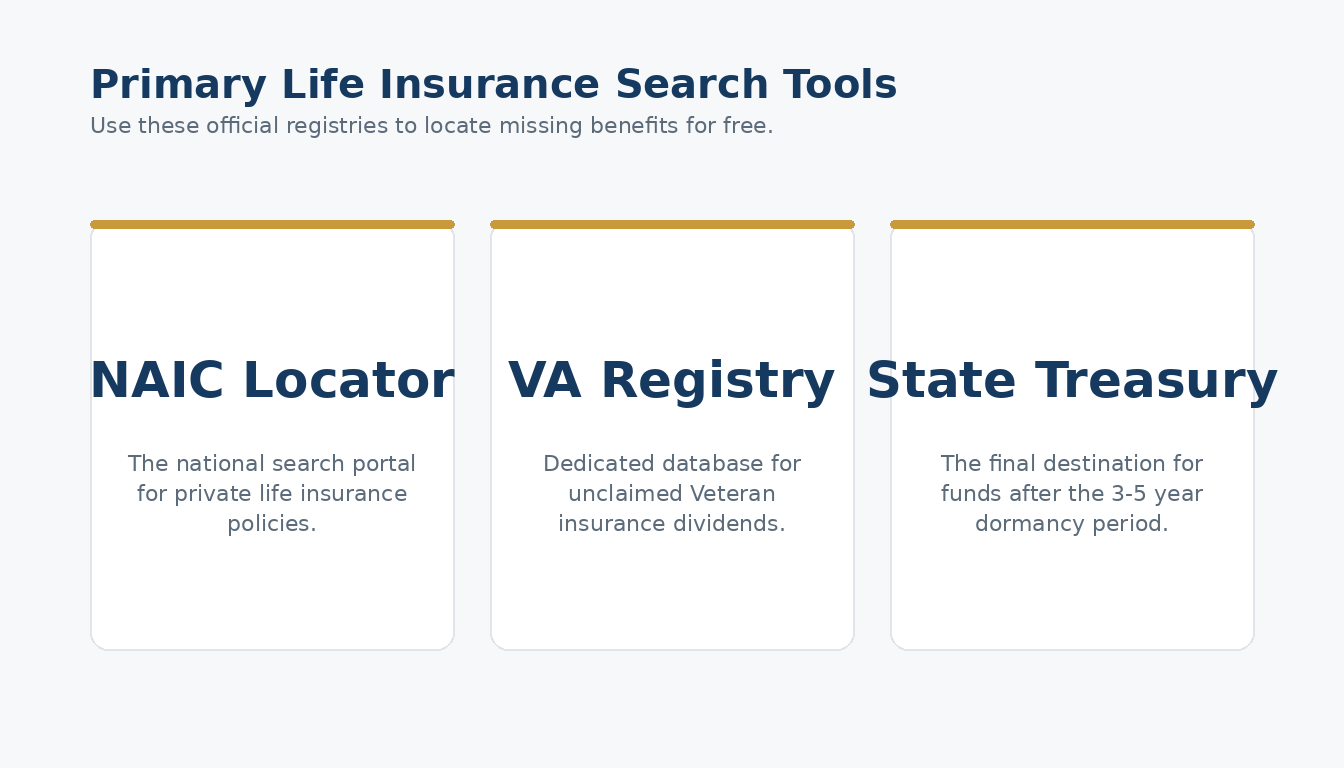
Once you have a list of potential insurers, use the official national tools. The most powerful is the Life Insurance Policy Locator Service provided by the National Association of Insurance Commissioners (NAIC). This tool allows you to submit a request that is sent to all participating insurance companies, who then check their records for a match. According to the NAIC, this tool has helped consumers find over $1 billion in previously lost benefits. It is important to note that the NAIC does not “search” a database themselves; rather, they broadcast your request to the compliance departments of hundreds of insurance companies, who then have 90 days to respond if a match is found.
Using Official Search Portals
There are two primary gateways for these funds. For private policies, visit the NAIC Policy Locator. This tool is free, but it requires a high level of detail to be effective. You will be asked for your relationship to the deceased and proof of your legal right to the information. For veterans and their families, the Department of Veterans Affairs maintains its own database. You can search for unclaimed insurance funds specifically for veterans at the official VA Unclaimed Insurance Funds portal. This includes benefits from programs like Servicemembers’ Group Life Insurance (SGLI) and Veterans’ Group Life Insurance (VGLI).
When using these tools, accuracy is paramount. You will need the deceased’s full legal name (including middle names and suffixes), Social Security number, and exact date of death. If you are a beneficiary, the company will contact you directly. If the money has already been sent to the state because the company couldn’t find you for several years, you will need to search the state treasurer’s database in the state where the policyholder last lived. However, there is a catch: if the insurance company is headquartered in a different state, the funds might be escheated to that state instead. For example, if your relative lived in Florida but the insurer was headquartered in New York, it is worth checking New York’s unclaimed property database as well.

The Multi-Step Payout Timeline
Filing a claim for life insurance is more rigorous than claiming a forgotten utility deposit. Because the sums are often significant, the verification steps are strict. Understanding the timeline helps manage expectations and prevents you from falling for ‘fast cash’ scams that offer to expedite the process for a fee. Most delays in payouts are not caused by the insurance company’s reluctance to pay, but by incomplete documentation provided by the claimant.
| Phase | Action Required | Typical Duration |
|---|---|---|
| Initial Search | Submit NAIC/VA request | 1 – 3 Weeks |
| Match Notification | Insurer confirms policy match | 30 – 90 Days |
| Documentation | Submit Death Certificate & ID | User Dependent |
| Review | Insurer verifies beneficiary status | 2 – 4 Weeks |
| Payout | Funds issued via check or ACH | 7 – 10 Days |
As noted by the American Council of Life Insurers, “The process of finding the rightful beneficiary is a priority for companies, but they must ensure they are paying the correct individual under the specific terms of the contract.” This verification is for your protection, ensuring a random ‘tracer’ doesn’t intercept your family’s legacy. If the policy is older than two years (the standard “contestability period”), the review is usually straightforward. However, if the policy was recently opened or if the cause of death is complex, the review phase may involve the insurer requesting medical records to ensure no material misrepresentations were made on the original application.
Common Mistakes and Red Flags
The biggest mistake claimants make is assuming that a search of a single state’s unclaimed property site is enough. If the insurance company was headquartered in a different state, the funds might be held there. Always search both the state of residence and the state where the insurance company is domiciled. Additionally, many people forget to check for ‘premium refunds’—small amounts of money returned if a policy was overpaid before death. While the death benefit might be $100,000, there could be an additional $1,200 in unearned premiums that belong to the estate.
Another overlooked area is “Industrial Life Insurance” policies. These were small-value policies sold door-to-door in the mid-20th century, often with face values of just $500 or $1,000 intended to cover burial costs. Because the amounts are small, people often lose track of them. However, many of these policies were “participating,” meaning they accrued dividends over 50 years. A policy that started at $500 in 1960 could be worth several thousand dollars today. These are frequently found in the NAIC database because the policyholders moved and the “collector” stopped coming to the door.
Regarding scams, be wary of any individual who contacts you claiming they found a ‘lost’ policy for you in exchange for 30% of the value. These ‘private investigators’ are often just using the same free tools mentioned in this guide. There is no secret database that they have access to that you do not. If someone asks for your Social Security number over the phone to ‘verify a policy,’ hang up and call the insurance company’s official customer service line directly. Legitimate insurance companies will never ask for a “processing fee” up front to release your funds.

Special Scenarios: Deceased Beneficiaries and Lost Companies
What happens if the named beneficiary is also deceased? In these cases, the funds typically go to the estate of the beneficiary or the secondary (contingent) beneficiary named in the policy. If no contingent beneficiary was named, the death benefit usually defaults to the estate of the policyholder. You will likely need ‘Letters of Administration’ or ‘Letters Testamentary’ from a probate court to prove you have the legal right to claim the money on behalf of the estate. This adds time to the process but ensures the money is distributed according to law or the deceased’s will.
If the insurance company that issued the policy no longer exists, don’t panic. The life insurance industry is highly consolidated. Most old companies were bought by larger firms. For example, policies once held by smaller regional insurers might now be managed by giants like Lincoln Financial or Brighthouse Financial. You can track the history of a company through the NAIC’s research tools or your state’s Department of Insurance. Even if a company went bankrupt, every state has a ‘Life and Health Insurance Guaranty Association’ that protects policyholders and ensures benefits are paid up to certain limits (usually $300,000 in death benefits). You can search for your state’s specific association through the National Organization of Life and Health Insurance Guaranty Associations (NOLHGA).
Frequently Asked Questions
Is there a fee to search for unclaimed life insurance?
No. Both the NAIC Life Insurance Policy Locator and the VA search tools are completely free to use. State unclaimed property websites are also free. You should never pay for a search service or provide a percentage of the find to a third party. If a private company contacts you, they are likely searching the same free databases you can access yourself. The only cost you might legitimately incur is a small fee for a certified copy of a death certificate from a vital records office.
How long do I have to claim a life insurance policy?
There is generally no expiration date on the right to claim life insurance benefits. Even if the money has been turned over to the state as unclaimed property, it is held in perpetuity until the rightful owner or heir claims it. Unlike a standard contract that might have a statute of limitations, the obligation of the insurer (and subsequently the state) to pay the beneficiary remains until the funds are successfully distributed. Even if a policy is 50 years old, it is worth investigating.
What if I don’t have the Social Security number of the deceased?
It is very difficult to perform an accurate search without a Social Security number, as insurers use this as the primary identifier to distinguish between people with similar names. You can often find this on a death certificate, old tax returns, military discharge papers (DD-214), or by requesting a copy of the deceased’s Social Security record through the SSA. If you absolutely cannot find it, some state databases allow you to search by name and last known address, though this will result in many false positives that you must manually filter.
Can I claim a policy if I am not the named beneficiary?
Generally, no. Life insurance is a private contract between the policyholder and the company. If you are not the named beneficiary or the legal representative of the estate, the company will not pay the funds to you. However, if you believe you were intended to be a beneficiary but were omitted due to a clerical error or fraud, you would need to seek legal counsel to contest the distribution. If all named beneficiaries are deceased and you are the next of kin, you can often claim the funds by opening a probate estate and filing as the executor or administrator.