

Last updated: July 2026
Figures and program details can change — always verify current details on the official source before acting.
When most people hear “unclaimed money,” they picture a forgotten checking account sitting in a state comptroller’s database. But three of the largest pots of unclaimed money in the country don’t come from banks at all — they come from jobs you left years ago and life insurance policies your family didn’t know existed. Between a federal pension insurer, the U.S. Department of Labor, and the insurance industry’s own national locator service, there are billions of dollars in retirement and life insurance benefits sitting unclaimed, most of it never showing up in the general-purpose unclaimed property searches most people already know about.
Quick answer
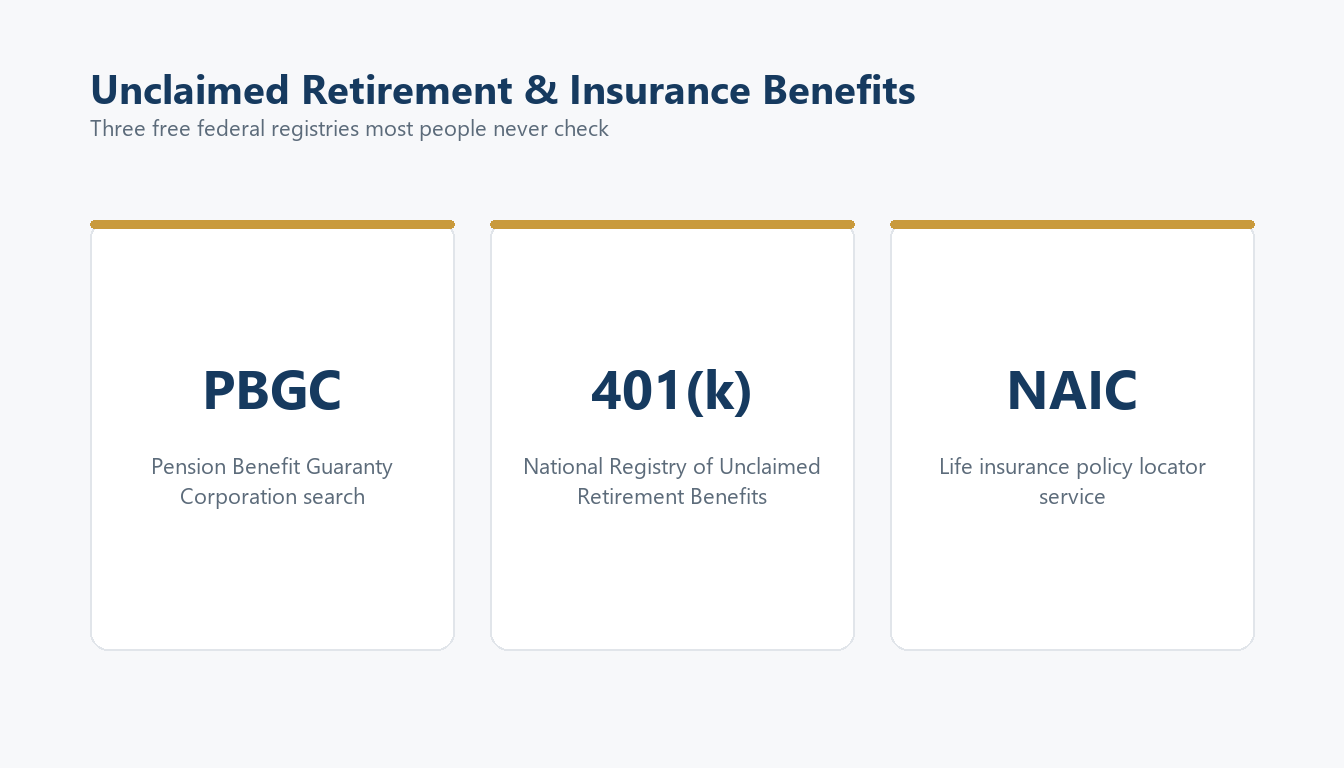
If you’ve ever left a job, especially one with a pension or 401(k), or had a relative pass away who may have carried life insurance, check three specific registries: the PBGC’s unclaimed retirement benefits search, the Department of Labor’s Retirement Savings Lost and Found database, and the NAIC’s Life Insurance Policy Locator. All three are free and none of them require you to pay a “finder” to search on your behalf.
Key takeaways
- Lost pensions, 401(k)s, and life insurance don’t show up in general unclaimed-property searches like MissingMoney.com.
- PBGC’s Missing Participants Program covers terminated pensions and wound-down 401(k)-type plans.
- The DOL’s Retirement Savings Lost and Found and Abandoned Plan Search help locate lost retirement accounts.
- NAIC’s Life Insurance Policy Locator can match a deceased relative to policies you didn’t know existed.
- All four registries are free to search directly — you never need to pay a benefit finder.
Why This Money Ends Up “Lost” in the First Place
Retirement and insurance money doesn’t vanish — it gets orphaned by paperwork. A company you worked for in the early 2000s merges, gets acquired, or shuts down, and the pension plan it sponsored terminates. If the plan administrator can’t track down every former employee to pay out their vested benefit, the money doesn’t just disappear; by law it has to go somewhere safe until the rightful owner is found. The same thing happens with 401(k) plans when a small employer closes and simply stops maintaining the account, or when a life insurance policyholder dies and the beneficiary never finds out the policy existed because the paperwork was in a filing cabinet nobody opened.
The common thread is that none of this shows up when you search a general unclaimed-property site like your state comptroller’s database or MissingMoney.com, because those systems are built around dormant bank accounts, uncashed checks, and similar financial instruments held by state treasuries — not pension plans regulated by federal law or life insurance policies held by private insurers. You have to go to the source.

The Three Registries Worth Checking
PBGC’s Missing Participants Program. The Pension Benefit Guaranty Corporation is the federal agency that insures private-sector pension plans. When a covered pension plan terminates and the administrator can’t locate someone who is owed a benefit, PBGC takes custody of the money so it isn’t lost. Today more than 80,000 people have an unclaimed defined-benefit pension sitting with PBGC, together worth over $400 million, with individual amounts ranging from twelve cents to nearly $1 million. For more than two decades the program has connected people to retirement benefits, and it has paid out over $57 million to workers and beneficiaries who came forward. The program used to cover only traditional pensions, but PBGC expanded it in 2018 to also accept unclaimed benefits from terminated 401(k)-type defined contribution plans — so if a small employer’s 401(k) plan was formally wound down rather than simply left dormant, this is a legitimate place to check, not just a pension-only tool. You search by last name and the last four digits of your Social Security number, and the database is refreshed quarterly.
The Department of Labor’s Retirement Savings Lost and Found database. Launched at the end of 2024, this is a newer, separate tool from the Employee Benefits Security Administration (EBSA) designed to help people locate retirement accounts they lost track of, by pulling information reported by plan administrators. It works alongside EBSA’s longer-running Abandoned Plan Search, which lets you look up whether a specific former employer’s plan has been formally terminated and abandoned, and who is now responsible for winding it down.
NAIC’s Life Insurance Policy Locator. Run by the National Association of Insurance Commissioners, this free tool is built for a different scenario: a relative has died and you suspect they had a life insurance policy or annuity, but you don’t know the company or have the paperwork. Since it launched in 2016, the locator has helped match beneficiaries to more than 460,000 policies and annuities worth a combined $10.1 billion. You submit the deceased person’s Social Security number, legal name, date of birth, and date of death, and participating insurers check their records against it.

Which Registry Covers What
| Registry | Best for | Info you need to search | Cost |
|---|---|---|---|
| PBGC Missing Participants Search | Old pensions and terminated 401(k)-type plans | Last name + last 4 of SSN | Free |
| DOL Retirement Savings Lost and Found | General lost 401(k)/retirement accounts | Name, SSN, date of birth | Free |
| DOL Abandoned Plan Search | Confirming a former employer’s plan was terminated | Employer or plan name | Free |
| NAIC Life Insurance Policy Locator | Life insurance or annuities left by a deceased relative | Deceased’s SSN, name, DOB, date of death | Free |
How to Search All Four in One Sitting
- List every employer you (or the deceased relative) worked for where a pension or 401(k) might have existed, especially jobs that ended more than five years ago or where the company no longer exists under the same name.
- Search PBGC’s unclaimed benefits tool with your last name and the last four digits of your Social Security number.
- Check the DOL’s Retirement Savings Lost and Found database and, separately, the Abandoned Plan Search if you know a specific former employer’s plan may have been terminated.
- If you’re searching on behalf of someone who passed away, gather their death certificate details and run the NAIC Life Insurance Policy Locator.
- Keep a record of what you searched and when, since these databases are updated on different schedules and a fresh search months later can surface something new.
Common Reasons Claims Get Rejected or Delayed
Finding your name in one of these databases is only step one — actually receiving the money is where most people get tripped up. A few patterns show up again and again:
- Name mismatches. A maiden name, a legal name change, or even a middle initial recorded differently on old plan paperwork versus your current ID can stall a match, especially with the PBGC search since it relies on an exact last-name lookup.
- No documentation of the employment relationship. If a plan requires proof you actually worked somewhere decades ago, an old pay stub, W-2, or offer letter can matter far more than people expect — it’s worth digging through old tax records before you start rather than after a claim stalls.
- Wrong beneficiary designation left unchanged. With life insurance in particular, a policy can technically be “found” through the NAIC locator but still be tied up if the named beneficiary is an ex-spouse or someone who predeceased the policyholder and the estate has to get involved instead.
- Assuming one search covers everything. Because PBGC, the DOL, and NAIC are three separate organizations with three separate databases, checking only one and assuming you’re in the clear is the single most common way people miss money they’re actually owed.
- Searching once and never again. PBGC’s database refreshes quarterly and new plans terminate every year, so a name that doesn’t appear today can appear in a later update — this isn’t a one-and-done check the way a bank account balance is.
None of these are reasons to give up on a claim — they’re just reasons to expect a follow-up request for documents rather than an instant payout, and to keep a folder of old employment and identity records on hand before you start.

What to Watch Out For
Because all four searches above are free and run directly by the federal government or an official insurance-regulator body, you should never need to pay anyone to perform the initial search for you. That hasn’t stopped a small industry of “benefit finder” and “unclaimed asset recovery” services from charging a fee, or taking a cut of whatever is recovered, for work you can do yourself in about fifteen minutes. Some of these services are legitimate businesses that specialize in the follow-up paperwork for complex estates, which can be a reasonable trade if you genuinely don’t have the time or capacity to chase it. But a service that asks for payment up front just to tell you whether money exists, before doing any actual recovery work, is offering you nothing you couldn’t get for free directly from PBGC, the DOL, or NAIC.

A New Federal Map for Your Lost Retirement Funds
Authorized by Section 303 of the SECURE 2.0 Act of 2022, the Department of Labor’s Employee Benefits Security Administration (EBSA) launched the federal Retirement Savings Lost and Found Database (at lostandfound.dol.gov). Designed to help locate a portion of the estimated 29.2 million forgotten 401(k) accounts—which collectively hold a staggering $1.65 trillion in assets—this digital registry allows users to search for unclaimed retirement benefits using their Social Security number after verifying their identity through Login.gov. Once accessed, the system does not display actual account balances; instead, it acts as a connection point, providing the exact name of the retirement plan and up-to-date contact information for the plan administrator so that savers can initiate a claim directly.
While the database is a significant step forward, claimants should be aware of several critical limitations. First, because the Internal Revenue Code’s strict privacy laws initially prevented the IRS from sharing Form 8955-SSA data, the Department of Labor had to rely on a voluntary direct-reporting intake portal for plan sponsors and recordkeepers. This voluntary structure means the registry is far from comprehensive, as many employers have not yet uploaded their data. Additionally, the voluntary direct upload template focuses narrowly on separated, vested participants who are age 65 or older. If you are younger, or if your former employer has neglected to upload your records, your account may not appear in the search results.
Furthermore, the database’s scope is restricted. It exclusively tracks private-sector and union-sponsored plans covered by the Employee Retirement Income Security Act (ERISA). It completely excludes municipal, state, and federal government plans, as well as church and religious organization plans. Finally, it does not track Individual Retirement Accounts (IRAs). If an old employer automatically rolled your small-balance 401(k) into a default IRA because you were unresponsive, this database will not show where those funds currently reside, requiring claimants to continue cross-referencing private registries like the National Registry of Unclaimed Retirement Benefits.
Bottom Line
General unclaimed-property searches only tell part of the story. If your career includes a job with a pension or 401(k) that you left behind, or you’re settling a relative’s estate and suspect a life insurance policy is out there somewhere, the PBGC, the Department of Labor, and the NAIC each maintain a free, official search built specifically for that gap — and none of them require a middleman to use.
Frequently Asked Questions
Do I have to pay taxes on an unclaimed pension or 401(k) payout?
Generally yes — a lump-sum retirement distribution is typically taxable income in the year you receive it, and you may be able to roll it into an IRA to defer taxes. Check with a tax professional before you accept a lump sum.
What if the company that owed me a pension no longer exists?
That’s exactly the situation PBGC’s Missing Participants Program and the DOL’s Abandoned Plan Search are built for — the plan’s obligations don’t disappear just because the sponsoring company does.
How long does the NAIC life insurance search take?
Typically around 90 business days, since the request has to be checked against records held by each participating insurer rather than a single central database.
Is there one single website that searches all of these at once?
No — PBGC, the DOL, and NAIC are separate organizations with separate systems, so each has to be searched individually.