

Last updated: July 2026
Figures and program details can change – always verify current details on the official source before acting.
Quick answer
New Jersey is currently holding approximately $6 billion in unclaimed property. You can search for your name for free through the official New Jersey Unclaimed Property Administration (UPA) website at unclaimedproperty.nj.gov. Most claims can be filed entirely online with digital document uploads, and there is no time limit to claim your funds.
Key takeaways
- New Jersey holds one of the largest unclaimed property funds in the U.S., totaling over $6 billion in 2026.
- The state uses a specific online portal (unclaimedproperty.nj.gov) that allows for fast-track digital claims.
- Common property types include forgotten utility deposits, uncashed payroll checks, and dormant investment accounts.
- New Jersey law requires businesses to turn over property after a three-year dormancy period for most asset types.
Busting the Myths of New Jersey Unclaimed Property
Myth 1: If I don’t claim my money quickly, the state of New Jersey gets to keep it forever.
Reality: This money doesn’t belong to the state; it belongs to current and former residents, as well as businesses that once operated within New Jersey borders. As of mid-2026, the New Jersey Department of the Treasury is managing a massive stockpile of forgotten assets. With over $6 billion currently sitting in the Unclaimed Property Administration (UPA) trust fund, New Jersey holds significantly more than many of its neighbors, including the funds detailed in our Pennsylvania unclaimed property guide.
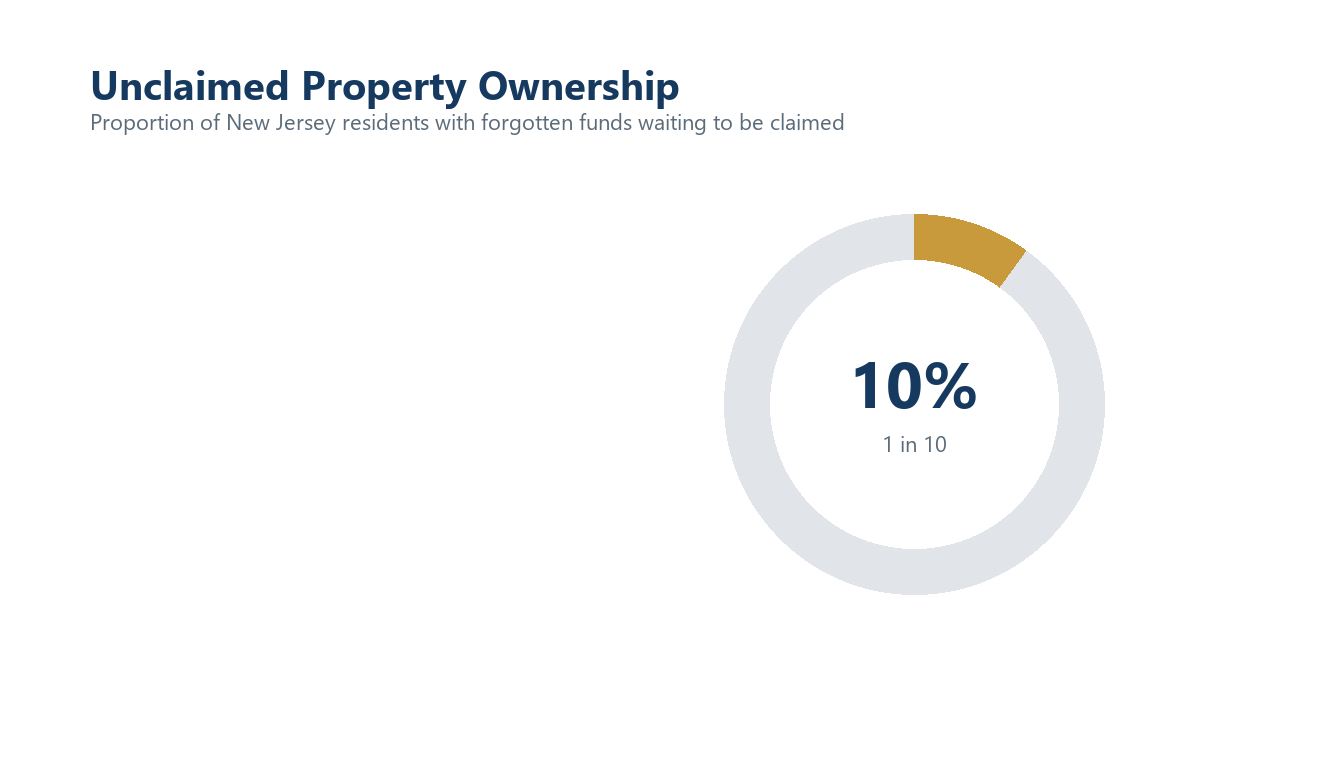
Every year, millions of dollars are added to this total as banks, insurance companies, and utilities lose track of their customers. Under the Uniform Unclaimed Property Act, these entities must legally transfer those funds to the state for safekeeping until the rightful owner is found. The sheer scale of the fund means that roughly one in every ten New Jersey residents likely has money waiting for them. Whether it is a $50 utility refund or a $50,000 forgotten stock portfolio, the state is legally obligated to return it to you once you prove your identity. In 2026, New Jersey has streamlined this process significantly, making it easier to search and claim than ever before.
When searching the database, it is critical to look for variations of your name. If your name is commonly misspelled or if you have used different middle initials, run multiple searches. Additionally, search for the names of deceased relatives. In New Jersey, unclaimed property never “escheats” (reverts permanently) to the state’s general fund; it is held forever, meaning you can claim funds belonging to a grandparent who passed away decades ago if you are the legal heir.
Myth 2: I have to pay a fee or hire a professional “finder” to get my money back.
Reality: The official New Jersey search and claim process is entirely free. To begin your search, you should avoid third-party sites that charge a fee. The only official, free website for New Jersey is maintained by the Department of the Treasury. While NJ does participate in national databases, their local portal provides the most up-to-date information on specific claim statuses and documentation requirements for high-value assets. If you find a match, the system will prompt you to “Claim” the property. Smaller, straightforward claims are generally processed with lighter documentation requirements, while larger amounts or complex assets like stocks require a more formal verification process to ensure the money goes to the correct person.
Because New Jersey holds such a massive fund, it is a prime target for “finders” or “locators.” These are individuals or companies that search public records to find people with large sums of money waiting for them. They then contact the owner and offer to help them recover the money for a percentage—sometimes as high as 35% or 50%. In New Jersey, it is perfectly legal for a licensed private locator to operate, but it is rarely necessary. You can do the exact same search and filing for free.
As we emphasize in our guide on how to find unclaimed money and spot scams, you should never pay for information that the state provides for free. If someone contacts you claiming to have found your money, take down the details, then go directly to the official NJ website to search for yourself. Be particularly wary of any “official-looking” letters that ask for your Social Security Number or a processing fee upfront. The New Jersey UPA will never ask you to pay a fee to receive your funds. If you receive a suspicious communication, you can report it to the New Jersey Division of Consumer Affairs to help protect others from potential fraud.
Myth 3: The payout process is immediate, and you don’t need any proof to make a claim.
Reality: The state of New Jersey is extremely thorough in its verification to prevent identity theft and fraud. Even for valid claims, you should expect to provide several pieces of evidence. The core requirement is proof of your Social Security Number (SSN) and a valid government-issued photo ID, such as a driver’s license or passport. Beyond basic identity, you must prove your connection to the “last known address” listed in the state’s records. If the property is from an apartment you lived in twenty years ago, you might need an old utility bill, a tax return, or even a high school transcript that shows you lived at that specific address during that timeframe.
If you are claiming on behalf of a deceased individual, the paperwork becomes more extensive. You will need a certified copy of the death certificate and proof that you are the executor of the estate or the legal heir. New Jersey provides specific forms for small estates (under $50,000) that can simplify this process, but it still requires careful attention to detail.

In recent years, the NJ Treasury has invested heavily in automation. If your claim is straightforward—meaning you are the original owner, the amount is moderate, and your current address is easily verifiable through public records—you may qualify for an expedited payout. These claims can sometimes be processed and paid within 30 to 45 days. However, for more complex claims, the timeline can stretch to 90 days or longer. This is particularly true for claims involving stock liquidations or safe deposit box contents. When the state holds stock, they may have sold it according to state law; in this case, you are claiming the cash value of the shares at the time of sale, plus any dividends accrued prior to that date. You can track the status of your claim through the same portal where you initiated the search. It is important to stay patient and respond quickly if the UPA requests additional information. Delays often occur not because of state bureaucracy, but because claimants fail to provide clear, legible copies of their supporting documents.

Myth 4: Only major bank accounts go unclaimed, and there’s nothing I can do to prevent it.
Reality: Unclaimed assets come in many different shapes and sizes, and staying organized is key to keeping your money in your hands. You might wonder how so much money goes missing in a single state. The answer lies in the “dormancy period.” In New Jersey, most financial assets are considered abandoned if there has been no contact with the owner for three years. For some specific items, like traveler’s checks, the period is much longer, but for the average checking account or uncashed paycheck, three years is the standard trigger. Once that period expires, the holder of the property—such as a bank or a former employer—must perform “due diligence” by attempting to mail a notice to your last known address. If you have moved and haven’t updated your records, that letter never reaches you. The business then sends the money to the NJ Treasury, and you become a name in their massive database.
The UPA doesn’t just hold cash; they also manage safe deposit box contents, which are occasionally auctioned off. The proceeds from these auctions are then held in perpetuity for the owner. This ensures that even if a physical item is sold, the monetary value remains available for the rightful heir or owner to claim at any point in the future. New Jersey categorizes these assets to help the UPA manage the billions in their care.
| Property Category | Dormancy Period | Common Examples |
|---|---|---|
| Banking Assets | 3 Years | Savings accounts, checking accounts, CDs |
| Insurance | 3 Years | Life insurance proceeds, premium overpayments |
| Utility Deposits | 1 Year | Electric, water, or cable TV security deposits |
| Retail/Government | 3 Years | Uncashed gift certificates, jury duty pay, tax refunds |
| Investments | 3 Years | Stock dividends, underlying shares, mutual funds |
While searching the database is a great first step, the best strategy is to prevent your money from becoming “unclaimed” in the first place. This requires a small amount of organizational effort once or twice a year. Keep a list of all your active bank accounts, utility deposits, and insurance policies, and ensure they all have your current mailing address on file. Another common source of unclaimed property in NJ is uncashed checks from the state itself. This can include property tax relief checks (like the ANCHOR program) or state income tax refunds. If you expect a check from the state and it doesn’t arrive within the expected timeframe, contact the Division of Taxation immediately rather than waiting for it to eventually end up in the UPA database. Finally, make sure your beneficiaries are aware of your assets. Many unclaimed life insurance policies end up with the state simply because the family didn’t know the policy existed. By maintaining a simple “financial map” for your heirs, you can ensure that your hard-earned money stays within your family rather than sitting in a state vault for decades.
Looking for another state? See our full state-by-state unclaimed money directory to find your state’s official search portal.
Frequently Asked Questions
Does New Jersey charge a fee for claiming property?
No. The New Jersey Unclaimed Property Administration does not charge any fees to search for or claim your property. Any website or person asking for an upfront fee is likely a scam or a private locator whose services you do not need.
How long can New Jersey hold my money?
New Jersey holds unclaimed property indefinitely. There is no statute of limitations, meaning you or your heirs can claim the funds 10, 20, or even 50 years after they were first turned over to the state.
Can I claim property for a business that is now closed?
Yes. If you were an officer or owner of a now-defunct New Jersey business, you can claim property held in the business’s name. You will need to provide documentation proving your authorization to act on behalf of the dissolved entity.
What happens to the interest earned on my unclaimed money?
In most cases, New Jersey does not pay interest on the funds it holds. You are entitled to the exact amount that was originally turned over to the state by the holder. This is why it is beneficial to claim your property as soon as possible.
For more information on large state funds, you may also want to check out the New York unclaimed property guide, as many people who work in NJ actually have assets across the border in NY as well.
Official Source Links:
New Jersey Unclaimed Property Administration (Official Site)
New Jersey Department of the Treasury
National Association of Unclaimed Property Administrators (NAUPA)