

Last updated: August 2026
Figures and program details can change – always verify current details on the official source before acting.
Quick answer
If the IRS or another federal agency seized funds from your bank account or wages to pay a debt that was already settled, or if a levy was issued in error, you have a strictly timed legal window to file for a return of those funds. In 2026, over $1.6 billion in unreturned federal levies remain in agency accounts because the affected individuals never filed the mandatory Form 8546 or its agency equivalents. This staggering figure represents money that technically belongs to taxpayers but remains trapped in the federal system because the recovery process is not automatic and requires the taxpayer to initiate a formal claim against the Treasury.
Key takeaways
- Federal law allows for the return of levied funds if the seizure was ‘wrongful’ or procedurally flawed.
- Unlike state unclaimed property, these funds are held in a ‘federal silo’ and will never appear on MissingMoney.com.
- The IRS 2026 guidelines provide a specific window (usually 2 years) to recover funds from a released or wrongful levy.
- You must audit your ‘Certified Transcript of Account’ to identify these hidden credits.
The Hidden Federal Silo: Why Your State Search Failed
Most Americans believe that if the government owes them money, it eventually trickles down to the state treasurer’s office. This is a costly misconception. When the IRS or the Bureau of the Fiscal Service (BFS) seizes money through a levy or an offset, those funds exist in a federal vacuum. If that levy is later found to be improper—perhaps you had already paid the debt or the notice was sent to a decades-old address—the money doesn’t move to your state’s unclaimed property list.
Instead, these funds sit as ‘unapplied credits’ or ‘levy proceeds’ within the federal Treasury. Because these are technically considered part of a tax or debt case file, they are protected by privacy laws that keep them off public search engines. You cannot find this money by typing your name into a website; you must initiate a proactive audit of your federal records. The distinction lies in the legal status of the funds: state unclaimed property generally consists of private sector obligations (utility deposits, uncashed payroll, insurance payouts) where the holder lost contact with the owner. In contrast, federal levy funds are government-held assets resulting from an enforcement action. Because the government is the “holder” and the “enforcer,” they are not legally bound by state escheatment laws.
Furthermore, the Treasury Offset Program (TOP) acts as a centralized clearinghouse for federal debts. If one agency (like the Social Security Administration) seizes too much, the excess doesn’t just sit in a general pot; it is often applied to other potential debts across a network of hundreds of federal and state agencies. If those agencies also have no record of debt, the money can enter a state of “accounting limbo” where it is credited to your Social Security number but never issued as a check until a specific Request for Return of Property is filed.

The 2026 ‘Wrongful Levy’ Audit: A Step-by-Step Recovery
The path to recovery starts with a document most people never request: the IRS Record of Account. In 2026, the IRS has streamlined the ‘Get Transcript’ tool, allowing you to see if there are credits on your account that were never refunded. You are looking for ‘Transaction Code 670’ (Payment) or ‘Transaction Code 736’ (Levy) that isn’t matched by a corresponding debt.
To perform a thorough audit, you must look for specific indicators of a “trapped” credit. Look for a line item showing a negative balance at the top of the transcript—this is a clear sign of an overpayment or an over-levy. However, the more common scenario is a “settled” account that still shows a TC 736 (Levy) amount that exceeds the original TC 300 (Assessment). If the levy amount plus any subsequent voluntary payments (TC 610) is greater than the total tax, interest, and penalties assessed, the IRS is holding your money.
If you identify a seizure that occurred after a debt was satisfied, or if the seizure caused ‘economic hardship’ (a specific 2026 legal threshold), you are eligible to file for a return of the funds. According to the IRS Internal Revenue Manual, ‘the Commissioner has the discretion to return levied property’ if it will facilitate the collection of the tax liability or is in the best interest of the government and the taxpayer. In 2026, the definition of “best interest” has been expanded to include cases where the levy prevented the taxpayer from maintaining basic life necessities, such as housing or medical care, even if the levy was technically legal at the time it was issued.
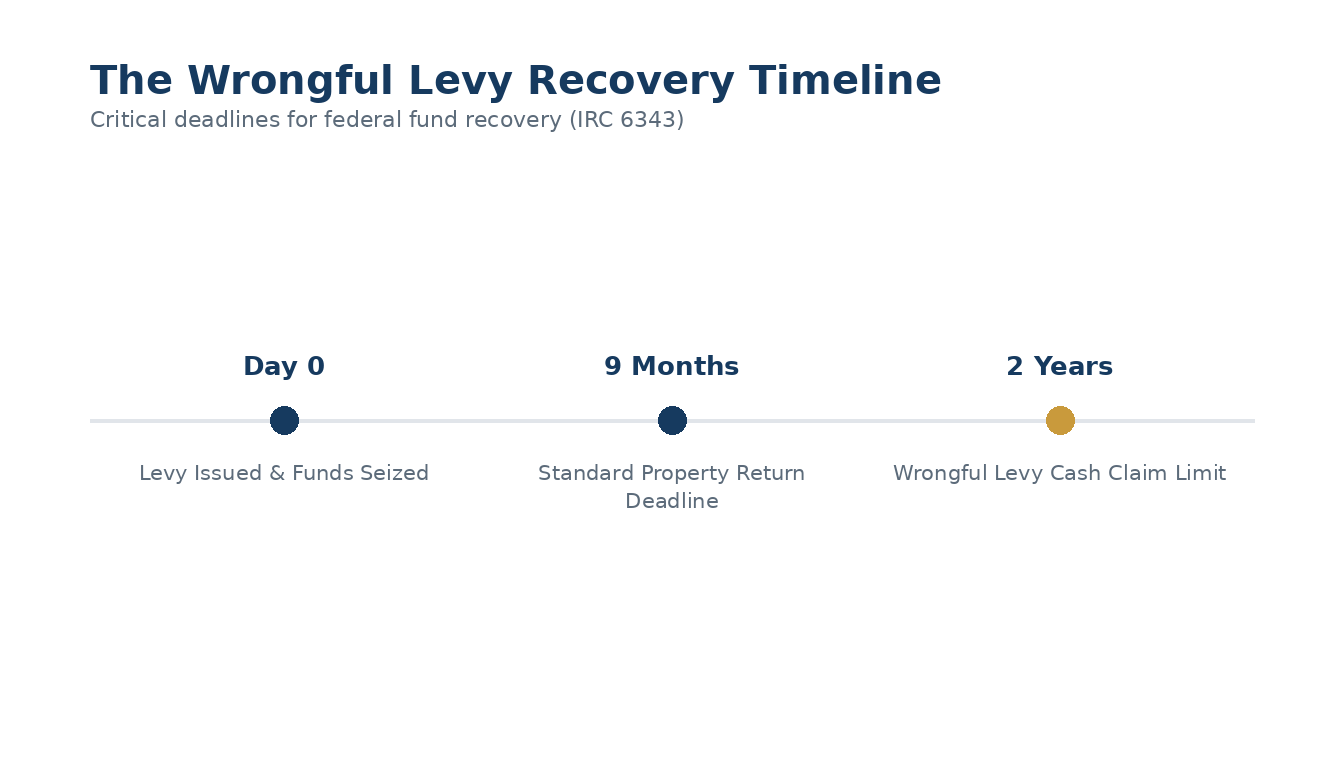
As shown in the timeline above, the clock starts ticking the moment the money is seized. Under Internal Revenue Code Section 6343(b), you generally have two years from the date of the levy to request the return of the money if the levy was wrongful. If the levy was simply ‘improper’ (procedural error), the window can be even tighter. For instance, if the IRS failed to send the “Notice of Intent to Levy and Notice of Your Right to a Hearing” (Letter 1058 or LT11) to your current address, you may have grounds for an immediate reversal, but you must act before the statute of limitations for the tax year in question expires.
The Role of the Bureau of the Fiscal Service (BFS)
While the IRS is the most common agency associated with levies, the Bureau of the Fiscal Service (BFS) manages the actual “snatching” of funds through the Treasury Offset Program. In 2026, if you find that your federal tax refund was taken to pay a debt you don’t recognize, you aren’t actually looking for a “wrongful levy” in the IRS sense—you are looking for a “wrongful offset.”
The BFS maintains a separate database from the IRS. To audit this, you must call the TOP Interactive Voice Response (IVR) system at 800-304-3107. This system will tell you which agency took your money and provide a contact number for that agency. If the agency (e.g., the Department of Education or a state child support office) acknowledges that the debt was already paid, they are the ones who must issue the refund, not the IRS. A common mistake in 2026 is filing paperwork with the IRS to get back money that was moved to a different agency via the BFS; this results in months of delays because the IRS no longer has control over those funds.
Proving ‘Economic Hardship’ in 2026
One of the most powerful tools for recovering levied funds is the ‘Economic Hardship’ claim under IRC 6343(a)(1)(D). Unlike a ‘Wrongful Levy’ claim, which argues the IRS had no right to the money, a hardship claim admits the debt might be valid but argues that taking the money now is illegal because it leaves you unable to pay for basic living expenses.
In 2026, the IRS uses the “National Standards for Allowed Living Expenses” to determine hardship. To win this claim, you must provide documentation showing that the bank levy or wage garnishment has made it impossible to meet these standards. This typically involves submitting Form 433-A (Collection Information Statement) alongside your request for the return of the levy. If you can show that the seized funds were specifically earmarked for rent, a mortgage payment, or essential medical treatment, the IRS is legally obligated to release the levy and, in many cases, return the funds already seized if they haven’t yet been fully processed into the Treasury’s general fund.
Common Mistakes: Why Valid Claims Are Denied
The most frequent reason for denial is using the wrong form. Many people mistakenly file a ‘Claim for Refund’ (Form 1040-X), which the IRS may reject because a levy return is technically different from a tax refund. For a wrongful levy, you must often submit a written request to the Advisory Group Manager in the district where the levy was issued. This request must include a copy of the levy notice (Form 668-A or 668-W) and proof that the debt was either satisfied or that the property didn’t belong to you.
Another common pitfall is failing to prove ‘administrative error.’ If the IRS sent the notice to your ‘last known address’ and you simply didn’t update your records, the levy is usually considered legal. To win a recovery, you must demonstrate that you provided the government with your new address via a filed return or a Form 8822 before the seizure occurred. In 2026, courts have been strict: simply moving is not enough; you must have given the IRS “clear and concise notification” of your new address. If you can show a post office change-of-address confirmation that predates the levy notice, your chances of recovery increase significantly.
Finally, many claims are denied because they are filed after the money has been “applied.” Once the IRS moves money from a ‘suspense account’ to a specific tax year liability, it becomes much harder to claw back. This is why speed is essential. The moment you see a ‘Notice of Levy’ on your bank statement, you should contact the Taxpayer Advocate Service (TAS) to place a ‘freeze’ on the processing of those funds while you dispute the underlying debt.

Myth vs. Reality: The Federal Seizure Fund
Myth: If the IRS takes too much money, they will automatically mail a check for the difference.
Reality: The federal government is a ‘debt-first’ entity. If you have other outstanding debts—such as student loans, child support, or state taxes—any over-levied funds will be automatically diverted to those debts via the Treasury Offset Program (TOP). You will only receive a check if your entire federal and state debt profile is at zero. Even if you are on a payment plan for another debt, the system is designed to seize any “windfall” (like an over-levy) and apply it to the principal of your other balances before returning a dime to you.
Myth: You need a lawyer or a ‘tax resolution’ firm to get this money back.
Reality: While complex cases may benefit from professional help, the process of auditing your transcript and filing Form 8546 (Claim for Reimbursement of Bank Charges Due to Erroneous Levy) or a 6343(b) request is a free, DIY process. ‘We see billions of dollars in uncollected credits simply because the paperwork wasn’t filed,’ notes the Taxpayer Advocate Service in their 2026 objectives report. Most tax resolution firms will charge you a percentage of the recovered funds (often 25-40%), which is unnecessary for simple administrative errors you can identify yourself using the Get Transcript tool.
Myth: A levy and a lien are the same thing.
Reality: This is a dangerous confusion. A lien is a legal claim against your property as security for a debt; it doesn’t take your money immediately. A levy is the actual seizure of the property or money. You can have a lien for years without losing a dollar, but a levy happens in an instant. The recovery processes for each are entirely different; you cannot file a Form 8546 for a lien, only for a levy.
Spotting the ‘Federal Grant’ and ‘Levy Refund’ Scams
Because federal levies involve high dollar amounts, they are prime targets for scammers. In August 2026, a surge of sophisticated phishing emails has been reported claiming to be from the ‘Federal Levy Recovery Department.’ These emails often promise an immediate ‘grant’ to replace your seized funds in exchange for a ‘processing fee.’
Real federal recovery does not involve fees. The IRS will never contact you via social media or text message to discuss a levy return. Any official correspondence will arrive via the U.S. Postal Service and will direct you to a .gov website or a specific federal building. If a caller asks for payment via Zelle, wire transfer, or gift card to ‘release’ your seized money, it is 100% a scam. Additionally, be wary of “recovery specialists” who claim they have a “secret list” of people owed money by the IRS; as we’ve established, no such public list exists—the only way to find out is through your own private Record of Account.

Official Resources for Federal Recovery
To begin your audit, use only these verified federal portals. Avoid any site that ends in .com, .org, or .net when dealing with federal financial records:
- IRS Get Transcript Portal: This is your primary tool. Request the “Record of Account Transcript” for the last three years. This combines the “Tax Return Transcript” and the “Account Transcript” into one comprehensive view of every action taken on your file.
- Bureau of the Fiscal Service (TOP): Essential if your money was taken from a non-IRS payment (like a Social Security check) or if your tax refund was diverted to pay a non-tax debt.
- Taxpayer Advocate Service: An independent organization within the IRS that helps people whose levy is causing financial hardship. They can issue a Taxpayer Assistance Order (TAO) to stop a levy in its tracks if you are in immediate financial danger.
How do I know if a levy was ‘wrongful’?
A levy is legally ‘wrongful’ if it was placed on property that you do not own, or if the debt it was intended to pay had already been satisfied. It can also be deemed wrongful if the IRS failed to follow statutory notice procedures required by the tax code. For example, if the IRS levies a joint bank account for a debt that only one spouse owes (in a non-community property state), or if they seize a trust account where you are only a trustee and not the beneficiary, that is a wrongful levy. Another common 2026 scenario involves ‘identity theft levies,’ where a debt was created by a fraudulent return filed in your name; once the identity theft is proven, the levy is retrospectively classified as wrongful, allowing for a full return of funds plus interest.
Is there a deadline to claim these funds?
Yes. For most wrongful levy claims, you have two years from the date of the seizure to file a claim. If you are claiming ‘economic hardship’ under Section 6343(a), you should act immediately, as the window for returning the specific property is often much shorter than the window for returning the cash proceeds. Specifically, if the IRS seizes physical property (like a car or equipment), they usually cannot return it once it has been sold at auction; at that point, you are only eligible for the cash proceeds of the sale, which are often significantly lower than the property’s actual value. For cash levies from bank accounts, the bank is required to hold the funds for 21 days before sending them to the IRS. This 21-day window is your golden opportunity to stop the transfer entirely before it enters the federal silo.
Can I get back the bank fees caused by an error?
Yes. If the IRS admits the levy was erroneous, you can file Form 8546 to be reimbursed for bank-charged fees (like overdraft or wire fees) up to a specific limit, provided you were not responsible for the error that led to the levy. To be successful, you must prove three things: first, that the IRS caused the error; second, that you haven’t already been reimbursed; and third, that you responded timely to any previous notices regarding the debt. You must file this claim within one year after the fee was paid. Keep in mind that the IRS will not reimburse you for “consequential damages,” such as a late fee on a mortgage payment that resulted from your bank account being empty; they only cover the direct fees charged by the financial institution for processing the levy itself.