
Last updated: August 2026
Figures and program details can change – always verify current details on the official source before acting.
Quick answer
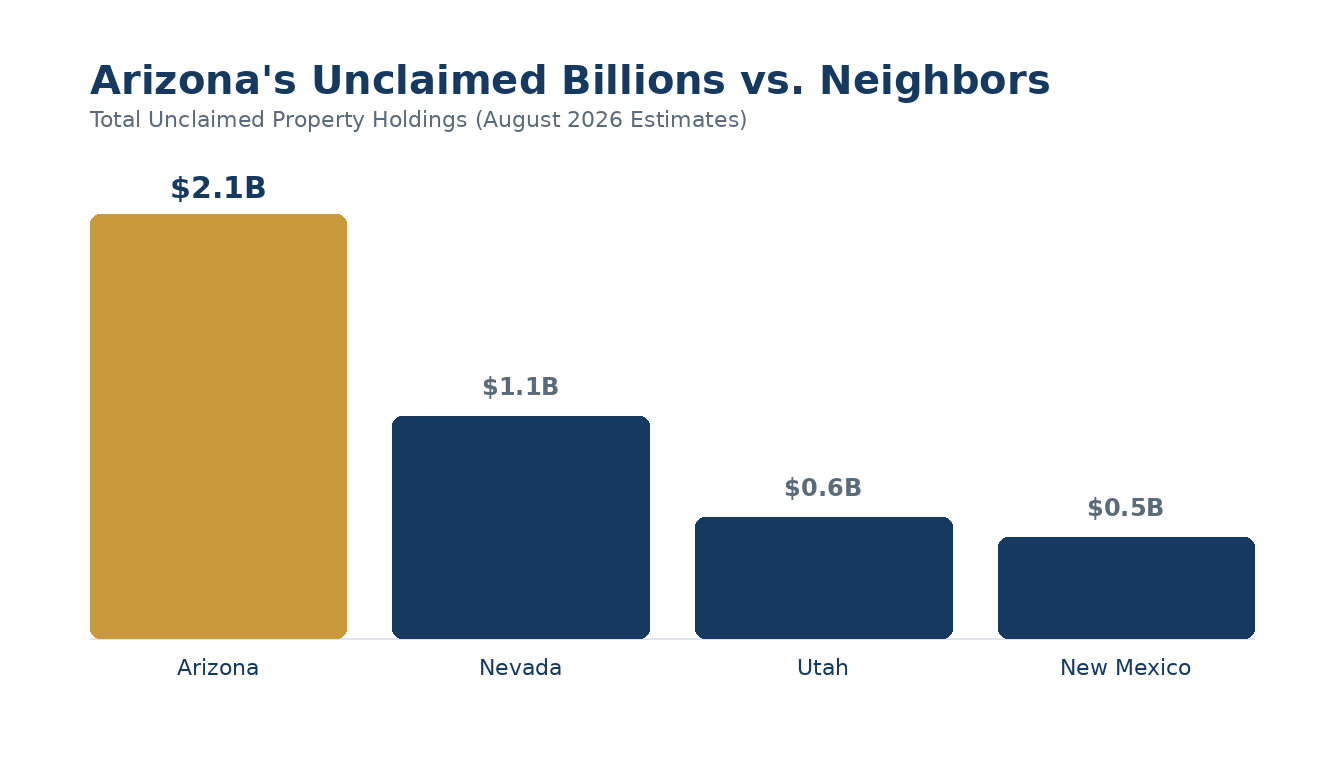
As of August 2026, the Arizona Department of Revenue (ADOR) is holding over $2.1 billion in unclaimed property. Residents can search for forgotten bank accounts, uncashed checks, and insurance benefits for free at the official azdor.gov portal. Most claims are processed within 90 days, and the state frequently issues automatic checks for verified accounts under $500.
Key takeaways
- Arizona’s fund has surpassed $2.1 billion, with one in four residents likely having an unclaimed asset.
- The state uses a ‘Proactive Outreach’ system to automatically mail checks to residents with verified addresses for smaller claims.
- Property types range from utility deposits to forgotten safe deposit box contents and mineral royalties.
- Arizona law caps professional ‘finder’ fees at 30% of the recovered amount, but the official state search is always free.
The 2026 Arizona Unclaimed Property Landscape: A $2.1 Billion Opportunity
In August 2026, the financial scale of Arizona’s unclaimed property program reached a historic milestone. The Arizona Department of Revenue (ADOR) is currently the custodian of more than $2.1 billion in assets that have been separated from their rightful owners. These funds do not belong to the state; rather, ADOR acts as a permanent trustee, holding the money until it is claimed by the owner or their legal heirs.
The growth of this fund is staggering. In the last fiscal year alone, millions of dollars were added to the vault from dormant bank accounts, uncashed payroll checks, and forgotten insurance dividends. Arizona’s status as a high-growth state with a mobile population contributes to this buildup—people often move between cities like Phoenix, Tucson, and Scottsdale without updating their forwarding addresses with utility companies or former employers.
According to official state data, approximately one in four Arizonans has money waiting in the system. The average claim value often exceeds $500, though the state has processed individual claims worth hundreds of thousands of dollars. Unlike many other states, Arizona maintains these funds in perpetuity, meaning there is no deadline to file a claim; however, the sooner you audit your name, the sooner that capital can be put back into your household budget.

The Arizona ‘Proactive Outreach’ Initiative: How the State Finds You
While many states require citizens to take the first step, Arizona has expanded its “Proactive Outreach” program in 2026. This initiative involves cross-referencing the unclaimed property database with current tax records and Motor Vehicle Division (MVD) data to identify residents who still live in the state but have forgotten assets in the system.
When ADOR finds a high-confidence match—typically for claims involving a single owner and a clearly verified current address—they may bypass the traditional claim process entirely. In these cases, the state issues an automatic check directly to the owner. This is part of a broader effort to reduce the administrative burden on the state and return liquidity to the Arizona economy.
As noted by the Arizona Department of Revenue in their official guidance, “The goal of the Unclaimed Property program is to return these assets to their rightful owners as quickly and efficiently as possible.” This commitment to efficiency is reflected in the rising number of “Mass Claims” processed each quarter. However, even with these proactive measures, billions remain unlinked because of name changes, out-of-state moves, or complex heirship issues.
How to Conduct Your 2026 Arizona Property Audit
If you haven’t received an automatic check, the next step is a manual search of the official database. In August 2026, the primary gateway for this search is the Arizona Department of Revenue Unclaimed Property portal. This is a secure, .gov-hosted site that allows for unlimited free searches.
To perform a comprehensive audit, you should not only search for your current legal name but also any variations or common misspellings. If you have married or changed your name for any reason, search under all previous surnames. Businesses should also search using their legal entity name and any “Doing Business As” (DBA) titles they have used in the past. Arizona’s system is particularly robust for business entities, often holding large sums from forgotten vendor refunds or overpaid commercial taxes.
The search process is straightforward: enter your last name and first name, and narrow the results by city if you have lived in multiple Arizona municipalities. If you find a match, the system will provide a “Property ID.” You will then be prompted to select your relationship to the property (e.g., Original Owner, Heir, or Trustee) to begin the digital filing process.
| Property Type | Arizona Dormancy Period | Common Examples |
|---|---|---|
| Wages & Payroll | 1 Year | Uncashed final paychecks, commissions |
| Utility Deposits | 1 Year | Refunds from SRP, APS, or municipal water |
| Bank Accounts | 3 Years | Checking, savings, or CD accounts |
| Life Insurance | 3 Years | Unclaimed death benefits or premium refunds |
| Safe Deposit Boxes | 3 Years | Contents of abandoned bank lockers |
Documenting Your Claim: The ‘Evidence Folder’ Strategy
Once you locate property, the state requires proof that you are the rightful owner. In 2026, Arizona has streamlined this by allowing digital uploads for most common documents. For a standard claim, you will typically need a copy of your government-issued photo ID (such as an Arizona Driver License) and proof of your Social Security Number.
The most common hurdle in Arizona claims is proving the link between the claimant and the address listed in the state’s records. If the property is associated with an apartment you lived in ten years ago, you may need to provide a document that shows you resided at that specific location. This can include an old tax return, a school transcript, or even a piece of postmarked mail from that era.
For claims involving deceased relatives, the documentation becomes more intensive. You will generally need a copy of the death certificate and proof of your authority to act on behalf of the estate, such as probate court documents or a small estate affidavit. Arizona Revised Statutes allow for simplified procedures for estates under a certain dollar threshold, which can significantly speed up the recovery of family heirlooms and funds.

The 90-Day Payout Timeline: What to Expect After Filing
Understanding the timeline is essential for managing expectations. Once you submit your claim through the ADOR portal, it enters a verification queue. During high-volume periods, such as immediately following a state outreach campaign, processing times can fluctuate. However, the standard window for a simple claim in 2026 is approximately 90 days.
The process follows a specific sequence: initial intake, document verification, and final approval by the Unclaimed Property unit. If information is missing, the state will contact you via mail or email to request additional evidence. It is vital to respond to these requests promptly; failure to provide requested documentation within the specified timeframe can result in the claim being closed, requiring you to start the process over from scratch.
Once approved, the state typically issues payment via a paper check mailed to your current address. There is currently no direct deposit option for unclaimed property in Arizona, a security measure designed to ensure the funds reach the physical hands of the verified owner. If you are claiming safe deposit box contents, the process involves a physical shipment or an appointment to collect the items in person.
Arizona Scam Watch: Identifying Fake ‘Department of Revenue’ Alerts
With $2.1 billion at stake, Arizona has seen a rise in sophisticated fraud schemes targeting potential claimants. Scammers often pose as “investigators” or even state employees, sending emails or text messages claiming that a large sum of money is waiting for you. They frequently use official-looking logos and reference real state statutes to build credibility.
The primary red flag in any Arizona unclaimed property scam is a request for an upfront fee. Under Arizona law, the Department of Revenue will never ask you to pay a fee, “tax,” or “shipping charge” to receive your money. Any legitimate costs associated with the state’s search and recovery process are deducted from the state’s internal administrative budget, not your payout.
Additionally, be wary of third-party “finders” or “locators.” While these are legal businesses in Arizona, they are strictly regulated. According to Arizona Revised Statute 44-335, any agreement to pay a finder must be in writing and signed by the owner. Furthermore, Arizona caps the fees these professionals can charge. If a finder asks for more than 30% of the value of the property, or asks for payment before the money is recovered, they are likely operating outside the law.

Common Mistakes That Stall Arizona Claims
Even with a clear guide, many claimants make simple errors that delay their funds by months. The most frequent mistake is submitting blurry or incomplete photos of identification. If the state cannot clearly read your name or the expiration date on your ID, the claim will be rejected instantly.
Another common issue involves “joint accounts.” If a bank account was held in the name of two people (e.g., a husband and wife), Arizona generally requires signatures or identification from both parties, or proof of death for the non-claiming party. Attempting to claim 100% of a joint account as an individual without documentation for the other owner is a leading cause of claim denials.
Finally, many people neglect to search for the names of their deceased parents or grandparents. In 2026, a significant portion of the $2.1 billion fund belongs to estates. These funds can often be recovered using the small estate procedures mentioned in our heir’s guide, provided the total value of the estate stays within Arizona’s statutory limits.
Arizona Unclaimed Property FAQ
How long does the state of Arizona hold unclaimed property?
Arizona holds unclaimed property indefinitely. Unlike some other types of government funds, unclaimed property never “escheats” or reverts to the state’s permanent ownership. You or your heirs can claim the funds 10, 20, or even 50 years after they were turned over to the Department of Revenue.
Is there a fee to search for money in Arizona?
No. Searching the official Arizona Department of Revenue database is completely free. You should never pay a website or a service just to search for your name. If you choose to hire a professional finder to handle the paperwork for you, they are legally allowed to charge a fee, but this is optional.
What happens to the contents of safe deposit boxes?
When a safe deposit box is declared abandoned, the bank sends the contents to the Department of Revenue. The state will hold the physical items (like jewelry or coins) for a period of time before potentially selling them at a public auction. If your items are sold, the state holds the cash proceeds from that sale in your name forever.
How do I check the status of a claim I already filed?
You can check your status on the azdor.gov website using the ‘Claim ID’ provided when you first filed. The status will typically show as ‘Received,’ ‘Under Review,’ or ‘Approved.’ If it has been more than 90 days and you haven’t received an update, you may contact the Unclaimed Property Unit directly.