

Last updated: August 2026
Figures and program details can change – always verify current details on the official source before acting.
Quick answer
As of August 2026, the Indiana Attorney General’s Office is holding over $1.5 billion in unclaimed property. Hoosiers can search for their share for free at the official IndianaUnclaimed.gov portal. Most claims are processed within 90 days, though simple individual claims for cash can often be verified electronically and approved in as little as 30 days without physical paperwork.
Key takeaways
- The Indiana unclaimed property fund has reached a record $1.5 billion in 2026.
- Indiana operates under the Revised Uniform Unclaimed Property Act (RUUPA), affecting how long banks can hold your cash.
- Small estate claims (under $50,000) can often bypass formal probate in Indiana.
- The official and only free search portal is IndianaUnclaimed.gov.
The $1.5 Billion Indiana Audit: Where the Money Sits in 2026
In August 2026, the scale of forgotten assets in the Hoosier State has reached an unprecedented level. According to the Indiana Attorney General’s Office, the state is currently the custodian of more than $1.5 billion in abandoned property. This isn’t just a single pot of gold; it is a massive, fragmented ledger consisting of millions of individual accounts ranging from $5 utility deposits to six-figure life insurance payouts.
The origin of these funds is strictly governed by state law. When a business—referred to as a “holder”—loses contact with an owner for a specific period (the dormancy period), Indiana law mandates they turn that property over to the State’s Unclaimed Property Division. This ensures the money is held in perpetuity until the rightful owner or their heirs come forward, rather than being absorbed as profit by a corporation or bank.
The composition of the $1.5 billion fund is diverse. Recent data suggests that uncashed payroll checks, dormant savings accounts, and matured certificates of deposit (CDs) make up the largest share of the volume. However, the highest dollar values are often found in forgotten stock dividends and insurance death benefits that were never triggered because the company could not locate the beneficiaries.
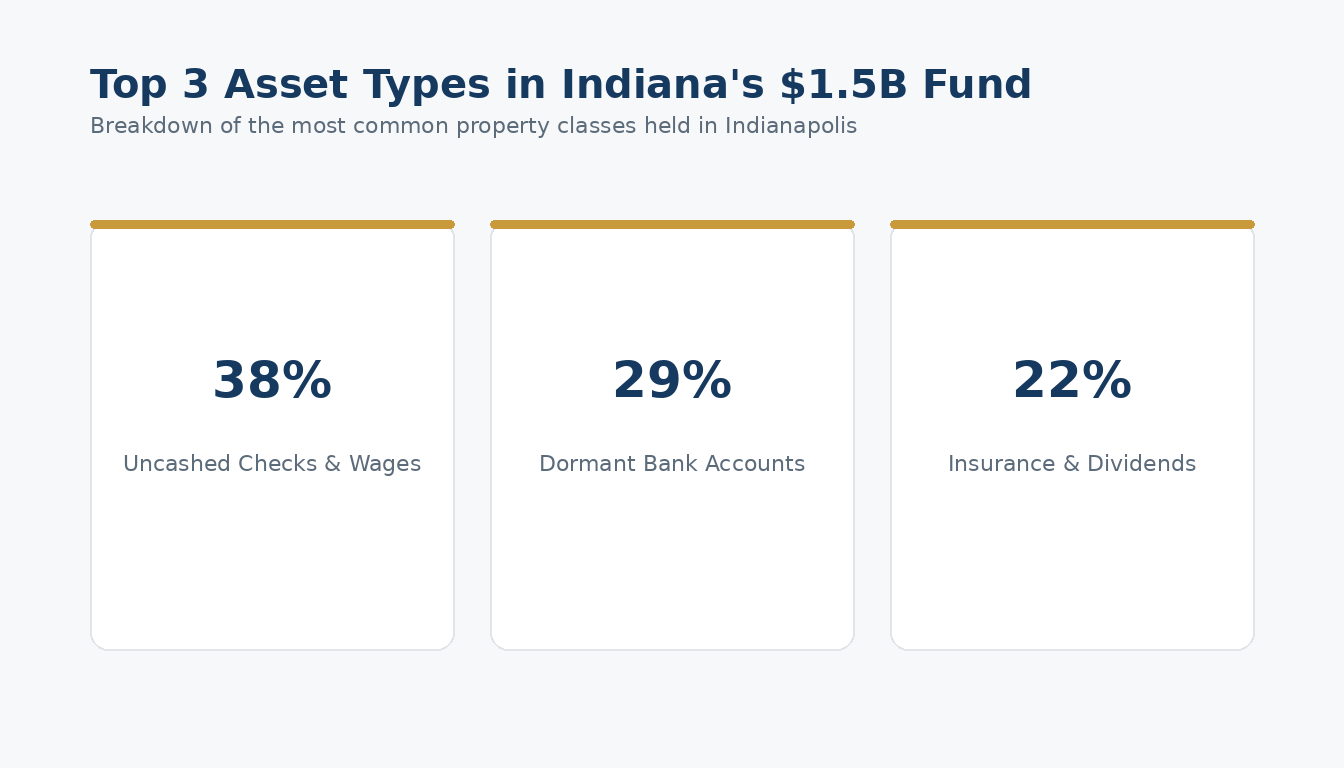
Understanding the sheer volume of this fund is the first step in a “transparency audit” of your own household finances. Many residents assume they would “know” if they were missing money, but the reality of modern banking and frequent relocation means that a single misaddressed final utility bill or a forgotten 401(k) from a summer job twenty years ago can easily slip into the state’s custody.
How to Audit Your Name on IndianaUnclaimed.gov
The process of recovering these funds in 2026 is entirely digital and free of charge. The official portal, managed by the Office of Attorney General Todd Rokita, serves as the central clearinghouse for every reported asset in the state. To begin your search, you do not need a Social Security number for the initial query; a simple name and city search is the starting point.
When searching the official Indiana Unclaimed portal, precision matters. The system is designed to handle phonetic variations, but it is highly recommended to search under your current name, any maiden names, and even common misspellings of your last name. Because these records are generated by third-party companies, data entry errors at the source are common.
If you find a match, the system will categorize the property as being “Under $100” or “Over $100.” For privacy reasons, the exact amount is rarely disclosed until you initiate the claim process and provide proof of identity. This prevents “bounty hunters” or professional finders from targeting high-value claimants before the owners themselves have a chance to find the money for free.

Once you select the properties that belong to you, the site will prompt you to “Claim as Owner” or “Claim as Heir.” In 2026, Indiana has expanded its electronic upload capabilities, allowing you to photograph your driver’s license and proof of Social Security number directly from your phone to satisfy the state’s verification requirements instantly.
The Indiana ‘Dormancy Clock’: Why Timing Matters
In Indiana, the “Dormancy Clock” refers to the period of time an asset must sit untouched before it is legally classified as abandoned. For most property types in Indiana, including checking accounts and uncashed checks, this period is three years. However, certain assets like wages have a shorter one-year clock, while others like traveler’s checks can take up to 15 years to escheat to the state.
As the Indiana Attorney General’s Office notes, “Unclaimed property is any financial asset with no vertical activity by its owner for an extended period of time.” This means that simply having a bank account isn’t enough; if you haven’t logged in, made a deposit, or responded to mail for three years, the bank is legally required to send that money to Indianapolis.
The 2026 audit reveals that many residents lose track of property during “transitional life events.” Moving to a new home is the number one cause of unclaimed property in Indiana. If a security deposit refund check is mailed to your old address and returned to the utility company as undeliverable, the dormancy clock begins ticking the moment that check was issued.
| Property Type | Indiana Dormancy Period | Common Examples |
|---|---|---|
| Wages/Payroll | 1 Year | Final paychecks, commissions, bonuses |
| Bank Accounts | 3 Years | Savings, checking, and matured CDs |
| Utility Deposits | 1 Year | Refunds from REMCs, NIPSCO, or Duke Energy |
| Insurance Benefits | 3 Years | Life insurance proceeds, premium refunds |
| Safe Deposit Boxes | 3 Years | Physical contents or proceeds from sale |
Claiming for Deceased Relatives: The $50,000 ‘Small Estate’ Shortcut
A significant portion of the $1.5 billion currently held by Indiana belongs to individuals who are now deceased. For many families, discovering these assets feels like a daunting legal hurdle, often leading to the misconception that they must hire an attorney or reopen a probate case. In 2026, Indiana law provides a specific “Small Estate” shortcut that simplifies this process immensely.
Under Indiana Code § 29-1-8-1, if the total value of the deceased person’s estate (including the unclaimed property) is less than $50,000, heirs can use a Small Estate Affidavit to claim the funds. This avoids the time and expense of formal probate court. You will simply need to provide a death certificate, proof of the decedent’s connection to the address on file, and a notarized affidavit stating you are the rightful heir.
If the claim exceeds $50,000, the state will typically require “Letters of Administration” or “Letters Testamentary” issued by a probate court. Even in these cases, the Unclaimed Property Division works to streamline the payout once the legal representative of the estate is identified. It is vital to check the names of parents and grandparents, as these funds do not “expire” and can be recovered by descendants decades after the original owner passed away.

One specific 2026 tip for Indiana heirs: check the “Owner City” search field using every town your relative lived in. Many older records are filed under the city where the person lived in the 1970s or 80s, and a statewide search for a common last name like “Miller” or “Smith” might return too many results to sort through manually.
Myth vs. Reality: Debunking Indiana Unclaimed Misconceptions
Myth: The State of Indiana uses unclaimed property to balance the budget, so they don’t want you to find it.
Reality: While the interest earned on the $1.5 billion fund may support state initiatives like the Abandoned Property Fund, the principal amount is held in trust forever. The Attorney General’s Office actively spends thousands of dollars annually on outreach, including booths at the Indiana State Fair, specifically to give the money back.
Myth: If I don’t claim my money within seven years, the state keeps it permanently.
Reality: Indiana is a “custodial” state. This means they never take legal ownership of the cash. Whether it takes you five years or fifty years to discover the account, the state is legally obligated to return it to you (or your legal heirs) upon proof of ownership.
Myth: I have to pay a 10% fee to the state to process my claim.
Reality: Searching and claiming through the official NAUPA-linked Indiana portal is 100% free. Any website or “service” asking for an upfront fee or a percentage of your claim is a private “finder” or a scammer. You can do exactly what they do, for free, in about ten minutes.
Common Mistakes That Delay Indiana Payouts
Even with a streamlined digital system, many Hoosiers face delays in receiving their checks due to avoidable errors. The most common mistake in 2026 is the “Documentation Gap.” When the state asks for proof of address, they are looking for a document that links you to the *old* address associated with the money. If you lived at that apartment ten years ago, a current utility bill won’t help; you may need an old tax return, a school transcript, or even an old piece of junk mail showing your name at that specific location.
Another frequent error involves the middle initial. If a bank reported your name as “Robert J. Anderson” but your current ID says “Robert Anderson,” the state’s automated verification system may flag it for manual review. In these cases, providing a birth certificate or social security card that shows the middle name can bridge the gap and move the claim toward approval.
Finally, avoid the mistake of submitting multiple separate claims for the same person. If you find five different properties, add them all to your “cart” on IndianaUnclaimed.gov and checkout once. Submitting five individual claims creates five separate files in the state’s system, often leading to administrative bottlenecks that can double your wait time.
The Payout Timeline: What Happens After You Submit
Once you hit the “submit” button on your Indiana claim, the file enters a multi-stage verification process. In August 2026, the state’s processing times generally follow this trajectory:
- Stage 1: Initial Review (1-14 Days): A state claims auditor reviews your uploaded documents to ensure they are legible and meet the requirements.
- Stage 2: Verification (14-45 Days): The state cross-references your claim with the data provided by the original holder (the bank or insurance company). This is the longest stage, especially if the records are decades old.
- Stage 3: Approval and Payment (45-90 Days): Once approved, the claim is sent to the Auditor of State for check issuance. While some states have moved to direct deposit, Indiana still primarily issues paper checks via USPS.
In cases where the claim is for a small amount (typically under $200) and your identity is verified through a Knowledge-Based Authentication (KBA) quiz—those “Which of these cars have you owned?” questions—the process can be expedited, with checks arriving in as little as 21 days.

Scam Alert: Protecting Your Claim from ‘Finder’ Fraud
As the Indiana unclaimed fund grows, so does the activity of scammers. In 2026, a common tactic involves “Official-looking” letters that appear to come from the “Indiana Department of Financial Recoveries” or a similarly fake agency. These letters often claim you have thousands of dollars waiting but require a “processing fee” of $50 or $100 to release the funds.
The Indiana Attorney General’s Office will never ask you for money to return your money. They will also never call you and ask for your Social Security number or bank account information over the phone to initiate a claim. All official communication will come through the IndianaUnclaimed.gov portal or via official state letterhead through the mail.
Professional “finders” are legal in Indiana, but they are strictly regulated. They cannot charge more than a specific percentage (usually 10%) and they are legally required to provide you with the information necessary to claim the money yourself. Most residents find that the official state website is so user-friendly that hiring a professional is an unnecessary expense that only shrinks your eventual payout.
How do I know if the Indiana unclaimed property search is real?
The search is 100% real and is a legal mandate of the State of Indiana. You can verify this by visiting the official state website at IndianaUnclaimed.gov, which is hosted on a secure .gov domain managed by the Indiana Attorney General’s Office. Over $1.5 billion is currently held in trust for residents.
Is there a deadline to claim my money in Indiana?
No. Indiana is a custodial state, meaning there is no statute of limitations on claiming your property. Whether the money was turned over last year or in 1985, you or your legal heirs can claim it at any time as long as you can prove ownership.
What documents do I need to file a claim in Indiana?
For a basic individual claim, you typically need a copy of your government-issued ID (driver’s license) and proof of your Social Security number. If you are claiming for an old address, you may also need a document linking you to that specific location, such as an old tax return or utility bill.
Can I claim unclaimed property for a business?
Yes. If you are a current officer or authorized representative of a business that has dissolved or changed names, you can file a claim. You will need to provide documentation showing your authority to act on behalf of the company, such as Articles of Incorporation or a corporate resolution.