

Last updated: August 2026
Figures and program details can change – always verify current details on the official source before acting.
Quick answer
Yes, you can legally claim unclaimed property belonging to a deceased relative if you are the rightful heir or the court-appointed representative of the estate. In August 2026, most states allow you to bypass expensive probate court for smaller claims (typically under $50,000 to $100,000) using a document called a Small Estate Affidavit. You will generally need a certified copy of the death certificate, proof of the deceased’s Social Security number, and documentation proving your identity and legal right to the funds.
Key takeaways
- Inherited claims account for nearly 25% of all funds currently held in state treasuries.
- The ‘Small Estate Affidavit’ is the primary tool for avoiding probate court when claiming amounts below state-specific thresholds.
- Automated programs like ‘Money Match’ rarely work for deceased claims; these almost always require a manual paper or PDF audit.
- Certified death certificates are the mandatory ‘Golden Key’ for any inherited asset recovery.
The Multi-Billion Dollar Family Legacy: Why Deceased Claims are Different
As of August 2026, an estimated $100 billion is being held by state and federal agencies across the United States. A staggering portion of this—nearly one in four successful claims—involves assets belonging to individuals who have passed away. From forgotten life insurance policies to uncashed final paychecks and utility deposits, these funds represent a lost family legacy that often sits in state vaults for decades because the heirs simply don’t know the money exists.
Unlike a standard claim where you are searching for your own name, claiming for a deceased relative requires navigating a complex intersection of unclaimed property law and state probate codes. The state’s primary goal is not just to return the money, but to ensure it goes to the right person. This means the burden of proof is significantly higher than a standard claim. You aren’t just proving the money exists; you are proving your place in the family tree.
In 2026, the process has become more digital, but the legal requirements remain strict. As noted by the National Association of Unclaimed Property Administrators (NAUPA), states are legally bound to protect the assets of the deceased from fraudulent ‘finder’ schemes, which is why inherited claims often take longer to process than individual ones.

The Hierarchy of Heirs: Who Has the Legal Right to Claim?
One of the most common mistakes is assuming that being the ‘closest relative’ automatically grants you the right to the money. In the world of unclaimed property, there is a specific ‘Pecking Order’ or Hierarchy of Heirs that state treasurers must follow. This hierarchy is determined by whether the person died with a will (Testate) or without one (Intestate).
If there is a will, the court-appointed Executor or Personal Representative is usually the only person who can initially file the claim. If the estate has already been closed, the money is distributed according to the will’s instructions. However, if there was no will, state ‘Intestacy’ laws take over. Generally, the order follows: surviving spouse, then children, then grandchildren, then parents, and finally siblings.
As a real-world example of this complexity, the California unclaimed property office explicitly states that if an owner is deceased, the claim must be filed by the person authorized to act on behalf of the estate or by a person who has a legal right to the property through a specific hierarchy of relationship.
Myth vs. Reality: Navigating the Legal Hurdles
Myth: I have to hire a lawyer and go through probate court to claim my grandfather’s $500 utility refund.
Reality: Most states have ‘Small Estate’ thresholds. If the total value of the unclaimed property (and sometimes the entire estate) is below a certain limit—often between $20,000 and $100,000 depending on the state—you can use a ‘Small Estate Affidavit.’ This is a notarized document that allows you to claim the funds without a full probate proceeding, saving you thousands in legal fees.
Myth: If the state has an ‘Automatic Payout’ or ‘Money Match’ program, they will just send me my deceased father’s money automatically.
Reality: Automated programs like Pennsylvania’s or Illinois’ ‘Money Match’ rely on current tax records and matching addresses. Because a deceased person is no longer filing taxes or living at the address on file, these systems almost never trigger for inherited property. You must almost always initiate a manual search and file a formal ‘Deceased Owner’ claim package.
The Heir’s Verification Checklist: 5 Documents You Must Gather
Before you even click the ‘File Claim’ button on a state website, you need to have your ‘Audit Pack’ ready. In 2026, most states allow you to upload these as high-resolution PDFs, but some still require physical mailings for high-value claims. If you are missing even one of these, the state will likely reject the claim or send a ‘More Information Needed’ letter, which can delay your payout by months.
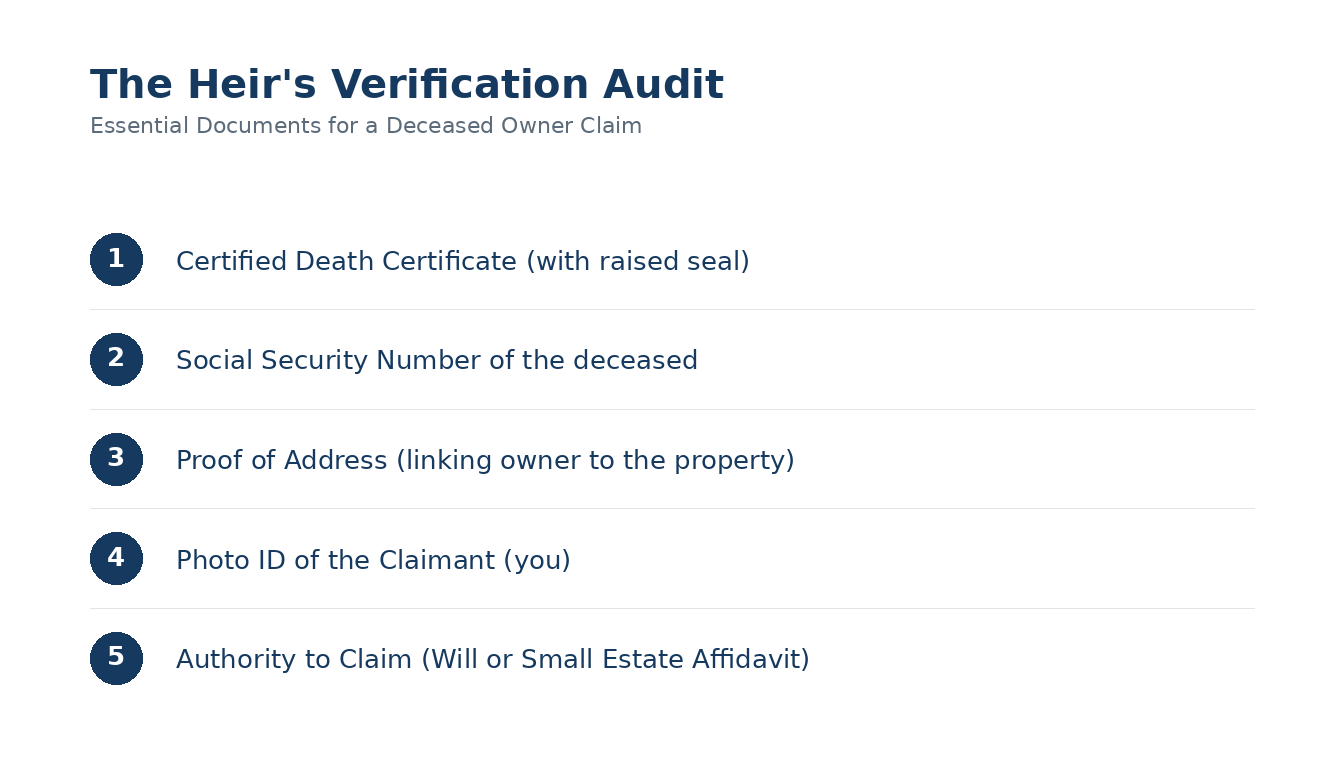
The most critical document is the Certified Death Certificate. This must be a ‘Certified’ copy—meaning it has the raised seal from the county or state registrar. A simple photocopy is rarely accepted for claims over $100. Additionally, you will need the Social Security Number of the deceased. While you don’t necessarily need the physical card, you must provide the number so the state can verify it against the reports submitted by banks or insurance companies.
Third, you need Proof of Address Linkage. This is a document that connects the deceased person to the address listed in the unclaimed property database—such as an old utility bill, a bank statement, or even a piece of junk mail from 20 years ago. Fourth, you need Proof of your Identity, usually a valid driver’s license or passport. Finally, you need the Authority to Claim—either the Probate Court ‘Letters of Office’ or the completed Small Estate Affidavit.
The ‘Small Estate’ Shortcut: Comparing State Thresholds
The Small Estate Affidavit is the single most important tool for the average heir. However, every state sets its own ‘ceiling’ for what qualifies as a small estate. If the unclaimed property exceeds this amount, the state will require you to open (or re-open) a formal probate case in court.
| State | Small Estate Limit (Approx. 2026) | Key Requirement |
|---|---|---|
| California | $184,500 | Requires a 40-day waiting period after death |
| Texas | $75,000 | Applies to ‘Intestate’ (no will) estates specifically |
| Florida | $0 (Varies) | Uses ‘Disposition Without Administration’ for small amounts |
| Illinois | $100,000 | Requires a standardized statewide affidavit form |
| New York | $50,000 | Commonly called a ‘Voluntary Administrator’ filing |
According to official guidance from the Texas unclaimed property division, if you are the surviving spouse or heir and the owner died without a will, you may be able to use the ‘Affidavit of Heirship’ to claim mineral royalties and bank accounts, provided the estate meets their specific simplified criteria.
Step-by-Step: Filing the Deceased Owner Claim
Once you have gathered your documents, the actual filing process follows a specific timeline. In 2026, most states have streamlined this into a digital workflow, but the verification stages remain the same.
- The Search: Use the official state portal or MissingMoney.com. Search for the deceased’s name, but also check for variations or common misspellings of their last name.
- The Initiation: Click ‘Claim’ and select the relationship ‘Heir,’ ‘Executor,’ or ‘Successor.’ This will trigger the state to ask for the deceased’s SSN immediately to confirm the match.
- The Documentation Upload: Upload your PDFs of the death certificate, your ID, and the Small Estate Affidavit. Ensure the scans are clear; blurry photos of documents are the #1 cause of rejection in 2026.
- The Review Phase (30-90 Days): A state claims auditor will manually review the family tree and the legal authority provided. If the claim is for a high-value asset like a safe deposit box or large stock portfolio, expect this to take longer.
- The Payout: Once approved, the state will issue a check. Note that the check is often made out to ‘The Estate of [Name]’ or to the heirs individually, depending on the probate status.
Insider Tip: If the property is a Safe Deposit Box, the process is even more rigorous. You may be required to be present at the vault opening or receive a detailed inventory of items like jewelry or coins before the ‘Auction Clock’ starts, as detailed in our safe deposit box recovery guide.
Common Mistakes and Red Flags to Avoid
When searching for a deceased relative’s money, you are a prime target for ‘Heir Finders’ or ‘Asset Recovery Consultants.’ These are private companies that scan public records and then mail you, offering to ‘help’ you recover the money for a fee—often 25% to 50% of the total.
Mistake #1: Paying a fee for information. In 2026, it is still 100% free to search and claim money from any official state treasury. You do not need a third party to ‘unlock’ the records for you. If someone asks for an upfront fee or your credit card number to ‘search the deceased database,’ it is a scam.
Mistake #2: Forgetting the ‘Paper Trail’ for Name Changes. If your mother had a maiden name and two married names, you must search all three. More importantly, you must provide a ‘bridge’ document—like a marriage certificate or divorce decree—that proves ‘Mary Smith’ and ‘Mary Jones’ are the same person listed on the death certificate.
Mistake #3: Ignoring the ‘Co-Owner’ Trap. If the property was a joint bank account (JTWROS), the surviving co-owner usually owns the money outright, and it does not go to the heirs or the estate. The state will require proof that the other co-owner is also deceased before they will release the funds to you as a secondary heir.
Reader Scenarios: ‘What If…’
What if the deceased relative lived in multiple states? You must file a separate claim in every state where they lived or did business. For example, if they worked in New York but retired to Florida, you might find uncashed wages in the New York unclaimed property database and a forgotten utility deposit in Florida.
What if I can’t find the original Will? If a will cannot be found, the estate is considered ‘Intestate.’ You can still claim the money, but you must follow the state’s hierarchy of heirs and likely provide an ‘Affidavit of Heirship’ that lists all known living relatives to ensure the state doesn’t pay you money that should technically be split with a sibling.
What if the property is from a relative who died 40 years ago? There is no statute of limitations on most unclaimed property. As long as the state is holding it, the rightful heirs can claim it. However, the ‘proof of address’ becomes much harder to find for older claims. In these cases, look for old census records or city directories to prove where your relative lived.
Frequently Asked Questions
Can I claim my deceased spouse’s unclaimed money without a lawyer?
In most cases, yes. As a surviving spouse, if the total amount is below your state’s Small Estate threshold, you can use a simplified affidavit. You will need your marriage certificate and their death certificate. If the amount is very large, however, you may be required to open probate.
How long does it take to get a check for a deceased relative?
Inherited claims are usually manually reviewed by state auditors. While a standard claim might take 2-4 weeks, a deceased owner claim in 2026 typically takes between 60 and 120 days, depending on the complexity of the family tree and the volume of claims the state is processing.
What happens if multiple heirs try to claim the same money?
The state will not ‘pick a winner.’ If multiple people file conflicting claims, the treasury will typically hold the funds and require all parties to sign a joint waiver or provide a court order specifying how the money should be split. This is why it is best to coordinate with siblings before filing.
Do I have to pay taxes on inherited unclaimed property?
The original principal amount (the forgotten check itself) is usually not considered taxable income, as it is part of an inheritance. However, any interest that the state may have added to the account while holding it is taxable. You will likely receive a Form 1099-INT from the state treasury the following year.
Citations and Official Resources:
1. National Association of Unclaimed Property Administrators (NAUPA)
2. California State Controller: Deceased Owner Claims Guide
3. Texas Comptroller: Unclaimed Property Heirship Guidelines