

Last updated: July 2026
Figures and program details can change – always verify current details on the official source before acting.
Quick answer
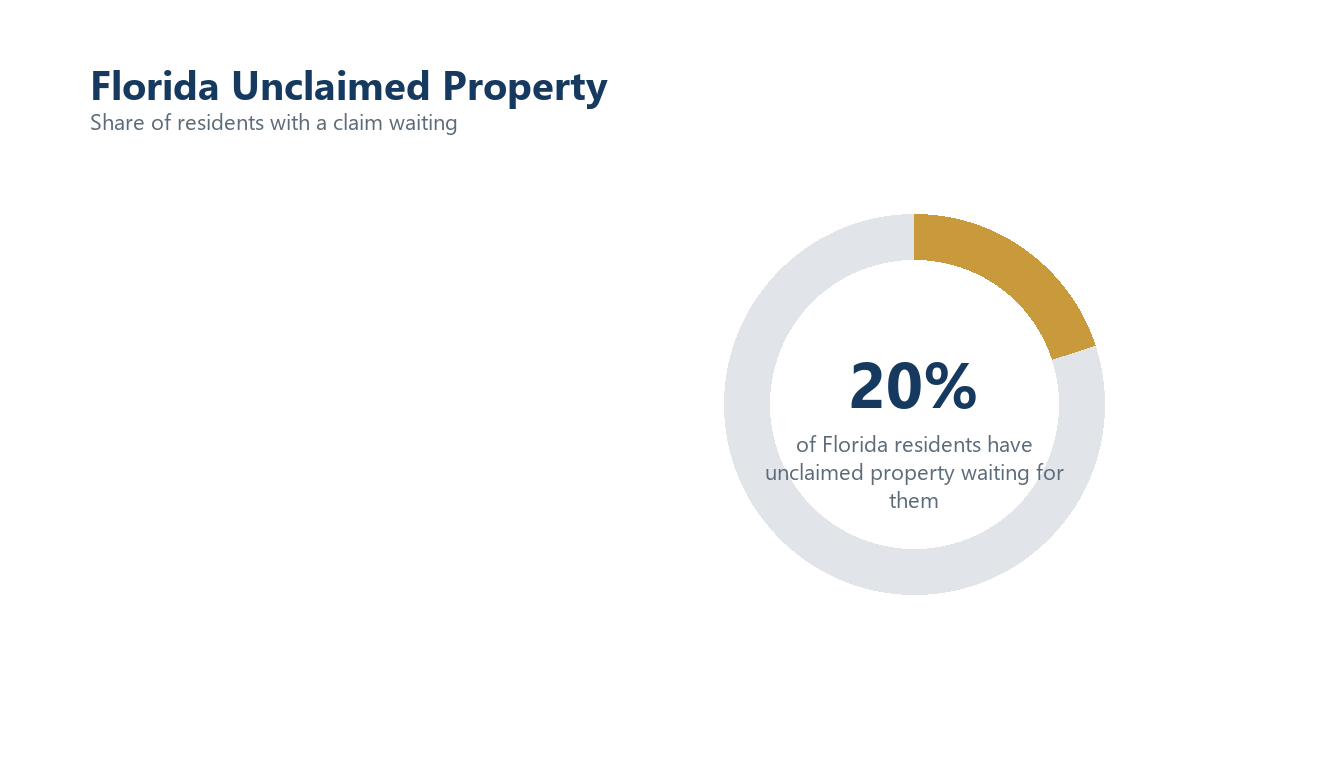
Florida currently holds over $2 billion in unclaimed property, with 1 in 5 residents having a claim waiting for them. You can search for free and file a claim at the official state website, FLTreasureHunt.gov. There is no time limit to claim your funds, and the state never takes ownership of the money; they merely hold it in trust for you or your heirs.
Key takeaways
- Florida is holding a record $2 billion+ in assets as of July 2026, largely due to recent statutory modernizations.
- Official searches and claims must be conducted through FLTreasureHunt.gov to avoid unnecessary fees or scams.
- The state auctions physical contents from abandoned safe deposit boxes but holds the cash proceeds for the owner indefinitely.
- Simple cash claims are often processed within 90 days, with many electronic claims being approved even faster.
How to Search and Claim Your Florida Unclaimed Property
Searching for and claiming your property is simple, secure, and entirely free. The only official way to search for Florida unclaimed property is through FLTreasureHunt.gov. While third-party “finders” may contact you offering to help for a fee (and Florida law caps the fees these individuals can charge), you can perform the exact same search yourself for free in under five minutes. There is rarely a reason to use them.
Follow this step-by-step walkthrough to locate and secure your missing assets:
1. Start Your Search: Begin with your current legal name on FLTreasureHunt.gov. Because the database is only as accurate as the records provided by the original company, you should also search for any common misspellings of your name, maiden names, or nicknames you may have used in the past. Florida also allows you to search for businesses. If you have ever owned a small business or a corporation in the state, it is worth checking the business name as well, as many business owners are surprised to find uncashed vendor checks or tax refunds waiting for them.
2. Add to Cart: Once you locate a property that belongs to you, select the properties you believe are yours and add them to your digital “claim cart.”
3. Verify Your Identity: For many smaller cash claims—specifically those under $1,000—Florida now offers an expedited electronic claim process. You will need to provide your Social Security Number (SSN) and current contact information. Florida uses secure encryption to protect this sensitive data. The system may ask a few “out-of-wallet” questions (like previous addresses or vehicles owned) to verify your identity instantly.
4. Submit Documentation: If your claim is more complex—such as an estate claim for a deceased relative or a claim involving physical safe deposit box contents—you will likely be required to upload or mail in physical documentation. To claim money for a deceased relative, you will generally need to provide a death certificate and proof that you are the legal heir or personal representative of the estate. If the estate was never formally probated, Florida has specific procedures for small estates to allow heirs to claim funds without a lengthy court process. This documentation often also includes a copy of your driver’s license and proof of your connection to the address listed on the property. Modernized systems in 2026 allow for digital signatures on many forms, but complex claims still often require traditional verification.
Understanding Florida’s Unclaimed Assets and Dormancy Laws
Florida’s “Great Florida Treasure Hunt” has reached historic proportions in 2026. Under Florida’s Disposition of Unclaimed Property Act (Florida Statutes Chapter 717), the state’s database has grown to include over $2 billion in unclaimed assets.
This massive pool of money comes from forgotten bank accounts, uncashed payroll checks, utility deposits, and insurance proceeds. When a business loses contact with an owner for a set period, Florida law requires them to send those funds to the Department of Financial Services (DFS).
Chief Financial Officer Blaise Ingoglia recently announced that the state returned a record-breaking $88 million in a single month during early 2026. Despite these record payouts, more money flows into the fund every year than is claimed, making it highly likely that you or someone you know is on the list.
Florida is a “custodial” state. Once the money reaches the state’s custody, it is deposited into the State School Fund. However, the state acts only as a custodian. As covered in our general guide to finding unclaimed money, these funds are always available for the rightful owner to reclaim, regardless of how much time has passed.
In Florida, property is typically classified as “unclaimed” after a dormancy period of one to five years. This period varies based on the type of asset. For example, wages and payroll are often turned over after just one year of inactivity. Most bank accounts and insurance policies have a five-year dormancy period. During this time, the “holder” (the bank or company) is required to perform due diligence by attempting to contact you at your last known address before transferring the funds to the state. The 2026 updates to Florida statutes have refined some of these timelines to ensure more efficient reporting by businesses.
| Property Type | Dormancy Period | Common Examples |
|---|---|---|
| Wages / Payroll | 1 Year | Unpaid commissions, final paychecks, bonuses. |
| Safe Deposit Boxes | 3 Years | Jewelry, coins, and documents (after rent expires). |
| Bank Accounts | 5 Years | Savings, checking, and certificates of deposit (CDs). |
| Insurance Proceeds | 5 Years | Life insurance payouts, premium refunds. |
| Utility Deposits | 1 Year | Electricity, water, or cable deposits. |
Safe Deposit Box Auctions and Physical Items
Unlike many states that only deal with cash, Florida also takes custody of physical items found in abandoned safe deposit boxes. If the rent on a box goes unpaid for three years, the bank drills it and eventually sends the contents to the state. The state holds these physical items for at least two additional years while attempting to locate the owner. If no claim is made, the items are sold at the annual Unclaimed Property Auction. In 2026, a major auction is scheduled for August 7-8 in West Palm Beach.
It is important to note that even after an item is sold at auction, the original owner has not “lost” their value. The state takes the cash proceeds from the sale and credits them to the owner’s account. Those funds remain claimable by the owner or their heirs forever.
Avoiding Scams and Common Claim Pitfalls
As the total amount of unclaimed property in Florida hits new highs, so do the number of scams targeting residents. Scammers often send text messages or emails claiming you have a “government grant” or an “unclaimed refund” waiting for you, provided you click a suspicious link. The Florida Department of Financial Services has explicitly stated that they will never contact you via text message regarding a claim. Official communication will typically come through the mail or from an official @MyFloridaCFO.com email address after you have already initiated a claim.
Furthermore, payout timelines are not instant, and that delay itself gets exploited by scammers who claim they can “rush” your payment for a fee. In reality, no legitimate service can speed up the state’s own processing timeline (see the FAQ below for exactly how long that takes). Many claims are delayed or denied simply due to administrative errors, not fraud. The most common mistake is failing to provide proof of the “last known address” associated with the property. If the property is linked to an apartment you lived in 15 years ago, you may need to dig up an old utility bill or tax return from that era. Another pitfall is assuming that because your name matches, the money is yours. In a state as large as Florida, there are often hundreds of people with the same name. The DFS requires specific proof—usually an SSN match or address history—to distinguish between two people with the same name. Ensure all forms are signed exactly as required; if a claim form requires a notary’s seal, do not skip that step.
For more on federal assets that might not appear here, see our guide on unclaimed pensions and life insurance. Note that heirship claims can take the full 90-day statutory limit as the state must verify the legal rights of all potential claimants.
Checklist for a Successful Florida Claim
- **Verify the URL:** Always ensure you are on FLTreasureHunt.gov.
- **Gather Documents:** Have your SSN, ID, and old address proof ready.
- **Search Variants:** Check maiden names and previous business names.
- **Be Patient:** Allow up to 90 days for the state to process your documentation.
- **Check Often:** New property is reported every year, so search at least once every 12 months.

Official Resources for Florida Residents
For the most accurate and up-to-date information, residents should rely solely on official state and national resources. These entities provide the necessary tools to search not just in Florida, but across the United States.
The Florida Division of Unclaimed Property (via MissingMoney.com, NAUPA-endorsed) is your primary point of contact for any claims within the state. For those who have lived in multiple states, the National Association of Unclaimed Property Administrators (NAUPA) offers a portal to search every state’s database simultaneously.
Additionally, you can check the MissingMoney.com website, which is the only national database officially endorsed by NAUPA and includes Florida’s data in its search results.

Looking for another state? See our full state-by-state unclaimed money directory to find your state’s official search portal.
Frequently Asked Questions
Is there a deadline to claim my money in Florida?
No. Florida is a “custodial” state, meaning they hold the money in perpetuity. Whether it takes you five years or fifty years to find it, the money (or the proceeds from the sale of physical items) will be waiting for you or your legal heirs.
How long does it take to receive a check from the state?
By law, the Florida Department of Financial Services has up to 90 days to process a completed claim. Simple electronic claims for small amounts are often paid much faster, sometimes within 30 days, while complex heirship claims may take the full 90-day window.
Do I have to pay a fee to get my unclaimed property?
No. Searching for and claiming your property through the official FLTreasureHunt.gov website is a completely free service provided by the State of Florida. You should never pay anyone a percentage of your money to “find” it for you.
Can I claim property for a business I no longer own?
Yes, provided you can prove you were the authorized officer or owner of the business at the time the property was generated. You will likely need to provide corporate filings or tax documents showing your relationship to the defunct entity. This applies even for very small businesses or sole proprietorships that were never formally dissolved, as long as you can show you were the last authorized owner or officer on record.