

Last updated: July 2026
Figures and program details can change – always verify current details on the official source before acting.
Quick answer
The Texas Comptroller’s office currently holds more than $4 billion in unclaimed property. Residents and former residents can search for free and file claims online via the official state portal, ClaimItTexas.org. There is no time limit to claim your funds, and the state never charges a fee for this service.
Key takeaways
- Texas is holding over $4 billion in forgotten funds from bank accounts, utility deposits, and mineral royalties.
- The official search portal is ClaimItTexas.org; avoid any site asking for a fee to search.
- Texas has unique rules for mineral interests and oil/gas royalties, which are often overlooked.
- Most claims are processed within 60 to 90 days if all documentation is provided correctly.
How to Search and Claim Your Texas Unclaimed Property
If you have ever lived or worked in the Lone Star State, there is a statistically significant chance that the government is holding money that belongs to you. As of mid-2026, the Texas Comptroller of Public Accounts reported holding more than $4 billion in unclaimed property. Imagine sitting down at your desk today, wondering if any of those forgotten funds have your name on them.

To find out if you are owed money, follow this direct search and claim process:
- Search the Official Registry: Your first step is to visit the official portal: ClaimItTexas.org. This is the only site managed by the Texas Comptroller for this purpose. Unlike the massive California unclaimed property database, which often requires a multi-step verification before showing exact amounts, Texas generally provides a clear range or exact figure once you find a match. While you might have read about how to navigate the New York unclaimed property system, the Texas process has its own unique nuances.
- Look Up Name Variations: When searching, do not just look for your current legal name. You should also search for common misspellings, maiden names, or the names of deceased relatives. Because Texas is a hub for business, you should even search for any small businesses or LLCs you may have operated in the past.
- Initiate the Claim: Once you find a match, you can add it to your “cart” and begin the claim process. The system will ask for your Social Security Number (SSN) to verify your identity against the records provided by the reporting company. While small claims (usually under $500) can often be processed entirely online with just an SSN verification, larger claims or those involving complex assets will require you to pull together physical or digital copies of documentation.
After you submit your claim, you drop any physical documents into the mail or submit them online.

Once submitted, the Texas Comptroller’s Unclaimed Property Division will review your file. For simple claims with clear documentation, you might receive a check or direct deposit in as little as 30 days, but the standard window is 60 to 90 days. If your claim involves safe deposit box contents (like physical jewelry or coins), the process takes longer because the state must physically locate the items in their vault and arrange for secure shipping. In 2026, Texas has streamlined this with a digital appointment system for high-value physical pickups in Austin. If you are claiming funds for a business or as an heir, expect the process to take at least three to four months due to an intense legal review to ensure the money isn’t paid to the wrong party.
Gathering Your Verification Files and Required Documents
Texas is thorough in its verification to prevent fraud. To move your claim forward, you will likely need a copy of your current driver’s license or state ID. Additionally, you may need proof of your connection to the address listed on the unclaimed property, such as an old utility bill or a tax document.

If the property belonged to a deceased relative, the requirements become more stringent. For heirship claims, be prepared to provide a death certificate and a copy of the will or probate documents. If no will exists, Texas provides specific “Affidavit of Heirship” forms that must be notarized to proceed.
If you ran a side hustle or a professional corporation, don’t forget to search for your business names. The documentation for business claims typically includes a W-9 and proof that you are an authorized officer of the company.
Texas is also unique because of its vast oil and gas industry. When claiming mineral interests, the state may require proof of ownership, such as a recorded deed or an assignment of interest. This is a more complex process than claiming a forgotten utility deposit, but the potential payout is often much higher.
What Types of Forgotten Assets Sit in the Texas Registry?
Say a search actually turns up a match. What exactly is this unclaimed property? In Texas, the definition is broad and includes everything from uncashed paychecks to the contents of safe deposit boxes. If a business cannot contact you for a set period of time, they must legally remit those assets to the state. Your potential payout could consist of utility deposits, insurance proceeds, dividends, or even store gift cards.
It is important to note that unclaimed property does not include real estate or vehicles; the Comptroller’s office will not be the place to search for lost land or a car. However, if a house you owned was sold and there were surplus funds from a foreclosure that couldn’t be delivered to you, that money might end up here.
One of the most common sources of unclaimed property in Texas is uncashed mineral royalty checks, a byproduct of the state’s massive energy industry. Many families hold mineral interests that have been passed down through generations. Often, a company will lose track of a mineral owner because they moved or passed away without updating the land records, and these royalty payments can accumulate into tens of thousands of dollars over a few decades. If you suspect your family had mineral rights in the Permian Basin or Eagle Ford Shale, searching the Texas registry every year is vital.
How did this money get here in the first place? Every type of financial asset has a “dormancy period.” This is the amount of time that must pass without any owner-generated activity before the holding institution is required to send the money to the Comptroller. In 2026, Texas continues to follow a strict schedule for reporting. For example, wages and utility deposits have a very short window, while bank accounts take longer to be classified as abandoned.
| Property Type | Dormancy Period (Texas) |
|---|---|
| Wages / Payroll | 1 Year |
| Utility Deposits | 1 Year |
| Bank Accounts (Checking/Savings) | 3 Years |
| Mineral Interests / Royalties | 3 Years |
| Insurance Proceeds | 3 Years |
| Safe Deposit Box Contents | 5 Years |
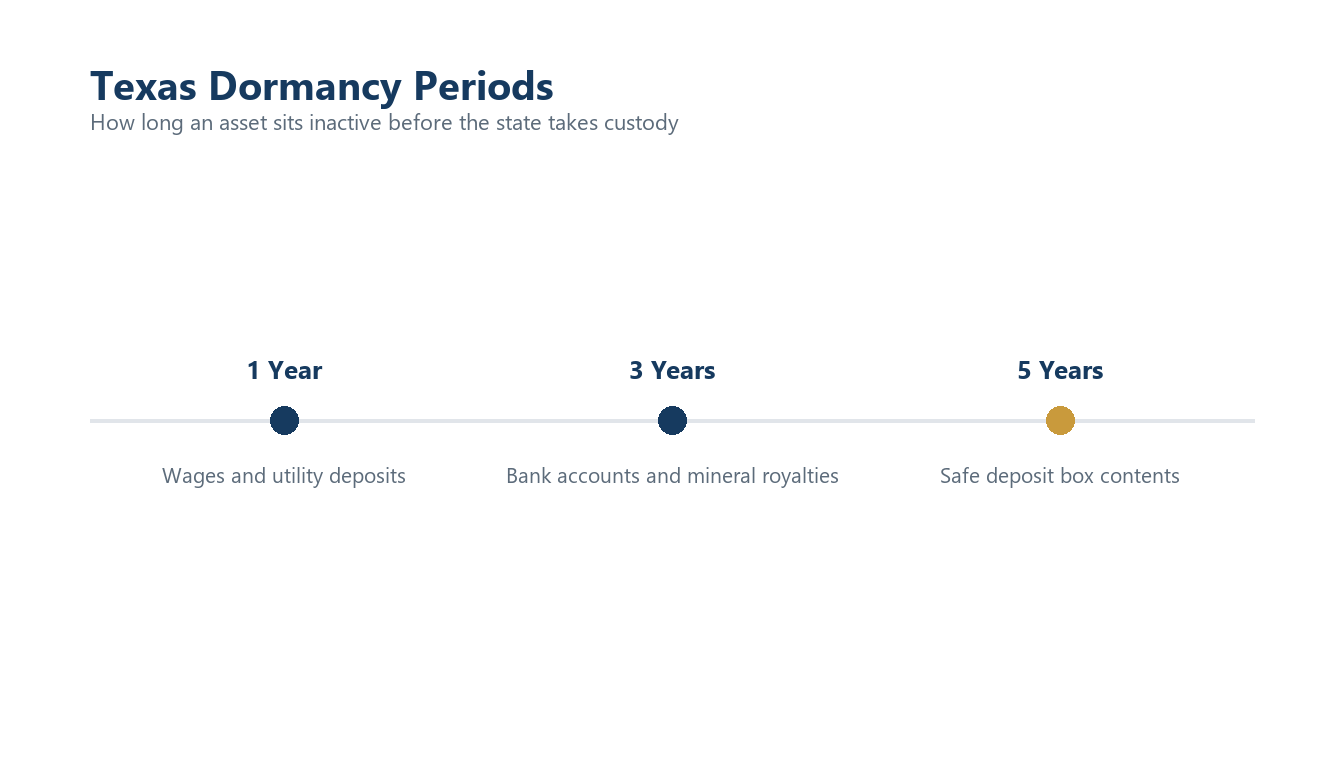
This fund grows every year as businesses report these dormant assets, usually after one to five years. Fortunately for you, unlike some other states, Texas has no statute of limitations on these funds, meaning the money stays available for the rightful owner or their heirs indefinitely.
Navigating Local Blind Spots and Spotting Registry Scams
What if you perform your search and find absolutely nothing, despite being certain you are owed money? You might be encountering a local “blind spot.” Many Texans are surprised to find no results on the state portal due to Texas Property Code Section 76. This statute allows local governments—including cities, counties, and school districts—to retain unclaimed property valued at $100 or less instead of remitting it to the Comptroller. These “micro-claims” typically consist of uncashed vendor payments, jury duty checks, or municipal court refunds, and they sit in local municipal treasuries indefinitely.
This local retention rule also applies to certain utility credits if the utility provider is municipally owned. Because these items never enter the statewide database, you must search the individual websites of the specific cities or counties where you have lived or done business, such as the City of Houston or the Dallas County Treasurer. While the state holds the multi-billion dollar “pot,” millions of dollars in smaller, localized checks remain sitting in city halls across the state.
Another issue is failing to check for “aggregate” amounts. Sometimes, a company reports many small amounts under one “aggregate” file. While you can’t search these by name, the Comptroller often breaks them down if you provide specific details about your history with a company. Even if it’s just a small $15 refund, making the effort helps clean up the state’s books and ensures businesses are held accountable.
As you navigate this process, you must also watch out for scammers. Because there is so much money involved, scammers often target Texans by pretending to be “official investigators” or “private locators.” They may send you a letter or email claiming they found a massive sum of money in your name and offer to recover it for a 30% fee. In Texas, it is illegal for a private locator to charge a fee for finding property that has been held by the Comptroller for less than seven months, and even after that period, their fees are capped by state law. However, you never need to hire a locator. The Texas Comptroller’s office provides all search and claim services for free. If someone asks for your credit card number or a “pre-payment” to release your unclaimed funds, it is a scam. Always go directly to the official .gov or state-sanctioned site.
Checklist: How to Claim Your Texas Funds
- Search: Use ClaimItTexas.org and search all variations of your name.
- Identify: Match the listed address with a place you have actually lived.
- File: Complete the online claim form and provide your SSN for instant verification if possible.
- Upload: If prompted, upload a clear photo of your ID and proof of address.
- Monitor: Keep your claim ID number and check the status every 30 days.
Conclusion
With $4 billion waiting to be returned, there is no reason to wait. The Texas unclaimed property system is one of the most transparent and user-friendly in the country. By taking ten minutes to search ClaimItTexas.org today, you could find a forgotten asset that belongs to you or your family. Just remember that while the state search covers most things, specific federal assets like unclaimed pensions and 401(k)s are held in different registries, so a complete search should always include both databases.
Looking for another state? See our full state-by-state unclaimed money directory to find your state’s official search portal.
Frequently Asked Questions
Is there a fee to claim my money in Texas?
No. The Texas Comptroller of Public Accounts does not charge any fee for searching or claiming property. If a website asks for money, it is not the official state site.
What happens to the money if I never claim it?
Texas holds the money in perpetuity. It never “rolls over” into the general fund in a way that prevents you from claiming it. It will wait for you or your heirs forever.
Can I claim money for a deceased relative?
Yes. You will need to provide documentation proving you are the legal heir or the executor of the estate. This usually includes a death certificate and probate documents.
How often is the Texas database updated?
The database is updated daily as new claims are processed and new properties are reported by businesses. Most companies report their unclaimed holdings to the state annually in July.
For more information, visit the official Texas Comptroller Unclaimed Property Page or the national registry at NAUPA.