

Last updated: July 2026
Figures and program details can change — always verify current details on the official source before acting.
Quick answer
California is sitting on roughly $15 billion in unclaimed property, and it’s one of the states that doesn’t fully participate in the multi-state MissingMoney.com search tool. If you’ve ever lived, worked, or banked in California, you need to search directly at the state’s own portal, claimit.ca.gov — it’s free, and there’s no deadline to claim.
Key takeaways
- California is holding about $15 billion in unclaimed property across more than 84 million individual properties.
- California does not fully participate in MissingMoney.com, so you must search claimit.ca.gov directly.
- There is no deadline to claim property once it has been transferred to the state.
- Search every California address you’ve lived at, plus maiden names and business names.
- Searching and filing a claim through claimit.ca.gov is completely free.
If you read our general guide to finding unclaimed money, you already know California is one of the states you have to search separately. To understand why checking California requires a specific approach, it helps to see how the official state portal compares directly to the standard national registry:
| claimit.ca.gov (official CA portal) | MissingMoney.com | |
|---|---|---|
| Covers California records | Yes, complete | No / partial |
| Covers other states | No | Yes (most participating states) |
| Cost to search or claim | Free | Free |
| Run by | California State Controller’s Office | NAUPA (multi-state nonprofit) |
Analyzing the Comparison: Why California Records Require a Dedicated Search
Most people search MissingMoney.com once and assume they’re done. As highlighted in the comparison above, the problem is that California, along with New York and Pennsylvania, doesn’t fully participate in that multi-state tool. If your California search comes back empty on MissingMoney.com, that doesn’t mean you’re in the clear — it likely means the state’s records simply aren’t in that shared database. To find your property, you have to query the state’s database directly.
According to the California State Controller’s Office, the state is currently holding about $15 billion in unclaimed property, spread across more than 84 million individual properties, owed to nearly 39 million Californians. Since the program began, the state has already returned more than $8.37 billion to rightful owners — and a single outreach effort in December 2025 alone reunited 100,000 people with $30.4 million. In other words, the odds that your name (or a family member’s) shows up are genuinely good.
Nationally, NAUPA estimates all U.S. states combined are holding roughly $70 billion in unclaimed property. California’s $15 billion share means it accounts for a substantial slice of that total on its own — unsurprising given it’s the most populous state, but it also means California’s database is proportionally one of the most worthwhile places to check if you’ve spent any time living or working there. For comparison, most individual states hold totals in the hundreds of millions to low billions, making California’s pool one of the largest single-state totals in the country.
This isn’t a dormant government database nobody touches — California actively runs outreach campaigns to reunite people with their property. In December 2025 alone, one targeted effort reconnected 100,000 property owners with a combined $30.4 million. The state also designates an annual Unclaimed Property Month to raise awareness, precisely because so much of the $15 billion sitting in the fund belongs to people who simply don’t know to look. That outreach only reaches a fraction of eligible owners each cycle, which is exactly why checking on your own, rather than waiting for a letter, matters.
Run by the State: Where the Property Comes From
As noted in the comparison table, the database is managed directly by the California State Controller’s Office. Under California’s Unclaimed Property Law, banks, insurance companies, corporations, and other holders must turn property over to the State Controller’s Office once there’s been no owner activity for a set period — generally three years. The most common categories are:
- Dormant bank and brokerage accounts
- Uncashed payroll checks and wages
- Insurance policy proceeds
- Stocks, bonds, and dividends
- Safe deposit box contents
Property is received by the state twice a year, with the largest batch typically arriving each June, so newly dormant accounts can take a while to actually show up in the searchable database.
Cost & Process: How to Search and Claim in California
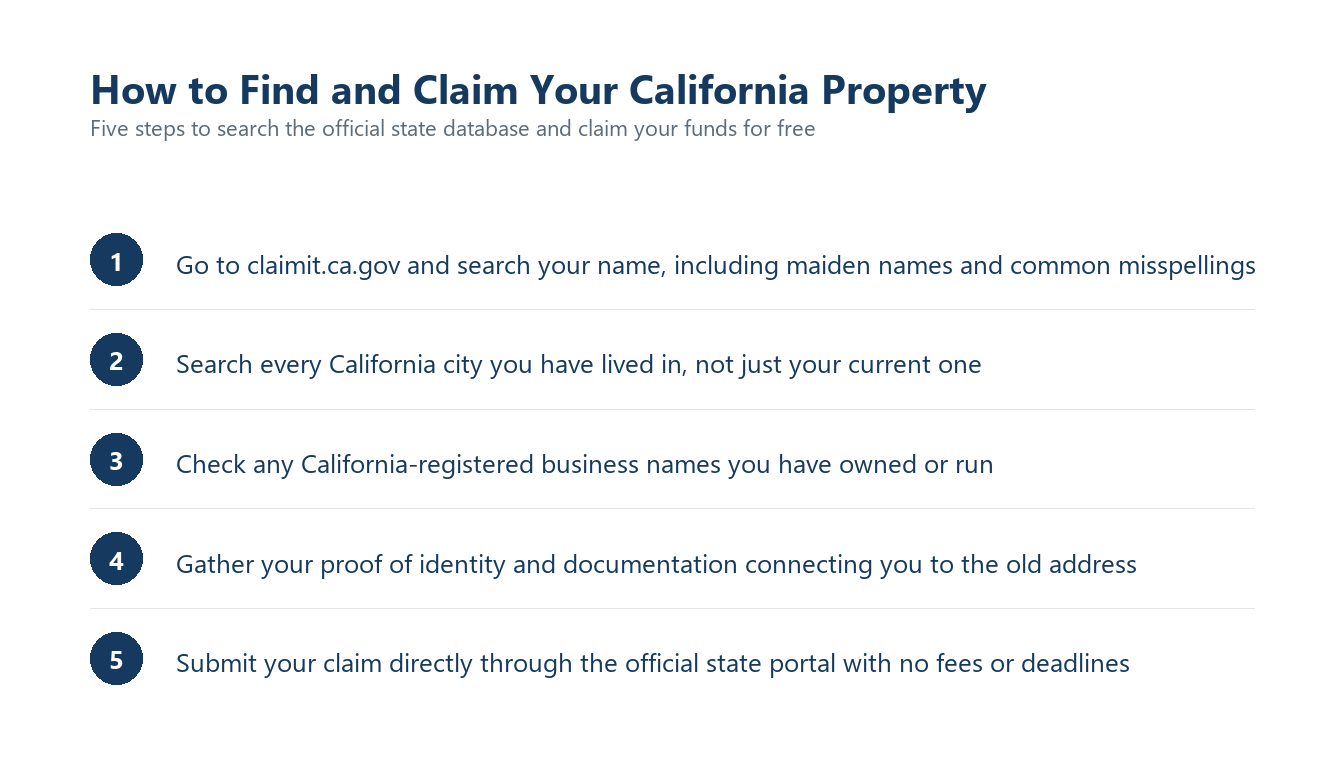
Searching and filing a claim through claimit.ca.gov is completely free. Here is how to navigate the official system step-by-step:
- Go directly to claimit.ca.gov and search by your name (try maiden names, nicknames, and common misspellings too).
- Search every California city you’ve lived in, not just your current one — the property is filed under the address on record when the account went dormant.
- Check business names too if you’ve ever owned or run a business registered in California.
- Gather proof of identity: a government-issued ID and something connecting you to the address on file, like an old utility bill or lease.
- Submit your claim through the official portal — there’s no fee, and no deadline to file once property has been transferred to the state.
Once you submit a claim through claimit.ca.gov, the State Controller’s Office reviews your submitted documentation against the information the original holder (bank, employer, insurer, etc.) reported when the property was turned over. Straightforward claims, where your current name and ID clearly match the record, tend to move fastest. If there’s a mismatch — a maiden name, an old address, a slightly different spelling — expect a request for supporting documents rather than an outright denial. This is standard verification, not a sign your claim was rejected. Keeping old pay stubs, leases, or utility bills from past California addresses on hand can speed this step up considerably if you’re claiming property tied to an address from years ago.
Business and Estate Claims
Unclaimed property isn’t limited to individuals. If you’ve ever owned, run, or been a partner in a California-registered business, it’s worth searching under every business name you’ve used, since dormant business accounts, uncashed vendor payments, and old payroll checks all get reported the same way personal accounts do. Estate claims work similarly but require proof that you’re the legal heir or the appointed representative of the estate — typically a death certificate plus documentation establishing your relationship to the deceased, such as a will, letters of administration, or a small estate affidavit depending on the property value.
Common Mistakes People Make in California Specifically
- Assuming a MissingMoney.com search covers California. It generally doesn’t — you have to search claimit.ca.gov separately.
- Searching only your current address. California is huge; if you’ve moved between cities or counties, search under each old address.
- Giving up after one search. New property is added twice a year, so a name that comes up empty today might show a result after the next reporting cycle.
- Ignoring safe deposit box notices. California auctions unclaimed safe deposit box contents after a holding period, but you’re still entitled to the cash value if you file a claim later.
The High Stakes of Unclaimed Securities: Dividends, Splits, and the Liquidation Clock
When investment assets like stocks, bonds, or mutual funds are transferred to the California State Controller’s Office (SCO) as unclaimed property, their fate depends heavily on timing. Under California law, the state acts as a custodian and is required to eventually liquidate these securities into cash—a process that typically occurs within 20 months of escheatment. If you claim your property while it is still held in its original security form, California will return the actual shares to you. In this scenario, you are entitled to all corporate actions that occurred during safekeeping, including stock splits, mergers, acquisitions, and any accrued cash dividends or interest. However, because the SCO must manually research these corporate actions to determine the current correct holdings, securities claims take longer to process, often requiring an additional 120 days to a full year of verification time after your initial claim is approved.
Once the state’s liquidation clock runs out and your shares are sold, the landscape changes dramatically. According to California Code of Civil Procedure Section 1562, any dividends or interest that accrued prior to liquidation will be credited to your account. However, once the assets are converted to cash, you are only entitled to the net proceeds of that historical sale. This means you completely miss out on any subsequent market gains, stock splits, or compounding dividends that occurred after the state liquidated your position. Adding to this loss of growth, a 2003 amendment to California’s Unclaimed Property Law eliminated the payment of interest on unclaimed funds held by the state. Ultimately, if your stock is liquidated, you will receive only a flat cash check representing the historical sale price, highlighting why acting quickly to recover escheated investments is so critical.
Bottom Line
With $15 billion on the table and roughly 1 in 7 Americans nationally estimated to have unclaimed property somewhere, California’s sheer size means it’s one of the highest-odds states to check. It takes about five minutes at claimit.ca.gov, it’s completely free, and there’s no downside to searching — even if you’ve checked before.
Looking for another state? See our full state-by-state unclaimed money directory to find your state’s official search portal.
Frequently Asked Questions
Is there really no deadline to claim property in California?
Correct — once property is transferred to the State Controller’s Office, there’s no time limit on filing a claim.
How long does a California claim take to process?
It varies with claim complexity and documentation, but simple claims with clear proof of identity are typically faster than claims involving estates or business property.
Can I claim property for a deceased relative?
Yes, but you’ll need to provide documentation showing you’re the legal heir or estate representative in addition to the standard identity proof.
Do I need to pay anyone to search or file a claim?
No. Searching and claiming through claimit.ca.gov is free. If anyone asks for a fee to “release” your California unclaimed property, that’s a scam — see our guide to spotting grant and refund scams.
I moved out of California years ago — can I still claim property there?
Yes. Where you live now doesn’t matter; what matters is whether you ever had an account, paycheck, or policy tied to a California address. You can file a claim from anywhere in the country (or the world) once you find a match.
What happens to unclaimed safe deposit box contents?
California can auction the physical contents of a safe deposit box after a holding period if no owner comes forward. However, if you later identify yourself as the rightful owner, you’re still entitled to claim the cash value of what was sold — you just won’t get the physical items back.
Will I be notified if California is holding property under my name?
Sometimes — the state does send outreach mailings and runs periodic public awareness campaigns, like the December 2025 effort that reached 100,000 owners. But mailings depend on having a current address on file, which is often exactly what’s missing when property goes unclaimed in the first place. Searching proactively is far more reliable than waiting for a letter that may never arrive.