

Last updated: September 2026
Figures and program details can change – always verify current details on the official source before acting.
Quick answer
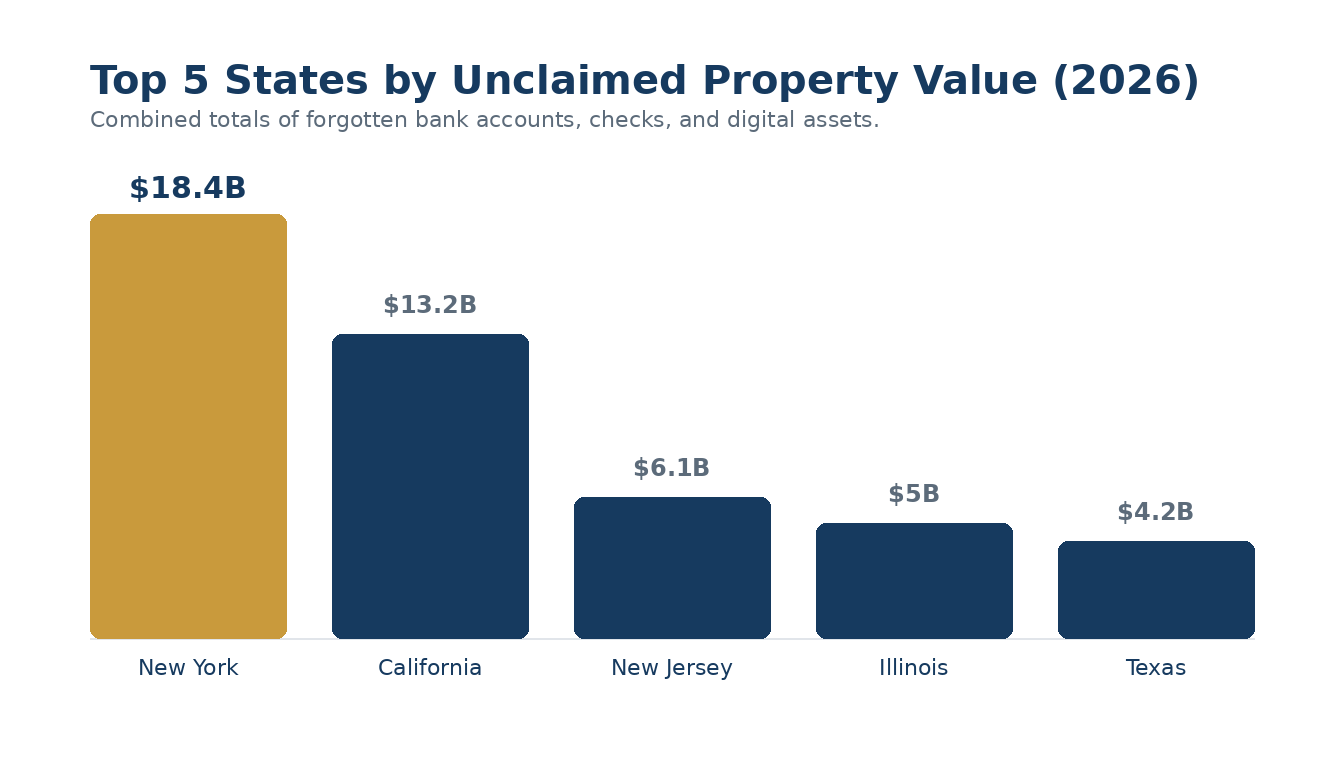
As of late 2026, U.S. state governments collectively hold over $70 billion in unclaimed property. New York leads with over $18 billion, followed by California with approximately $13 billion. While most states require a 3-year dormancy period for bank accounts, recovery methods vary significantly, with several states now offering proactive “match” programs that automatically send checks to residents without a formal claim filing.
Key takeaways
- Total unclaimed funds nationwide have reached record highs due to improved reporting requirements for digital assets and crypto-exchanges.
- State dormancy periods are the legal clocks that determine when a private company must turn over your funds to the government.
- Proactive programs like Illinois’s Money Match and Virginia’s Cash Now are transforming recovery from a manual search process into an automatic government service.
- Identifying the “State of Corporate Domicile” is crucial if a company you did business with is headquartered in a different state than where you live.
The Multi-Billion Dollar Landscape of Unclaimed Property
The scale of unclaimed property in the United States is often underestimated by the general public. What many perceive as a niche curiosity is, in reality, a massive financial ecosystem involving tens of billions of dollars. These funds do not represent government money; rather, they are private assets—savings accounts, uncashed payroll checks, insurance benefits, and utility deposits—that have lost contact with their rightful owners. Under U.S. law, when contact is lost for a specific duration, these assets must be turned over to state treasuries for safekeeping.
By September 2026, the cumulative total held by the fifty states and the District of Columbia is estimated to exceed $70 billion. This staggering figure is driven by two primary factors: the increasing complexity of the modern financial system, which makes it easier for small accounts to be forgotten, and more aggressive enforcement of escheatment laws by state regulators. For journalists, financial researchers, and everyday citizens, understanding how these funds are distributed across the country is the first step in a successful recovery strategy.
The distribution of these funds is not uniform. Highly populated states and states that serve as major financial hubs, such as New York and California, hold significantly higher balances. However, the efficiency with which these states return money to their citizens varies wildly. This resource serves as a definitive comparative index to help you navigate the different legal frameworks and recovery tools currently in operation across the United States.

A Comparative Directory of State Unclaimed Property (2026 Data)
The following table compiles the most recent available data on total funds held, standard dormancy periods for common financial assets, and the official recovery portals for the largest state programs in the country. This data is synthesized from annual financial reports, state treasury disclosures, and official legislative databases.
| State | Estimated Funds Held (2026) | General Dormancy (Bank Accts) | Official Search Portal / Program Name |
|---|---|---|---|
| New York | $18.4 Billion | 3 Years | NYS Search for Lost Money |
| California | $13.2 Billion | 3 Years | SCO Unclaimed Property Search |
| New Jersey | $6.1 Billion | 3 Years | Unclaimed Property Administration |
| Illinois | $5.0 Billion | 3 Years | iCash / Money Match |
| Pennsylvania | $4.5 Billion | 3 Years | PA Treasury / Money Match |
| Texas | $4.2 Billion | 3 Years | ClaimItTexas.org |
| Ohio | $3.9 Billion | 3 Years | Ohio Treasury Search |
| Massachusetts | $3.4 Billion | 3 Years | FindMassMoney / Fast Track |
| Georgia | $3.2 Billion | 5 Years | Georgia Unclaimed Property Search |
| Florida | $3.1 Billion | 5 Years | Florida Treasure Hunt |
| Washington | $3.0 Billion | 3 Years | UCP Search / Claim Your Cash |
| Virginia | $3.0 Billion | 3 Years | VAMoneySearch / Cash Now |
| Maryland | $2.3 Billion | 3 Years | Maryland Unclaimed Property Search |
| Michigan | $2.1 Billion | 3 Years | Michigan Unclaimed Property Search |
| North Carolina | $1.3 Billion | 3 Years | NCCash.com / NCCash Match |
The Evolution of Escheatment: From Feudal Law to Modern Finance
To understand why these billions of dollars sit in state vaults, one must look back at the legal doctrine of escheat. Originating in English common law, escheat was the process by which a feudal lord or the Crown would reclaim land if a tenant died without heirs. In the modern American context, this doctrine has evolved into the Uniform Unclaimed Property Act (UUPA), which shifts the focus from land to “intangible” property like stocks, bonds, and bank balances.
The primary purpose of modern escheatment is twofold: first, to protect the owner’s interest by moving the funds from a private company (which might otherwise profit from keeping the money) to a public custodian; and second, to allow the state to use the interest or the funds themselves for the public good until the owner comes forward. It is a fundamental principle that the state never takes legal ownership of the property; they act only as a permanent custodian. Your right to claim the money never expires.
In 2026, we are seeing a significant shift in how these laws are applied. With the rise of digital wallets and cryptocurrency, states have updated their statutes to ensure that “virtual” assets are also subject to dormancy and escheatment rules. This has led to a surge in the total value of property held, as thousands of dormant crypto-accounts and digital payment balances are now being remitted to state treasuries for the first time.
Understanding Dormancy Periods: The Clock That Triggers Escheatment
A dormancy period is the length of time that must pass without any owner-generated activity before an asset is legally considered abandoned. This period is not universal; it varies based on the type of asset and the specific laws of the state where the holder (the company) is located. For most traditional bank accounts—including savings and checking accounts—the standard dormancy period is three years. This means if you do not make a deposit, withdrawal, or log in to your online portal for three years, the bank is legally required to flag the account.
However, other assets have different timelines. Payroll checks often have a much shorter dormancy period, frequently only one year, because of the high likelihood that an uncashed check was simply lost. Conversely, traveler’s checks may have a dormancy period as long as 15 years. It is important to note that “activity” must be initiated by the owner. Automatic interest payments or service fee deductions do not count as activity and will not stop the dormancy clock from ticking.
When the dormancy period ends, the holder is required to perform “due diligence.” This usually involves sending a letter to the last known address of the owner. If the owner does not respond within a set timeframe (usually 30 to 60 days), the funds are transferred to the state. This transition is often where owners lose track of their money, especially if they have moved several times and the due diligence letter never reaches them.

The Rise of Proactive Payouts and Automatic Matching
Perhaps the most significant development in the unclaimed property niche over the last five years is the move toward proactive payout programs. Traditionally, the burden of discovery was entirely on the citizen. You had to know the money existed, find the right portal, and submit a claim with supporting documentation. In a digital-first era, many states have realized that they have enough data to bypass this manual process.
Programs like Illinois’s “Money Match” and North Carolina’s “NCCash Match” utilize cross-agency data sharing to identify owners who still live at the address on file or whose identities can be verified through tax records. When a match is made, the state treasury simply mails a check to the resident without requiring any action on their part. These programs have successfully returned millions of dollars to people who never would have thought to search a database.
However, these automatic programs are usually limited to smaller claims—typically those under $2,000 or $5,000. Larger claims, or claims involving complex ownership like estates or corporate refunds, still require a traditional manual filing. Furthermore, not every state has adopted this technology. As shown in the comparison table, states like California and New York still largely rely on a manual search-and-claim model, although they have significantly streamlined their online portals to allow for electronic document uploads.
State of Corporate Domicile: Why You Must Search Outside Your Home State
A common mistake made by claimants is only searching the database of the state where they currently reside. While this is a good starting point, it ignores the “Priority Rules” established by the U.S. Supreme Court in cases like Texas v. New Jersey. These rules dictate which state gets the money when an owner cannot be found.
The First Priority Rule states that the property should be sent to the state of the owner’s last known address. However, if the company holding the money has no record of your address, the Second Priority Rule applies: the money is sent to the state where the company is incorporated (its corporate domicile). Because thousands of major corporations are incorporated in Delaware, that state holds a disproportionately large amount of unclaimed property relative to its population.
If you have ever worked for a national corporation, used a large insurance provider, or held a brokerage account, you should expand your search. You should check the treasury portals of every state where you have lived, but also the treasury of the state where your former employers or financial institutions are headquartered. This simple shift in strategy often uncovers funds that a resident-only search would miss entirely.
Avoiding Pitfalls: The Difference Between Official Portals and Private Finders
The visibility of $70 billion in “free money” has inevitably attracted third-party private investigators, often called “finders” or “locators.” While these individuals and companies operate legally in most states, they are not government employees. They search public records to find large unclaimed sums and then contact the owners, offering to help them recover the money in exchange for a percentage of the total—sometimes as high as 10% to 25%.
It is crucial to understand that you never need to pay a finder to get your money. Every state listed in our data table provides a free search and claim service. The official portals allow you to submit the same documentation a finder would, and the state will process your claim directly. While finders can be helpful for complex cases involving multi-generational estate claims, the average individual can almost always handle their own claim through the official .gov websites at zero cost.

Methodology
The data presented in this resource was compiled through a comprehensive review of official state sources and national oversight bodies. Primary figures for “Estimated Funds Held” were pulled from the 2024 and 2025 Annual Comprehensive Financial Reports (ACFR) provided by state treasury departments and controllers’ offices. In instances where FY2025 data was not yet finalized, projections were made based on the 3-year growth trend of remitted property for that specific jurisdiction.
Dormancy periods were verified against the state-specific statutes and the 2016 Revised Uniform Unclaimed Property Act (RUUPA) adoption records. Search portal names and specific program identifiers (e.g., “Money Match,” “Fast Track”) were individually verified by accessing the official .gov treasury domains for each respective state as of September 2026. National aggregates were cross-referenced with the National Association of Unclaimed Property Administrators (NAUPA) and MissingMoney.com’s annual reporting summaries.
Frequently Asked Questions
Is there a deadline to claim unclaimed property?
In almost all U.S. states, there is no deadline to claim your property. The state acts as a permanent custodian, and the funds remain available for the rightful owner or their heirs indefinitely. However, it is better to claim funds sooner, as some assets like physical safe deposit box contents may eventually be auctioned, with the state holding the cash proceeds instead of the original items.
Why does Delaware hold so much unclaimed money?
Delaware is the legal home to more than half of all publicly traded companies in the U.S. and more than 60% of Fortune 500 firms. Under the Supreme Court’s “Second Priority Rule,” if a company doesn’t have a valid last-known address for an owner, the unclaimed funds must be sent to the company’s state of incorporation. This makes Delaware a massive repository for unclaimed assets from across the globe.
What documentation do I need to file a claim?
Standard requirements include a copy of your government-issued ID (such as a driver’s license), proof of your Social Security number, and proof of your connection to the address on file (like an old utility bill or bank statement). For claims involving deceased relatives, you will generally need a death certificate and documentation proving you are the legal heir or executor of the estate.
Does the government charge a fee to return my money?
No. Official state treasury programs are a free public service. Any website or individual asking for an upfront payment or a percentage of the funds to “process” your claim is a private entity, not a government official. You can always file directly with the state for free.
Sources:
– National Association of Unclaimed Property Administrators (NAUPA)
– MissingMoney.com (Official Multi-State Database)
– New York State Office of the State Comptroller
– California State Controller’s Office – Unclaimed Property Division
– California State Treasurer