

Last updated: August 2026
Figures and program details can change – always verify current details on the official source before acting.
Quick answer
Key takeaways
- General unclaimed property searches often miss billions in child support held in “internal silos.”
- The State Disbursement Unit (SDU) is the primary registry for undistributed funds.
- Verification requires matching a Social Security Number and a Case ID, not just a name.
- Funds usually move to the State Treasury only after 3 to 5 years of inactivity.
The $5 Billion ‘Internal Silo’ Mystery
While millions of Americans diligently search state treasury databases for forgotten utility deposits or old bank accounts, a massive pool of cash remains virtually invisible to standard search engines. In August 2026, the federal Office of Child Support Services (OCSS) reports that billions of dollars in child support payments are currently classified as “Undistributed Collections” or UDC.
These funds represent money that has been successfully collected from a non-custodial parent but cannot be delivered to the family. Because these funds are managed by judicial or human services agencies rather than financial institutions, they often sit in a “federal silo” that is exempt from the standard reporting rules that govern banks. This means your share of a $5.1 billion pool could be sitting in a state account even if a search of your state’s general unclaimed property website returns zero results.
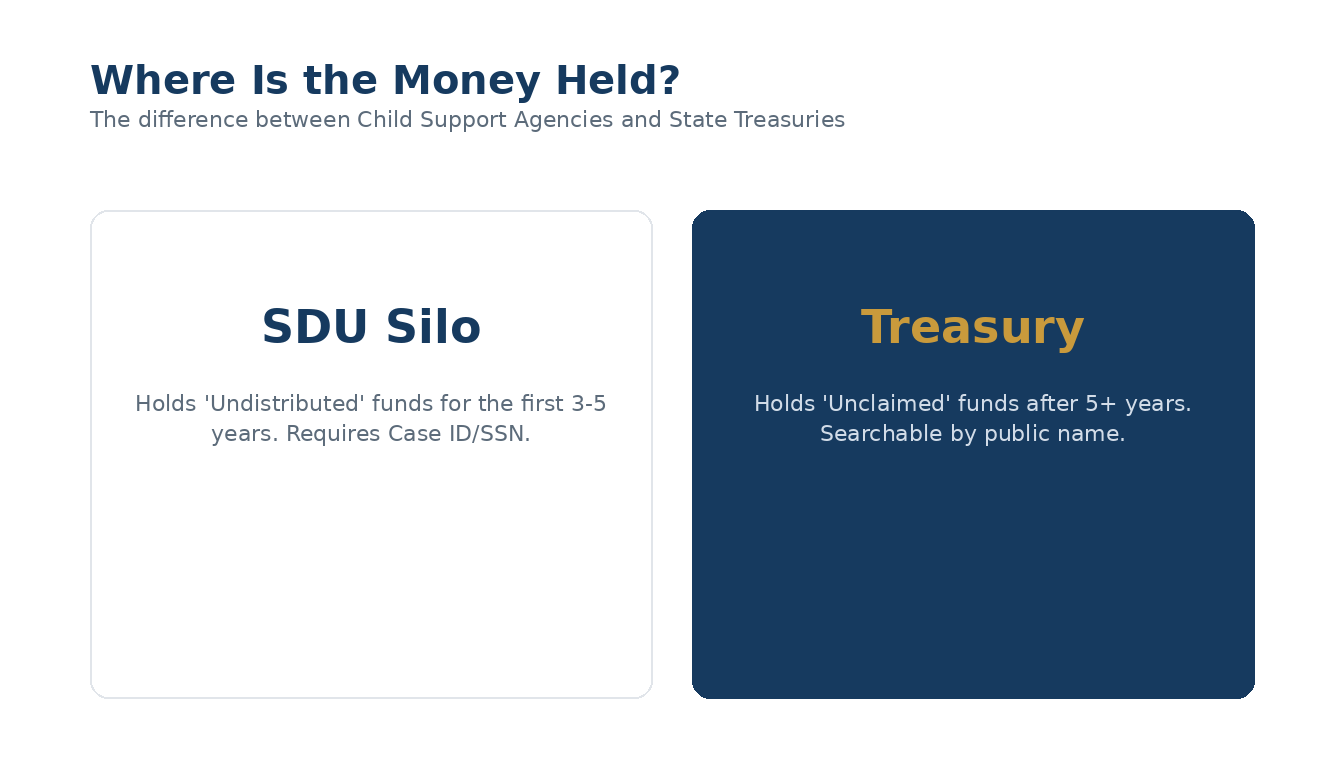
Understanding the distinction between “undistributed” and “unclaimed” is the first step in your audit. Undistributed funds are still in the active custody of the child support agency, usually because of a bounced check or a closed debit card account. Only after several years of failed outreach does the agency “escheat” or transfer that money to the general state treasury. If you only check the treasury, you are missing the most recent (and often most valuable) payments.
Why Child Support Checks Go Missing
The journey of a child support payment is more complex than a standard bank transfer. When a payment is made, it passes through a State Disbursement Unit (SDU). If the SDU does not have a valid, verified address for the custodial parent, the funds are placed in a holding account. In 2026, the most common trigger for a “lost” payment is the transition between physical checks and Electronic Payment Cards (EPCs).
Consider the case of a family that moved across state lines three years ago. If the custodial parent failed to update their address with the specific child support agency—not just the Post Office—any manual check or replacement debit card was likely returned as undeliverable. At that moment, the funds enter a state of limbo. They are “collected” for federal reporting purposes but “undistributed” to the family.
As noted by the Office of Child Support Services (OCSS), state agencies are required to make “diligent efforts” to locate the recipient, but these efforts are often limited to automated database matches. If your name has changed due to marriage or if you have moved multiple times, those automated systems may fail to link your current identity to the old case file.
The Dual-Audit Strategy: SDU vs. Treasury
To conduct a complete 2026 audit, you must look in two distinct places. First, you must contact the SDU in every state where a child support order was ever active. This is the “internal silo.” Most states, such as the California State Disbursement Unit, maintain their own internal accounting systems that operate independently of the State Controller’s office.
If the money has been sitting idle for more than three to five years (depending on the state’s dormancy period), it may have migrated to the general Unclaimed Property fund. This is why a comprehensive search requires a “two-pronged” approach. You are not just looking for “money”; you are looking for a specific case record that may have been flagged with an “Address Unknown” status.
The complexity increases in interstate cases. If the payer lives in Texas but the child support order was established in Florida, the money may be held in either state depending on which agency was responsible for the collection. This “interstate gap” is where millions of dollars disappear every year, as agencies sometimes struggle to synchronize their records across state lines.
How to Search the State Disbursement Unit (SDU)
Unlike general unclaimed property portals that allow you to search by name alone, SDU audits often require more specific “Golden Key” data points. Because child support records are protected by strict federal privacy laws, you cannot simply browse a public list of names. You will typically need your Case ID number or your Social Security Number to trigger a search of the undistributed pool.
In Texas, for example, the Attorney General’s Child Support Division provides an interactive portal where parents can view their payment history. If you see a payment listed as “Collected” but the status does not show “Disbursed” or “Check Cleared,” you have found a potential UDC asset. This is a manual audit process that requires you to log in to the specific state portal where your case was managed.
If you have lost your Case ID, you should not give up. Most state agencies allow you to recover this information by verifying your identity through a secure phone line or by visiting a local child support office in person. In 2026, many states have introduced “Identity Verification” tools that use KBA (Knowledge-Based Authentication) to help you regain access to old records without needing to find a 10-year-old piece of paper.
Common Mistakes in Child Support Claims
The most frequent error claimants make is assuming that the “State Treasury” search is exhaustive. It is not. Because of the unique legal status of child support—where the money is technically owed to a child but managed by the state—some agencies hold funds for up to seven years before declaring them “abandoned.” If you stop your search at the Treasury website, you are missing the most likely location for your funds.
Another common mistake is failing to check for “Pass-Through” payments. In many states, if a family is receiving TANF (Temporary Assistance for Needy Families), the state keeps a portion of the child support to reimburse itself for the assistance provided. However, many states have “pass-through” laws that allow the first $50 or $100 of a monthly payment to go directly to the family. These small, recurring amounts frequently go unclaimed because parents assume the state is keeping the entire payment.
Finally, do not overlook the “Interstate Lien” factor. If a non-custodial parent had a tax refund or a lottery prize intercepted to pay off arrears, that money might be held in a special “tax intercept” silo for up to six months before it is released. If you moved during that six-month window, the intercepted payment is highly likely to become an undistributed collection.
| Asset Location | Typical Hold Time | Data Needed to Search |
|---|---|---|
| State Disbursement Unit (SDU) | 0 – 5 Years | SSN, Case ID, Full Name |
| State Treasury (Unclaimed Property) | 5+ Years | Full Name, Last Known Address |
| Federal Tax Intercept Hold | 180 Days | SSN, Case ID |
The Role of the Federal Parent Locator Service (FPLS)
In 2026, the OCSS uses a powerful tool called the Federal Parent Locator Service (FPLS) to help reunite families with lost money. This system links employment records, tax filings, and unemployment claims across all 50 states. If the government detects that a custodial parent who is owed UDC has started a new job or filed a tax return with a new address, the FPLS can trigger a “proactive match.”
However, these matches are not always automatic. The system may flag a match, but a human caseworker often needs to verify the data before a check is re-issued. This creates a backlog. By proactively contacting the agency and providing your current “Verified Address,” you can jump to the front of this processing line. You are essentially completing the loop that the FPLS started.
As OCSS official guidance states: “Undistributed collections remain a priority for the program because these funds belong in the hands of the families who need them.” This mission-driven approach means that caseworkers are generally eager to resolve these cases once the parent makes contact. Unlike private banks, child support agencies do not profit from holding onto this money; in fact, high UDC balances can negatively impact a state’s federal performance rating.

Documenting Your Claim for 2026
When you find an undistributed payment, the claim process is more rigorous than a simple refund request. Because you are dealing with court-ordered funds, you will need to provide specific documentation to prove you are the rightful recipient. At a minimum, expect to provide a color copy of a government-issued ID and a secondary proof of address, such as a recent utility bill.
If the original child support order was issued under a different name (such as a maiden name), you will also need to provide a “linkage document,” such as a marriage certificate or a court order for a name change. In 2026, most states allow you to upload these documents through a secure “Document Upload” portal, which significantly speeds up the processing time compared to traditional mail.
If you are claiming funds on behalf of a child who is now an adult, the rules change slightly. In most states, child support arrears are owed to the custodial parent, not the child. Even if the “child” is now 30 years old, the parent who provided the support during the child’s minority is the one who must file the claim. However, if the custodial parent is deceased, the adult child may be able to claim the funds through a “Small Estate Affidavit” or probate process.
2026 Red Flags: Spotting Child Support Scams
The emotional nature of child support makes it a prime target for scammers. In August 2026, a widespread “Unclaimed Support” scam involves text messages or social media ads claiming you have a “pending payment” and asking you to click a link to “verify your debit card.” These are phishing attempts designed to steal your personal information or gain access to your bank account.
Official child support agencies will never ask you to provide your full Social Security Number or bank PIN via a text message. Furthermore, there is never a fee to claim undistributed child support. Any website or “service” that asks for a percentage of the money or an upfront “processing fee” is a scam. These are public funds, and the agencies are legally required to return them to you for free.
Always initiate contact yourself. Instead of clicking a link in an email, go directly to your state’s official “.gov” website. If you receive a suspicious phone call, hang up and call the number listed on your state’s official child support portal. Protecting your identity is just as important as recovering your cash.
Unclaimed Child Support FAQ
Can I search for child support money without a Case ID?
Yes, though it is more difficult. You can contact your state’s SDU or the child support agency’s customer service line and provide your Social Security Number and date of birth. They can use these identifiers to locate any active or closed cases in their system and check for undistributed balances.
How long does it take to receive a UDC payout?
Once you have verified your address and identity, most states can re-issue a payment within 10 to 20 business days. If the money has already been moved to the State Treasury as “unclaimed property,” the timeline may extend to 30 or 60 days depending on the state’s manual review process.
What happens if the payer has died but I am still owed arrears?
If the non-custodial parent is deceased, you may still be able to collect unclaimed funds from their estate or through intercepted life insurance and retirement benefits. These payments often end up in the “Undistributed Collections” silo during the probate process, so an SDU audit is critical for heirs and survivors.
Will my current spouse’s income be affected if I claim old child support?
No. Child support is a debt owed specifically to you for the care of your child. Claiming these funds is a recovery of a past-due asset and does not impact your current spouse’s income or tax liability in the vast majority of cases.